
Pest Control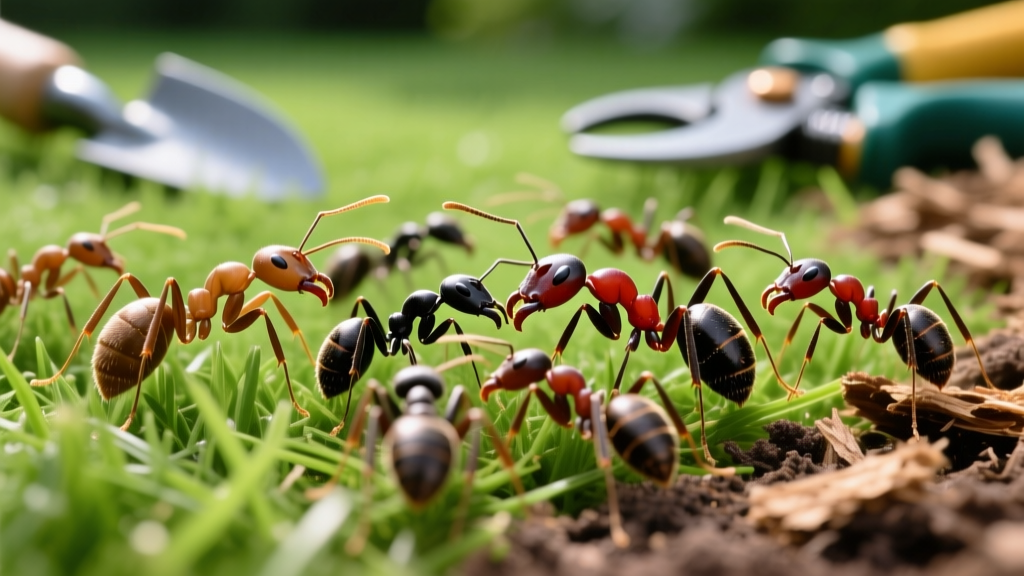
What Type of Ants Are in Your Lawn? Identification & Treatment
The Threat Landscape: Why Species Identification Dictates Treatment
Guessing the type of ants invading your turf is the most expensive mistake in yard defense. Applying a generic repellent spray to a budding species like the Argentine ant will not eliminate the colony; it will trigger a survival response that splits the nest into a dozen new satellite colonies across your property. Conversely, treating a wood-destroying Carpenter ant with a standard lawn granular bait wastes time and money, as they rarely forage for sweet baits in open turf. Effective insect defense requires precise species identification, followed by targeted active ingredients applied at specific environmental thresholds.
Visual Identification Matrix: 5 Common Yard Ant Species
Before purchasing any pesticide, capture a foraging worker and compare it against this diagnostic matrix. Use a jeweler's loupe or macro smartphone lens to check the thorax and petiole (the node between the thorax and abdomen).
| Species | Size & Color | Nesting Location | Primary Lawn Threat |
|---|---|---|---|
| Red Imported Fire Ant (Solenopsis invicta) | 1/8 to 1/4 inch; Reddish-brown | Large, dome-shaped soil mounds in full sun | Aggressive stinging; root damage from extensive tunneling |
| Carpenter Ant (Camponotus spp.) | 1/4 to 1/2 inch; Black or bi-colored | Moist, decaying wood, stumps, and thick mulch beds | Structural damage to adjacent sheds/fences; minimal turf damage |
| Argentine Ant (Linepithema humile) | 1/16 inch; Uniform light to dark brown | Shallow soil, under pavers, along foundation edges | Massive supercolonies; displaces native insects; severe nuisance |
| Pavement Ant (Tetramorium caespitum) | 1/8 inch; Dark brown to black with pale legs | Under driveways, sidewalks, and patio stones | Soil excavation undermining hardscaping; dirt mounds on turf edges |
| Odorous House Ant (Tapinoma sessile) | 1/16 to 1/8 inch; Dark brown/black | Under rocks, logs, and shallow mulch | Nuisance foraging; emits rotten coconut odor when crushed |
Species-Specific Defense Protocols and Product Selection
Once you have identified the specific type of ants in your yard, deploy the corresponding chemical or organic protocol. The retail prices below reflect average 2026 market rates for professional-grade, homeowner-accessible products.
1. Fire Ants: The Two-Step Broadcast and Mound Method
According to research from Texas A&M AgriLife Extension, the most effective fire ant eradication strategy is the Two-Step Method. This combines a broadcast bait application to suppress the overall population with targeted mound treatments for immediate relief.
Step 1 (Broadcast): Apply Advion Fire Ant Bait (Active ingredient: Indoxacarb 0.04%) at a rate of 1.5 lbs per acre using a handheld rotary spreader. Cost: ~$38 per 1.5 lb jug. Apply in the late afternoon when soil temperatures are between 70°F and 85°F and no rain is forecast for 48 hours.
Step 2 (Mound Drench): 7 to 10 days later, treat remaining active mounds with a liquid drench of FenvaStar Plus (Lambda-cyhalothrin). Mix 0.33 fl oz per gallon of water and pour 1 to 2 gallons directly over the mound, starting from the outer edge and working inward to prevent the queen from escaping.
Step 2 (Mound Drench): 7 to 10 days later, treat remaining active mounds with a liquid drench of FenvaStar Plus (Lambda-cyhalothrin). Mix 0.33 fl oz per gallon of water and pour 1 to 2 gallons directly over the mound, starting from the outer edge and working inward to prevent the queen from escaping.
2. Carpenter Ants: Non-Repellent Perimeter Defense
Carpenter ants do not eat wood; they excavate it to build galleries. They nest in landscape timbers, rotting stumps, and tree hollows, foraging into your lawn at night. The University of Florida IFAS emphasizes that locating and treating the parent nest is critical.
Do not use fast-acting, repellent sprays like Bifenthrin around their trails. Instead, use a non-repellent transfer insecticide like Alpine WSG (Dinotefuran). Mix 10 grams of Alpine WSG per gallon of water and spray the foundation perimeter, tree bases, and landscape timbers. The ants will walk through the treated surface, unknowingly carrying the active ingredient back to the nest. Cost: ~$48 per box of 5x10g packets. For organic control, apply diatomaceous earth (DE) directly into excavated wood galleries, ensuring the wood moisture content is reduced below 15% using a moisture meter.
3. Argentine Ants: Eradicating the Supercolony
Argentine ants form massive, interconnected supercolonies that can span entire neighborhoods. Spraying over-the-counter aerosol repellents causes 'budding,' where the colony fractures into multiple new nests, worsening the infestation.
Defense requires slow-acting liquid gel baits that foragers can carry back to feed the queens. Maxforce Quantum Ant Bait (Imidacloprid 0.03%) is highly effective due to its hygroscopic properties, meaning it retains moisture in hot, dry yard conditions. Apply small, pea-sized drops directly onto foraging trails along hardscape edges and irrigation valve boxes. Cost: ~$44 per 120ml tube. Reapply every 14 days until foraging ceases.
Strategic Decision Framework: Baiting vs. Barrier Sprays
Choosing between baits and liquid barriers depends entirely on your timeline and the ant species present. Use this framework to select your primary defense tactic:
When to Choose Granular/Gel Baits
- Target Species: Fire ants, Argentine ants, Odorous house ants.
- Objective: Total colony eradication, including deep-soil queens.
- Timeline: Results take 7 to 21 days.
- Environmental Factor: Ideal for sensitive areas near edible gardens or koi ponds where liquid runoff is a risk.
When to Choose Liquid Barrier Sprays
- Target Species: Pavement ants, nuisance foragers, perimeter defense.
- Objective: Immediate knockdown and creation of a chemical exclusion zone.
- Timeline: Results visible within 2 to 24 hours.
- Environmental Factor: Best applied to concrete foundations, retaining walls, and non-porous hardscapes.
Cultural Controls and Preventative Yard Defense
Chemical interventions will fail if the underlying environmental attractants remain unaddressed. Integrate these cultural controls into your seasonal lawn maintenance schedule to make your yard inhospitable to nesting.
Thatch and Moisture Management
Thatch layers exceeding 0.75 inches create a moisture-retaining canopy that protects shallow-nesting species like Argentine and Odorous house ants from desiccation. Maintain turf thatch below 0.5 inches using a vertical mower (dethatcher) in early fall. Additionally, audit your irrigation system; fix leaking drip emitters and adjust sprinkler heads to prevent overspray onto hardscapes, as constant moisture softens soil and accelerates wood decay, inviting both Pavement and Carpenter ants.
Mulch and Hardscape Modifications
Keep organic wood mulch at least 12 inches away from your home's foundation. If mulching near the house, switch to inorganic options like crushed gravel or cedar mulch, which contains natural repellent oils (thujone). For Pavement ants excavating under driveways, seal expansion joints and cracks wider than 1/16 inch with a flexible, polyurethane-based concrete sealant to physically block sub-slab nesting access.
Expert Note on Pesticide Resistance: Rotating active ingredients is critical for long-term yard defense. If you use an Indoxacarb-based bait for fire ants in the spring, switch to a Pyriproxyfen (insect growth regulator) or Spinosad (organic) bait in the late summer to prevent the colony from developing metabolic resistance to a single chemical class.
Successfully defending your lawn requires moving beyond generic 'bug sprays' and addressing the specific biological drivers of the type of ants present in your soil. By combining precise species identification with targeted, professional-grade active ingredients and strict moisture management, you can reclaim your turf and protect your hardscaping from structural undermining. For comprehensive regulatory guidelines on safe outdoor pesticide application, always consult the United States Environmental Protection Agency (EPA) before treating large-scale infestations near waterways or public spaces.

