
Pest Control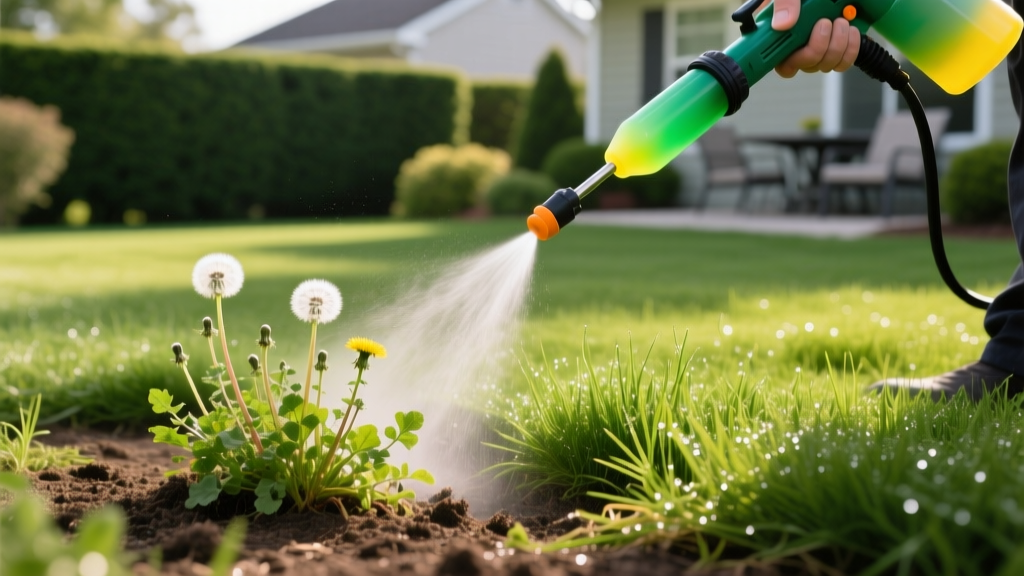
Using Lawn Fertilizer With Weed Killer for Targeted Spot Treatment
The Granular Dilemma: Broadcast vs. Spot Application
Most homeowners purchase a lawn fertilizer with weed killer (commonly known as weed and feed) intending to broadcast it uniformly across the entire yard. These products combine high-nitrogen fertilizers (typically 28-0-3 or 29-0-4 NPK ratios) with broadleaf herbicides like 2,4-D, dicamba, and MCPP (mecoprop). However, when dealing with localized weed outbreaks, spot-treating with these granular products requires precise agronomic calculation. Applying a broadcast-rate granular product to a small 50-square-foot patch risks severe nitrogen burn, while under-applying fails to deliver a lethal herbicide dose to the weed's foliage.
According to NC State Turfgrass Weed Management, granular herbicides rely entirely on the particles sticking to the moist foliage of broadleaf weeds to be absorbed. If you are spot-treating, you must shift your strategy from soil-based fertilization to foliage-based herbicide delivery.
⚠️ Agronomic Warning: Never use a granular lawn fertilizer with weed killer to spot-treat single weeds or areas smaller than 100 square feet. The concentrated nitrogen load will scorch the surrounding desirable turfgrass before the herbicide can translocate to the weed's root system. For micro-spots, switch to a dedicated liquid spot-spray like Ortho WeedClear (0.15% 2,4-D).
Weed Species Profiles: When Granular Spot-Treatment Works
Not all weeds respond equally to granular herbicide carriers. The physical structure of the weed's leaf determines whether the fertilizer-bound herbicide will stick or slide off.
White Clover (Trifolium repens)
Clover leaves are slightly textured and naturally hold morning dew. When applying a lawn fertilizer with weed killer to a dense 200-square-foot clover patch, the granules easily adhere to the damp trifoliate leaves. The MCPP and dicamba in the mixture will be absorbed within 24 hours, causing the characteristic epinasty (twisting and curling) that signals herbicide uptake.
Dandelion (Taraxacum officinale)
Dandelions feature a waxy, smooth cuticle on their broad leaves. Granular weed and feed frequently slides off dandelion foliage, landing on the soil where the 2,4-D is rapidly degraded by soil microbes before it can be absorbed by the taproot. Spot-treating dandelions with granular products yields a failure rate exceeding 60%. For dandelions, liquid surfactant-bound herbicides are mandatory.
Macro-Spot Treatment: Step-by-Step Calibration
When you have a distinct, localized infestation (e.g., a 500-square-foot patch of broadleaf plantain near the driveway), you can successfully use a lawn fertilizer with weed killer by treating it as a 'macro-spot'. Follow this exact calibration protocol to avoid turf burn.
- Calculate the Exact Square Footage: Measure the length and width of the weed patch. A 20 ft x 25 ft area equals 500 sq ft.
- Weigh the Product: Standard application rates for products like Scotts Turf Builder Weed & Feed 3 are 2.5 lbs per 1,000 sq ft. For a 500 sq ft macro-spot, you need exactly 1.25 lbs (20 oz) of product. Use a digital kitchen scale; do not guess by volume.
- Prepare the Foliage: Granular herbicides require a wet surface to dissolve and adhere. If there is no morning dew, run a sprinkler over the target area for 3 minutes and wait 15 minutes for the water to settle on the leaves.
- Calibrate the Spreader: Load the 20 oz of product into a handheld rotary spreader (e.g., Scotts Whirl). Set the dial to 3.5. Walk at a consistent pace of 3 feet per second, overlapping your wheel tracks by 2 inches to ensure the herbicide coats the weed leaves without dumping excess nitrogen in a single pass.
- Post-Application Wait: Do not water the lawn for 48 hours. Watering immediately will wash the 2,4-D and dicamba off the weed foliage and into the soil, neutralizing the herbicidal effect while leaving the nitrogen to burn the grass.
Product Matrix: Granular Weed & Feed vs. Liquid Spot Sprays
Choosing the right tool depends on the weed species, the size of the infestation, and the current ambient temperature. The EPA's guide to weed killers emphasizes that volatilization (the product turning into a gas and drifting to non-target plants) is a major risk with certain active ingredients in high heat.
| Feature | Granular Lawn Fertilizer With Weed Killer | Liquid Broadleaf Spot Herbicide |
|---|---|---|
| Active Ingredients | 2,4-D, Dicamba, MCPP + Urea/Nitrogen | 2,4-D, Quinclorac, Dicamba + Surfactant |
| Ideal Target Area | Macro-spots (200 to 2,000+ sq ft) | Micro-spots (Single weeds up to 100 sq ft) |
| Best Weed Species | White Clover, Chickweed, Spurge | Dandelion, Plantain, Thistle |
| Temperature Limit | Do not apply above 85°F (Dicamba drift risk) | Do not apply above 90°F |
| Cost per 1,000 sq ft | ~$6.50 (Based on $65 / 40lb bag) | ~$4.00 (Based on $15 / 32oz concentrate) |
Environmental Thresholds and Failure Modes
The most common reason spot-treatments fail when using a lawn fertilizer with weed killer is ignoring environmental thresholds. Herbicide chemistry is highly sensitive to temperature and soil moisture.
💡 Pro Tip: The 85°F Volatilization Rule
Dicamba, a primary ingredient in most granular weed and feeds, begins to volatilize (turn into a vapor) when ambient temperatures exceed 85°F. If you spot-treat a clover patch near your garden on an 88°F afternoon, the dicamba vapor can drift and severely damage nearby tomatoes, peppers, and ornamental shrubs. Always schedule granular spot-treatments for early morning when temperatures are below 80°F and dew is naturally present.
Dicamba, a primary ingredient in most granular weed and feeds, begins to volatilize (turn into a vapor) when ambient temperatures exceed 85°F. If you spot-treat a clover patch near your garden on an 88°F afternoon, the dicamba vapor can drift and severely damage nearby tomatoes, peppers, and ornamental shrubs. Always schedule granular spot-treatments for early morning when temperatures are below 80°F and dew is naturally present.
Soil Moisture Edge Cases
If your lawn is experiencing drought stress, the weeds will close their leaf stomata to conserve water. When stomata are closed, the 2,4-D and MCPP cannot enter the plant's vascular system. Furthermore, applying high-nitrogen fertilizer to drought-stressed turfgrass will draw moisture out of the grass blades via osmosis, resulting in immediate yellowing and necrosis. Penn State Turfgrass Extension recommends deep-watering the lawn 24 hours before applying any granular weed and feed product to ensure both the turf and the weeds are actively growing and hydrated.
Frequently Asked Questions
Can I mix liquid herbicide into my granular fertilizer for a custom spot treatment?
No. Coating your own granular fertilizer with liquid herbicide (a process called impregnation) requires specialized industrial tumbling equipment to ensure uniform distribution. Hand-mixing liquid herbicide into a bucket of granular fertilizer will result in 'hot spots' of concentrated chemical that will instantly kill your turfgrass.
How long does it take for the weeds to die after a granular spot treatment?
You should see visible leaf curling (epinasty) within 48 to 72 hours. Complete root death and browning of the weed typically takes 14 to 21 days, depending on the weed's maturity and the ambient temperature. Do not reapply the product if the weed is still green after 5 days; you risk nitrogen toxicity to the surrounding soil.
Will the fertilizer component burn my grass if I spot-treat?
If you strictly follow the 2.5 lbs per 1,000 sq ft rate and apply it to damp foliage, the grass will not burn. However, if you overlap your spreader passes too heavily in a small area, the localized salt index of the urea will dehydrate the grass roots. Always use a handheld spreader with a deflector shield when treating the edges of a macro-spot to prevent overlapping onto already-treated grass.

