Pest Control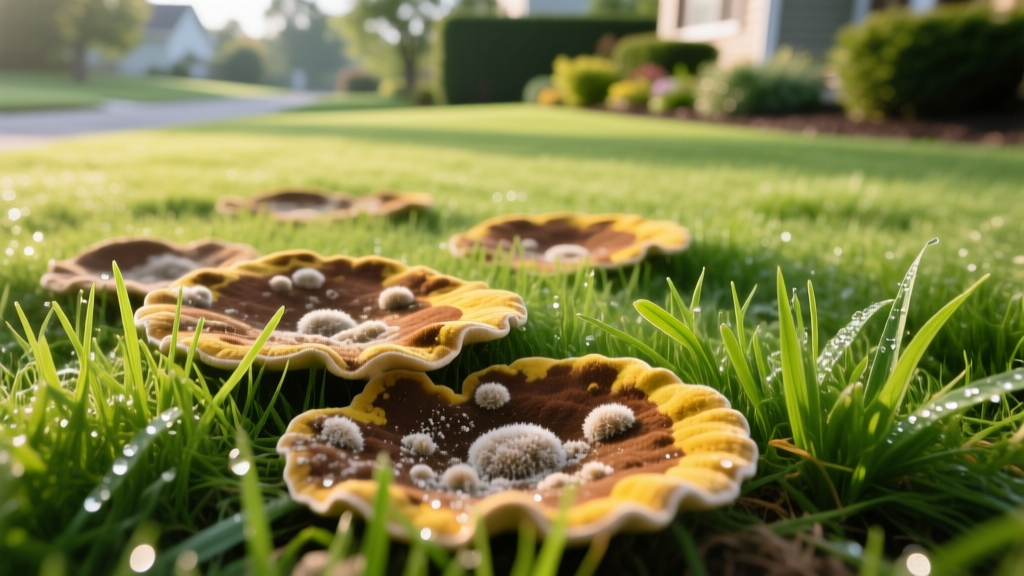
What Does Lawn Fungus Look Like? A Visual Identification Guide
Identifying turfgrass disease requires analyzing the geometry, color, and texture of the damage. When homeowners ask what does lawn fungus look like, the answer depends on the specific pathogen, but all fungal infections manifest through four primary visual signatures: spots, rings, patches, and threads. Misdiagnosing these symptoms often leads to ineffective chemical applications and wasted money. This guide breaks down the exact visual markers of the most destructive lawn fungi, providing the diagnostic framework needed to select the correct active ingredient for eradication.
The 4 Primary Visual Signatures of Turfgrass Fungi
Diagnostic Baseline: Before inspecting the lawn, note the current weather. Most foliar fungi require 10 to 12 hours of continuous leaf wetness and temperatures between 75°F and 85°F to sporulate and infect. If your lawn has been dry for a week, visible damage is likely abiotic (drought or chemical burn) rather than fungal.
1. Spot and Blotch Formations
Spot diseases attack individual grass blades rather than the entire plant crown. Dollar spot (Clarireedia jacksonii) is the most common, presenting as distinct, straw-colored circles exactly 2 to 6 inches in diameter—roughly the size of a silver dollar. On a micro level, individual blades will display hourglass-shaped lesions with bleached centers and dark reddish-brown margins. Leaf spot (Bipolaris sorokiniana) appears as scattered, dark purple-to-brown oval spots on the blades that eventually turn tan in the center, giving the lawn a generalized grayish or scorched appearance from a distance.
2. Ring and Arc Geometries
Fungi that spread outward radially from a central point create rings. Fairy ring (various Basidiomycetes) manifests as dark green, rapidly growing arcs or complete circles ranging from 1 to 30 feet in diameter. The dark green color is caused by the fungus breaking down organic thatch and releasing nitrogen into the soil. The grass inside the ring often dies due to soil hydrophobicity caused by dense mycelial mats. Necrotic ring spot (Ophiosphaerella korrae) creates a distinct 'frog-eye' pattern: a circle of dead, straw-colored grass with a healthy, green tuft of grass surviving in the exact center.
3. Expanding Patches
Patch diseases kill the crown and roots, leading to large, irregular dead zones. Brown patch (Rhizoctonia solani) forms circular patches ranging from 6 inches to several feet across. The defining visual marker of active brown patch is the 'smoke ring'—a dark, purplish-gray border at the leading edge of the patch that is only visible in the early morning when dew is present. By midday, the smoke ring disappears, leaving only brown, sunken turf.
4. Threads and Webbing
Some pathogens produce visible mycelium (fungal threads) on the grass surface. Pythium blight (Pythium aphanidermatum) creates white, cottony, cobweb-like threads that mat the grass blades together during periods of extreme heat and humidity. Snow mold (Typhula incarnata or Microdochium nivale) is identified in early spring as pink or gray crusty webbing plastered to the grass blades, usually in areas where snow drifted and persisted for months.
Diagnostic Decision Matrix: Visual Cues and Environmental Triggers
| Disease | Primary Visual Shape | Blade/Crown Symptom | Peak Infection Temp | Primary Grass Targets |
|---|---|---|---|---|
| Dollar Spot | 2-6 inch straw circles | Hourglass lesions on blades | 60°F - 85°F | Bermudagrass, Fescue, Bentgrass |
| Brown Patch | Large irregular patches | Morning smoke ring, rotted sheaths | 75°F - 95°F (High Humidity) | Tall Fescue, Ryegrass, St. Augustine |
| Necrotic Ring Spot | Frog-eye rings (6-24 inches) | Blackened, rotted roots and crowns | 65°F - 80°F (Soil Temp) | Kentucky Bluegrass, Fine Fescue |
| Pythium Blight | Greasy, matted streaks | White cottony mycelium at dawn | 85°F - 95°F (Night > 70°F) | Perennial Ryegrass, Bentgrass |
Differentiating Fungal Damage from Abiotic Stress
Homeowners frequently confuse fungal infections with dog urine spots, drought stress, or fertilizer burn. Use these field tests to confirm a fungal diagnosis:
- The Tug Test: Grasp the brown grass and pull gently. If the grass pulls up easily with blackened, mushy, or missing roots, you are dealing with a root-rotting fungus like Necrotic Ring Spot or Take-All Root Rot. If the roots are firm and white, the issue is likely foliar (Brown Patch) or abiotic.
- The Halo Check: Dog urine spots typically feature a dead brown center surrounded by a distinct, vibrant dark green halo of stimulated growth caused by the nitrogen in the urea. Fungal patches rarely display this perfect green halo.
- The Sheath Slide: Pull a single grass blade and slide your fingers up the sheath. If the sheath is slimy, dark brown, and rots away from the stem, Rhizoctonia solani (Brown Patch) is actively destroying the plant crown.
For comprehensive regional data on pathogen life cycles, the NC State Turfgrass Disease Profiles and the University of Minnesota Extension provide critical localized thresholds for infection.
Immediate Action Plan: Fungicide Selection and Application Rates
Once visual identification is confirmed, chemical intervention must be timed correctly. Fungicides are categorized by their FRAC (Fungicide Resistance Action Committee) codes. Rotating FRAC codes is mandatory to prevent pathogen resistance.
Cost & Coverage Reality Check: A standard 10 lb bag of granular Azoxystrobin (e.g., Scotts DiseaseEx) costs between $22 and $28 and covers 5,000 square feet at curative rates. Liquid concentrates (e.g., Propiconazole 14.3%) cost roughly $40 for a pint, yielding 15 to 20 applications per 1,000 sq ft, making liquids significantly cheaper per application but requiring precise calibration of a pump sprayer.
Curative Treatment Protocol
- Apply a Contact/Systemic Combo: For active foliar outbreaks (Dollar Spot, Brown Patch), apply a systemic fungicide containing Propiconazole (FRAC 3) at a rate of 1.5 to 2.0 fluid ounces per 1,000 square feet. This halts internal fungal growth within 24 hours.
- Follow with a Strobilurin: Seven to fourteen days later, apply Azoxystrobin (FRAC 11) at 2.0 lbs per 1,000 sq ft (granular) to protect new tissue and prevent spore germination.
- Adjust Irrigation: Fungi require leaf wetness. Switch your irrigation schedule to deliver 1 inch of water per week in a single, deep watering cycle between 4:00 AM and 6:00 AM. This allows the grass blades to dry rapidly once the sun rises, breaking the infection cycle.
- Raise Mowing Height: Scalping stresses the crown and exposes the soil to moisture retention. Raise your mower deck to 3.5 inches for Tall Fescue and 2.5 inches for Kentucky Bluegrass to increase air circulation at the soil line.
If the thatch layer exceeds 0.5 inches, the fungus will harbor in the organic matter, rendering surface fungicides ineffective. Perform core aeration and dethatching in the early fall to physically remove the fungal reservoir and restore soil drainage.