
Pest Control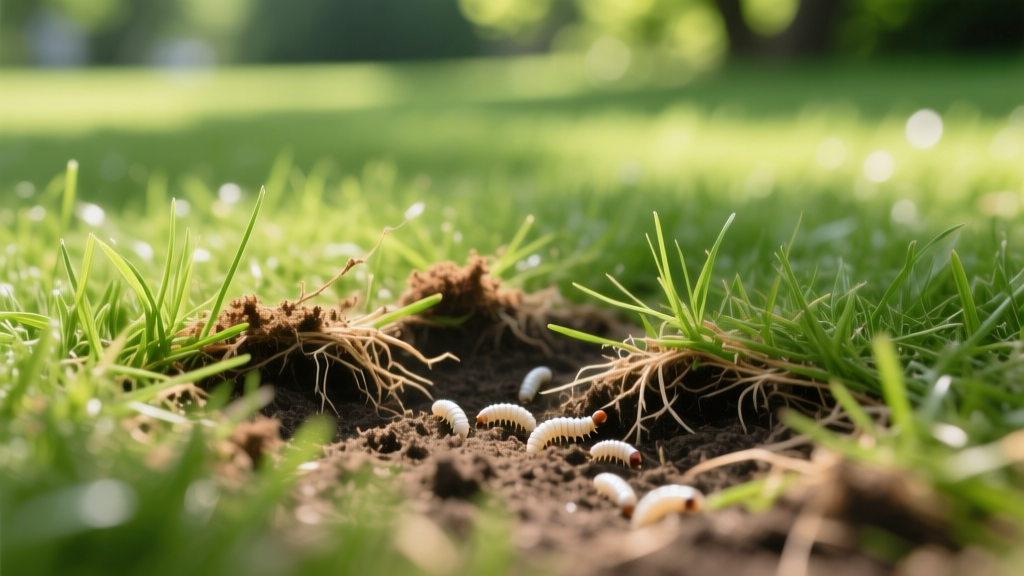
7 Early Symptoms of Lawn Grubs and Proven Defense Tactics
White grubs—the larval stage of scarab beetles like Japanese beetles, June bugs, and European chafers—are among the most destructive subsurface pests in North American yards. They feed aggressively on turfgrass roots, severing the plant's ability to uptake water and nutrients. Because the damage occurs below the soil line, many homeowners mistake the initial symptoms for drought stress or fungal disease, delaying treatment until the turf is entirely destroyed.
Effective insect and rodent yard defense requires early detection. By the time your lawn rolls back like a loose carpet, the grubs have already matured, making them significantly harder to eradicate. Below is a comprehensive diagnostic guide to the symptoms of lawn grubs, followed by a professional-grade defense protocol.
The 7 Telltale Symptoms of Lawn Grubs
1. Spongy Turf Texture
Before visible browning occurs, walk across your lawn in the late morning when the soil is dry. If the turf feels unusually spongy, bouncy, or loose underfoot, grubs are likely severing the root system. This loss of root anchoring creates an air gap between the soil and the thatch layer, resulting in a trampoline-like sensation.
2. Irregular Brown Patches That Don't Respond to Water
Grub damage manifests as irregular, localized brown patches, typically appearing in late summer or early fall. Unlike drought stress, which affects the entire lawn or sun-exposed areas uniformly, grub damage is patchy. If you increase your irrigation schedule and the brown patches continue to expand, root severing is the probable cause.
3. Increased Animal Digging and Foraging
Skunks, raccoons, armadillos, and crows are natural predators of white grubs. If you notice shallow, cone-shaped holes (skunks), large chunks of peeled-back sod (raccoons), or uniform 2-inch divots (crows), your lawn is serving as a buffet. Animal digging is often the first visible symptom of a severe subsurface infestation.
4. The "Tug Test" Failure
Grasp a handful of grass at the edge of a brown patch and pull upward. In a healthy lawn, you will meet resistance from deep roots. In a grub-infested lawn, the turf will detach effortlessly from the soil, revealing a lack of root mass and often exposing the pests just below the surface.
5. Visible C-Shaped Larvae in the Soil Profile
Using a flat spade, cut a 1-foot by 1-foot square of turf about 2 inches deep and peel it back. Inspect the top 3 inches of the soil. White grubs are easily identifiable by their creamy white bodies, brown heads, six distinct legs, and characteristic "C" resting posture.
6. Presence of Adult Beetles in Early Summer
A heavy presence of adult Japanese beetles or June bugs swarming your landscape lights or defoliating ornamental shrubs in June and July is a strong predictive indicator. These adults will lay their eggs in your irrigated turf, guaranteeing a grub emergence in late August.
7. Localized Wilting Despite Adequate Irrigation
Because the roots are destroyed, the grass blades cannot access soil moisture. You will notice the grass wilting, folding, or taking on a dull, bluish-gray hue during the heat of the day, even if the soil beneath is visibly moist.
Differential Diagnosis: Grubs vs. Drought vs. Fungus
Misdiagnosing the symptoms of lawn grubs leads to wasted money on incorrect treatments. Use this matrix to differentiate between common turf ailments.
| Indicator | Lawn Grubs | Drought Stress | Brown Patch Fungus |
|---|---|---|---|
| Root Attachment | Turf pulls up easily; no roots visible | Roots remain firmly anchored in soil | Roots remain anchored; rot at crown |
| Patch Pattern | Irregular, localized, expanding slowly | Uniform across sunny/elevated areas | Circular rings with smoke-gray margins |
| Soil Moisture | Soil is moist, but grass is wilting | Soil is dry and hydrophobic | Soil is moist; high humidity present |
| Secondary Signs | Animal digging, spongy feel, C-shaped larvae | Footprints remain on grass for hours | Fuzzy mycelium visible in early morning |
The 5-Step Yard Defense Protocol
Once you have confirmed the symptoms of lawn grubs, immediate and calculated action is required. According to University of Minnesota Extension turf specialists, treatment thresholds and timing dictate success.
Step 1: Calculate the Infestation Threshold
Not all grubs require chemical intervention. Perform the 1-square-foot peel test in three different areas of your lawn. Count the grubs.
- 0-5 grubs per sq. ft.: Healthy turf can outgrow this feeding pressure. No treatment needed.
- 6-9 grubs per sq. ft.: Monitor closely. Treat only if animal damage is occurring or turf is stressed by heat.
- 10+ grubs per sq. ft.: Immediate curative treatment is mandatory to prevent total lawn loss.
Step 2: Deploy Curative Chemical Interventions (Late Summer/Fall)
If you are treating an active, mature infestation in August or September, preventative products will not work. You need a fast-acting curative insecticide.
- Active Ingredient: Trichlorfon (commonly sold as Dylox 6.2).
- Application Rate: Follow label rates strictly, typically around 1.5 to 2 lbs per 1,000 sq. ft.
- Critical Requirement: Trichlorfon degrades rapidly in alkaline soil and sunlight. It must be watered in with at least 0.25 inches of irrigation immediately after application to move it into the root zone where the grubs are feeding.
- Cost: Approximately $65-$85 for a 30lb bag covering 10,000 sq. ft.
Step 3: Utilize Biological Controls for Sustainable Defense
For organic yard defense or long-term population suppression, beneficial nematodes are highly effective when timed correctly. The University of Kentucky Entomology department recommends the species Heterorhabditis bacteriophora (Hb) for white grub control.
- Timing: Apply in late summer when grubs are small (second instar) and soil temperatures are consistently above 60°F.
- Application: Mix with water and apply via a hose-end sprayer in the late afternoon or evening to avoid UV degradation. Water immediately.
- Cost: Roughly $45-$60 per million nematodes, sufficient for 2,000 sq. ft. of turf.
Step 4: Implement Preventative Strategies (Spring/Early Summer)
To stop the next generation, use a long-residual preventative insecticide in May or June before eggs hatch.
- Active Ingredient: Chlorantraniliprole (commonly sold as Acelepryn).
- Advantage: It provides 3 to 4 months of residual control and has a highly favorable environmental and pollinator safety profile compared to older chemicals.
- Cost: Roughly $120-$140 for a 30lb bag of granular product covering 10,000 sq. ft.
Step 5: Post-Treatment Turf Recovery
Killing the grubs does not repair the severed roots. Once the infestation is neutralized, rake out the dead thatch, aerate the compacted soil, and overseed with an endophyte-enhanced turfgrass blend (such as modern tall fescues or perennial ryegrasses). Endophytic fungi naturally deter surface-feeding insects and improve overall turf vigor.
⚠ Pollinator Safety Warning: If you choose to use neonicotinoid preventatives like Imidacloprid (Merit), you must strictly avoid applying them to lawns where flowering weeds (like white clover) are present. Penn State Extension strongly advises mowing the lawn immediately before application to remove any flower heads, preventing toxic exposure to foraging bees and other vital pollinators.
Frequently Asked Questions
Can I treat for grubs in the spring?
Spring treatment is generally ineffective and a waste of money. By April and May, grubs are in their final larval stage, feeding very little before pupating into adult beetles. Furthermore, spring rains easily leach the chemicals past the root zone before they can work. Reserve spring applications strictly for long-residual preventatives like Chlorantraniliprole targeting the next generation's eggs.
Will watering my lawn drown the grubs?
No. While grubs require moisture to survive near the surface, standard lawn irrigation (1 to 1.5 inches per week) will not drown them. In fact, heavily irrigated lawns in July and August are more attractive to egg-laying female beetles because the soft soil makes it easier for them to deposit eggs.
How deep do grubs burrow in the winter?
As soil temperatures drop below 50°F in late autumn, white grubs migrate downward, burrowing 4 to 8 inches below the frost line to hibernate. They return to the root zone in early spring as the soil warms, but their feeding window is brief before pupation.

