
Pest Control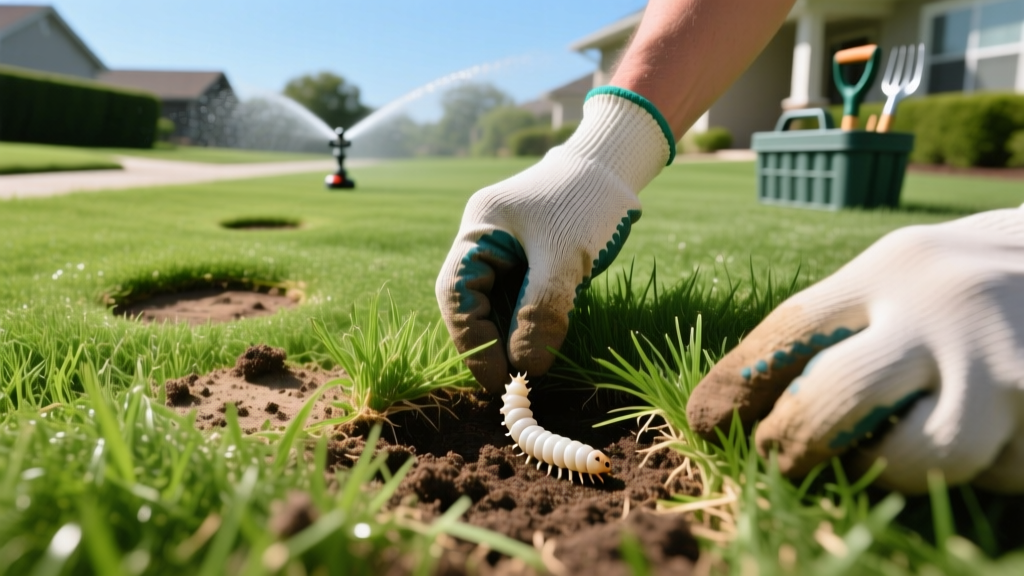
Effective Lawn Grubs Treatment: Preventative vs Curative Timing
The Hidden Threat: Diagnosing a Grub Infestation
White grubs—the larval stage of scarab beetles like Japanese beetles, June bugs, and European chafers—are among the most destructive turfgrass pests in North America. They feed aggressively on grassroots, severing the plant's ability to uptake water and nutrients. Because the damage occurs underground, homeowners often mistake early-stage grub damage for drought stress or fungal disease. By the time brown, irregular patches appear in late summer or early fall, the root system has already been decimated.
Before purchasing any lawn grubs treatment, you must confirm the presence of an active infestation and determine if the population density warrants chemical intervention. Turfgrass can tolerate low grub populations without visible damage.
The Diagnostic Tug Test & Threshold
Cut a 1-foot by 1-foot square of turf with a spade and peel it back like a carpet. Count the C-shaped, white grubs in the top 2 inches of soil. Replace the turf and water it immediately.
- 0–5 grubs per sq. ft.: No treatment necessary. The lawn can outgrow the damage.
- 6–9 grubs per sq. ft.: Monitor closely. Treat only if the lawn is already stressed by heat or drought.
- 10+ grubs per sq. ft.: Immediate lawn grubs treatment is required to prevent total turf loss.
According to UMass Amherst Extension, European chafers tend to cause the most severe damage in cool-climate lawns because their larvae feed later into the fall and start earlier in the spring compared to Japanese beetles.
Preventative vs. Curative Lawn Grubs Treatment Matrix
The single biggest mistake homeowners make is applying a preventative product when they need a curative one, or vice versa. Preventatives target newly hatched larvae, while curatives are designed to kill large, actively feeding grubs. Below is a structural comparison to help you select the correct chemical strategy.
| Feature | Preventative Treatment | Curative Treatment |
|---|---|---|
| Optimal Timing | May through mid-July | August through October (or early Spring) |
| Target Life Stage | Young, 1st-instar larvae | Mature, 2nd and 3rd-instar larvae |
| Primary Active Ingredients | Chlorantraniliprole, Imidacloprid, Clothianidin | Trichlorfon, Carbaryl |
| Kill Speed | Slow (requires 60-90 days for full soil activation) | Fast (24 to 72 hours) |
| Residual Control | Long (up to 4 months) | Short (degrades in 2-3 weeks) |
| Average Cost (5,000 sq ft) | $20 - $30 | $25 - $45 |
Curative Protocol: Eliminating Active Infestations
If you discover brown patches and high grub counts in late August or September, you must deploy a curative lawn grubs treatment. At this stage, the grubs are large (up to 1 inch long) and eating voraciously. Preventative chemicals like Imidacloprid will not penetrate their thick exoskeletons or act fast enough to save the turf.
The Trichlorfon Standard
The most effective curative active ingredient is Trichlorfon (commonly sold as Dylox or Bayer 24-Hour Grub Killer Plus). Trichlorfon is highly soluble, allowing it to wash into the root zone rapidly and shock the nervous system of mature grubs. You will typically see dead grubs near the soil surface within 48 hours of application.
⚠️ Critical Application Warning: Trichlorfon degrades rapidly in alkaline soils (pH above 7.5). If your soil pH is high, the chemical may break down before it reaches the root zone. Furthermore, Trichlorfon is highly toxic to earthworms and aquatic life. Never apply it near storm drains, ponds, or waterways, and avoid using it on lawns where robins and foraging birds are actively feeding.
Organic Curative Alternative: Beneficial Nematodes
For homeowners seeking an organic lawn grubs treatment, Heterorhabditis bacteriophora (Hb) nematodes are the only proven biological curative. These microscopic worms seek out grubs, enter their bodies, and release bacteria that kill the host within 48 hours. You must apply live nematodes (available via mail-order from specialized biological supply houses) in the late afternoon or on a cloudy day, as UV light kills them instantly. The soil must remain consistently moist for 14 days post-application to ensure nematode survival.
Preventative Protocol: Securing the Root Zone
If your lawn suffered grub damage last year, or if you live in an area with heavy Japanese beetle or June bug populations, a preventative application is the most cost-effective strategy. The goal is to have the chemical fully dissolved and bound to the root zone before the beetle eggs hatch in mid-to-late summer.
Chlorantraniliprole vs. Neonicotinoids
Chlorantraniliprole (the active ingredient in Scotts GrubEx1) has become the industry standard for preventative care. Unlike older neonicotinoids (such as Imidacloprid or Clothianidin), Chlorantraniliprole targets the ryanodine receptors in insects and is highly selective. It poses virtually zero risk to bees, earthworms, and beneficial predatory insects. However, it is slow-acting. You must apply it between May and early June to allow 60 to 90 days for the granules to break down and move into the soil profile before eggs hatch in August.
According to Penn State Extension, applying Chlorantraniliprole in August is entirely ineffective for that year's grub generation, as the chemical will not activate in time to stop the already-hatched larvae.
Critical Failure Modes: Why Treatments Fail
Even when using the correct chemical at the right time, lawn grubs treatment can fail entirely due to poor cultural practices. If you have applied grub control but still see damage, one of the following failure modes is likely the culprit:
- The Thatch Barrier: If your lawn has a thatch layer thicker than 0.5 inches, granular products will get trapped in the dead organic matter. The chemical never reaches the soil where the grubs feed. You must dethatch or perform core aeration before applying any grub treatment.
- Failure to Water-In: Granular grub control is completely useless sitting on the surface. You must apply exactly 0.25 to 0.5 inches of irrigation immediately after spreading the product. This washes the active ingredient off the grass blades and into the top 2 inches of soil. Use a rain gauge or a straight-sided tuna can to measure the water output.
- Late Fall Applications: By November, when soil temperatures drop below 50°F, mature grubs migrate 4 to 8 inches deep into the soil profile to overwinter and enter diapause (dormancy). Curative chemicals applied at this time will not reach them, and the grubs will simply resume feeding in the spring.
Managing Secondary Damage from Foraging Wildlife
A successful lawn grubs treatment often introduces a secondary, highly frustrating problem: wildlife damage. Skunks, raccoons, armadillos, and crows can smell the grubs from considerable distances. These animals will tear up your lawn, rolling back large sections of turf like a carpet to access the protein-rich larvae.
Crucially, wildlife will continue to dig up your lawn for 2 to 3 weeks after a successful curative treatment. The dead grubs still emit scent markers and remain an easy food source. To protect your turf while the chemical takes effect and the carcasses decompose, deploy physical deterrents. Pin down bird netting over the most damaged areas, or use motion-activated sprinklers (such as the Orbit 62100 Yard Enforcer) to startle nocturnal foragers without harming them.
Post-Treatment Lawn Recovery
Once the grub population is eradicated, the severed turf will not magically reattach to the soil. For small patches, press the loosened turf back into contact with the soil and water heavily to encourage new root growth. For large areas where the roots have been entirely consumed, you must rake away the dead grass, loosen the topsoil, and overseed with a regionally appropriate grass seed blend. Keep the overseeded areas continuously moist for 21 days to ensure germination and re-establishment of the turf canopy.

