
Pest Control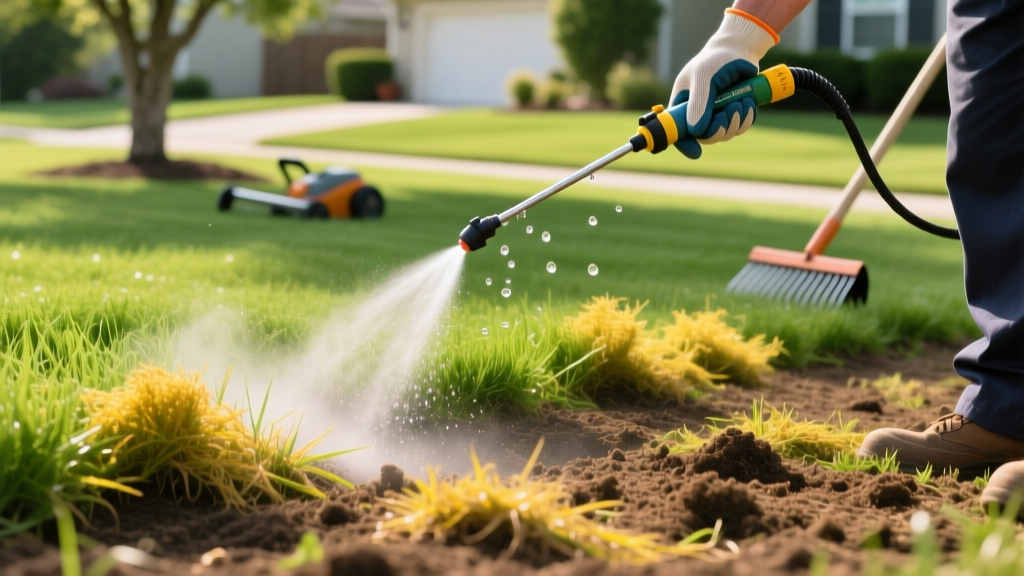
MSMA Herbicide Application: Soil Nutrition & Dallisgrass Control
The Intersection of Soil Nutrition and MSMA Efficacy
Monosodium methanearsonate (MSMA) is an organic arsenical herbicide historically used for post-emergent control of tough grassy weeds like dallisgrass (Paspalum dilatatum), bahiagrass, and crabgrass in warm-season turfgrasses. However, its efficacy is entirely dependent on the physiological state of the target weed, which is directly governed by soil nutrition.
Before addressing application mechanics, it is critical to understand the current regulatory landscape. Following EPA phase-outs, MSMA is no longer registered for residential home lawn use. It is strictly limited to commercial turf, golf courses, sod farms, and specific agricultural applications. For commercial turf managers and licensed applicators, integrating MSMA with a precise soil nutrition program is the only way to achieve complete dallisgrass eradication without causing severe phytotoxicity to desirable Bermuda or Zoysia grass.
⚠️ Regulatory Warning: If you are a homeowner, MSMA products (such as MSMA 6.6 or Target 6.6 Plus) are illegal to apply to residential lawns. Homeowners must rely on alternative herbicides like Celsius WG, Tribute Total, or Revolver. This guide is intended for licensed commercial applicators and turf managers operating on permitted properties.
Why Dallisgrass Thrives in Nutrient-Imbalanced Soils
Dallisgrass is an opportunistic perennial weed that exploits compacted, poorly drained, and low-nitrogen soils. According to NC State TurfFiles, dallisgrass develops deep, fleshy rhizomes and short, stout rootstocks that allow it to survive drought and close mowing. When desirable warm-season turf is starved of nitrogen, the canopy thins, allowing dallisgrass to capture sunlight and dominate the sward.
The 'Feed to Kill' Strategy
MSMA is a contact herbicide with limited systemic translocation. For the active ingredient to move from the leaf tissue down into the rhizomes and rootstocks, the weed must be actively growing and translocating nutrients. If you apply MSMA to a nutrient-deficient, drought-stressed dallisgrass patch, the herbicide will merely burn the leaf tips (contact activity) while the root system survives and regenerates within 14 days.
To achieve a true kill, commercial applicators use a 'Feed to Kill' protocol: applying a fast-release nitrogen source 7 to 10 days before the MSMA application to force the dallisgrass into an active growth phase, ensuring maximum vascular translocation of the arsenic.
Fertilizer and MSMA Application Timeline
Timing the intersection of soil nutrition and herbicide application requires precise scheduling. The following matrix outlines the optimal sequence for commercial Bermuda and Zoysia turf.
| Phase | Action | Product / Rate | Objective |
|---|---|---|---|
| Day 0 | Stimulate Growth | Urea (46-0-0) at 0.5 lbs N / 1,000 sq ft | Force dallisgrass into active vascular translocation. |
| Day 7-10 | First MSMA App | MSMA 6.6 at 2.0 fl oz / 1,000 sq ft + NIS | Initial burn and systemic movement to rhizomes. |
| Day 14-21 | Second MSMA App | MSMA 6.6 at 1.33 fl oz / 1,000 sq ft + NIS | Eliminate regrowth from surviving rootstocks. |
| Day 30 | Canopy Recovery | Balanced NPK (e.g., 20-5-10) at 1.0 lbs N / 1,000 sq ft | Fill in bare spots with desirable turf to prevent reinvasion. |
Managing Arsenic Accumulation and Soil Chemistry
The most significant soil nutrition concern with MSMA is the accumulation of inorganic arsenic in the soil profile. While organic arsenicals like MSMA are less toxic than inorganic forms, microbial degradation in the soil eventually converts MSMA into inorganic arsenate (AsO4 3-). Understanding how this interacts with your fertilizer program is critical for environmental safety and turf health.
The Arsenic-Phosphorus Antagonism
In soil chemistry, arsenate and phosphate (PO4 3-) are structural analogs; they behave almost identically. Arsenic naturally binds tightly to iron and aluminum oxides in the soil, rendering it immobile and relatively safe. However, if your soil nutrition program relies heavily on high-phosphorus fertilizers (such as 10-10-10 or starter fertilizers applied unnecessarily), the excess phosphate ions will compete with arsenate ions for those same iron and aluminum binding sites.
When phosphate displaces arsenate, the arsenic is released into the soil solution, increasing the risk of leaching into groundwater or causing root toxicity. The EPA notes that managing soil chemistry is vital when using arsenical compounds. To mitigate this:
- Avoid Blind Phosphorus Applications: Only apply phosphorus if a recent soil test indicates a deficiency (typically below 25 ppm Mehlich-3 P).
- Maintain Optimal pH: Keep soil pH between 6.0 and 6.5. At higher pH levels (above 7.0), iron and aluminum oxides dissolve or lose their binding capacity, releasing arsenic into the soil solution.
- Utilize Iron Sulfate: If soil tests reveal high arsenic mobility, applying iron sulfate (FeSO4) can introduce fresh iron binding sites to lock the arsenic back into the soil matrix.
Step-by-Step MSMA 6.6 Application Protocol
For licensed applicators treating a 10,000 square foot commercial Bermuda grass fairway, follow this exact mixing and application protocol to maximize efficacy and minimize turf injury.
Equipment Setup: Use a calibrated backpack or ride-on sprayer delivering 1.5 to 2.0 gallons of water per 1,000 sq ft. Ensure flat-fan nozzles (e.g., TeeJet 8002VS) are used for even coverage.
- Calculate the Mix: For 10,000 sq ft, you will need 20.0 fl oz of MSMA 6.6 (at the 2.0 fl oz/1k rate) mixed into 15 to 20 gallons of water.
- Add Surfactant: MSMA requires a Non-Ionic Surfactant (NIS) to penetrate the waxy cuticle of dallisgrass. Add NIS at 0.25% v/v (approximately 2.5 fl oz per 10 gallons of water).
- Check Temperature Thresholds: Apply only when daytime temperatures are between 75°F and 85°F. Applying MSMA when temperatures exceed 90°F will cause severe phytotoxicity, temporarily bleaching and stunting the desirable Bermuda or Zoysia turf.
- Spray and Withhold Water: Apply the solution evenly. Do not irrigate for at least 24 hours post-application to allow maximum foliar absorption.
- Expect Temporary Discoloration: MSMA will cause a temporary yellowing (chlorosis) of Bermuda grass. This is a normal physiological response to the arsenic and will green up within 10 to 14 days as the turf metabolizes the compound.
Nutrient-Driven Cultural Alternatives to MSMA
If MSMA is unavailable or restricted in your jurisdiction, you must rely on a combination of alternative herbicides and aggressive soil nutrition strategies to outcompete dallisgrass.
Deep-Root Fertilization and Aeration
Dallisgrass thrives in compacted soils where oxygen levels are low. Implementing core aeration twice a year (spring and early fall) relieves compaction. Pair this with a slow-release, methylene-urea based nitrogen fertilizer (e.g., 30-0-0 with 50% water-insoluble nitrogen). This provides a steady, low-dose nutrient stream that favors the deep-rooted desirable turf over the shallow, opportunistic dallisgrass. For chemical control in the absence of MSMA, utilize thiencarbazone-methyl + foramsulfuron + halosulfuron (Tribute Total), which offers excellent post-emergent dallisgrass suppression without the soil accumulation risks of arsenic.
Frequently Asked Questions
Can I mix MSMA with liquid nitrogen fertilizers in the same tank?
It is not recommended. Mixing MSMA with liquid nitrogen (like UAN 28% or 32%) in the spray tank can cause rapid foliar burn to the desirable turfgrass due to the synergistic effect of the arsenic and the high salt index of the liquid nitrogen. Apply the nitrogen fertilizer granularly or as a separate liquid application 7 days prior to the MSMA spray.
How long does MSMA remain active in the soil?
MSMA itself degrades relatively quickly in the soil (half-life of 7 to 21 days) via microbial demethylation. However, the resulting inorganic arsenic does not degrade; it is an element. It will remain in the soil profile indefinitely, bound to iron and aluminum oxides, which is why avoiding excess phosphorus fertilization is critical to prevent it from mobilizing.
Will MSMA kill dallisgrass in one application?
No. Dallisgrass possesses extensive underground rhizomes and rootstocks that store carbohydrates. A single application of MSMA will only burn the top growth. A minimum of two to three applications, spaced 14 to 21 days apart, is required to exhaust the root system's energy reserves and achieve a complete kill.

