
Pest Control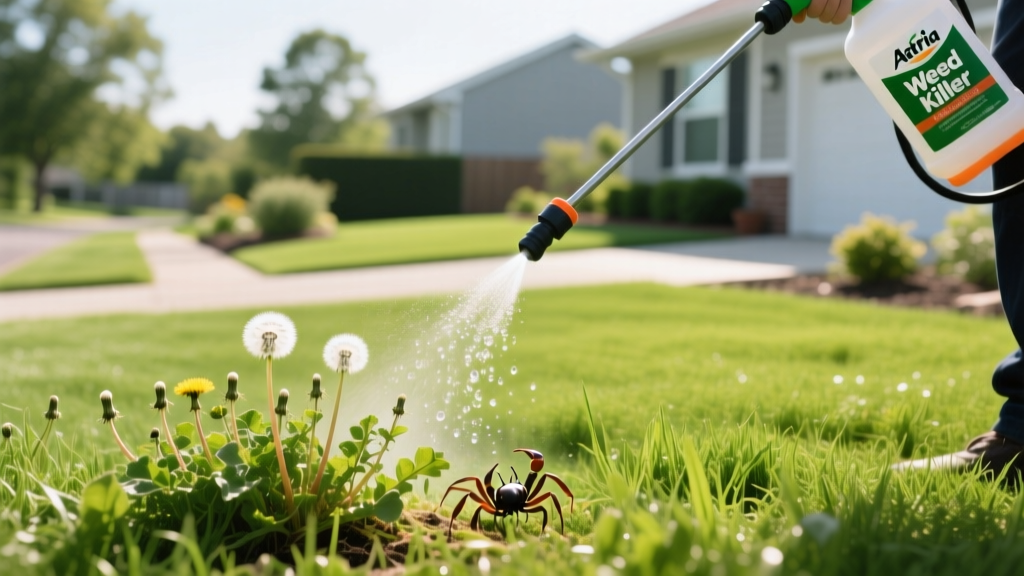
Natria Weed Killer Spot-Treatment Guide for Tough Lawn Weeds
Transitioning from systemic synthetic herbicides to organic contact killers requires a fundamental shift in lawn care strategy. When executing a weed species spot-treatment guide using Natria weed killer, homeowners must understand that this product does not translocate to the roots. Instead, it relies on rapid cellular desiccation. This guide details the exact protocols for spot-treating stubborn lawn weeds using Natria's herbicidal soap formulations, addressing specific weed biology, environmental variables, and common application failures.
The Science of Herbicidal Soaps: Why Natria Works Differently
Natria's primary active ingredient in its Ready-to-Use Weed & Grass Killer is Ammoniated Soap of Fatty Acids (typically at a 20% concentration). According to the EPA's guidelines on minimum-risk and organic pesticides, fatty acid salts act as contact herbicides. They dissolve the waxy cuticle of the plant leaf, causing the cell membranes to collapse and leak their contents, leading to rapid desiccation.
Because Natria is a contact herbicide, it only kills the green tissue it physically touches. It possesses no soil residual activity and will not travel down the phloem to destroy deep taproots or extensive stolon networks. Therefore, spot-treatment success relies entirely on application technique, timing, and repeat treatments to exhaust the weed's stored carbohydrate reserves.
Target Weed Species and Spot-Treatment Protocols
Different weed architectures require distinct spraying strategies. Treating a taproot broadleaf weed identically to a stoloniferous weed will result in rapid regrowth.
Dandelions (Taraxacum officinale)
Dandelions possess a thick, fleshy taproot that can extend 10 to 15 inches into the soil. A single application of Natria weed killer will burn the foliage to the ground within 24 hours, but the weed will resprout from the crown within a week.
- Protocol: Adjust the spray nozzle to a pin-stream rather than a wide mist. Direct the stream precisely into the center of the dandelion crown where the leaves meet the root.
- Frequency: Expect to apply 2 to 3 treatments, spaced exactly 5 to 7 days apart. The goal is to repeatedly destroy new foliage before it can photosynthesize and replenish the taproot.
White Clover (Trifolium repens)
White clover spreads via above-ground stolons (runners) that root at the nodes. Spraying only the visible leaf clusters leaves the stolon network intact.
- Protocol: Trace the stolon back from the main leaf cluster. Spray the nodes and the connecting runners until wet. Use a piece of cardboard as a physical shield to protect surrounding desirable turfgrass from drift.
- Frequency: 1 to 2 applications. Clover foliage is highly susceptible to fatty acid salts, and destroying the nodes usually severs the plant's vascular network.
Crabgrass (Digitaria)
As an annual grassy weed, crabgrass lacks a deep perennial root system, making it highly vulnerable to contact herbicides—if caught early.
- Protocol: Target crabgrass at the 1- to 2-tiller stage (when it is less than 2 inches wide). Mature crabgrass develops a thick, silica-reinforced cuticle that resists soap penetration. Apply a generous, even coating over the entire weed.
- Frequency: Usually a single application is fatal for young crabgrass. Mature plants may require a second pass after 48 hours.
Weed Species vs. Natria Application Matrix
| Weed Species | Growth Habit | Natria Efficacy | Required Applications | Primary Failure Mode |
|---|---|---|---|---|
| Dandelion | Taproot Broadleaf | Moderate (Foliage only) | 2 - 3 passes | Missing the center crown; root resprouts |
| White Clover | Stoloniferous | High | 1 - 2 passes | Spraying leaves but ignoring stolon nodes |
| Crabgrass | Annual Grass | High (if young) | 1 pass (young) / 2 (mature) | Applying to mature plants with thick cuticles |
| Plantain | Fibrous Broadleaf | High | 1 - 2 passes | Insufficient coverage of waxy leaf surface |
Critical Application Variables and Failure Modes
Organic herbicidal soaps are highly sensitive to environmental conditions. The University of Minnesota Extension notes that organic contact herbicides require precise environmental windows to function effectively.
⚠️ Temperature Warning: Do not apply Natria weed killer when ambient temperatures exceed 85°F. At high temperatures, the water carrier evaporates before the fatty acids can penetrate the leaf cuticle, rendering the treatment useless and increasing the risk of vapor drift to desirable plants. The optimal application window is between 65°F and 80°F.
The Hard Water Interaction
If you are using a Natria concentrate and diluting it yourself, water hardness is a critical variable. Calcium and magnesium ions in hard water bind to the fatty acid salts, forming insoluble soap scum. This precipitation removes the active ingredient from the solution before it even reaches the weed. Solution: Always mix concentrates with distilled water or clean rainwater to maintain the chemical integrity of the ammoniated soap.
Wind and Droplet Size
Because Natria is non-selective, it will burn any green tissue it contacts, including your Kentucky Bluegrass or Bermuda turf. Avoid spraying when wind speeds exceed 5 mph. Adjust your spray nozzle to produce larger, heavier droplets rather than a fine mist. Fine mists are easily carried by micro-currents and will cause cosmetic spotting on surrounding lawn grass.
Step-by-Step Spot-Treatment Execution
- Calibrate the Nozzle: Twist the sprayer tip to a narrow stream for taproot weeds (dandelions) or a targeted fan for broad patches (clover).
- Deploy Physical Shields: Hold a 12x12 inch piece of corrugated cardboard 2 inches above the soil, directly behind the target weed, to catch overspray.
- Apply to Wetness, Not Drenching: Spray the weed until the foliage is visibly wet and glistening. Do not spray to the point of runoff; excess liquid dripping onto the soil provides no herbicidal benefit and wastes product.
- Monitor and Document: Flag the treated weed with a small landscape pin. Check the site at 24 hours (foliage should be dark brown and desiccated) and again at 5 days to assess resprouting.
- Execute Follow-Up: If green tissue emerges from the crown or nodes, apply a second targeted dose immediately.
Post-Treatment Lawn Recovery and Cost Analysis
Because spot-treating with Natria leaves small, desiccated brown patches in the lawn where the weeds previously grew, post-treatment recovery is necessary. Once the weed is confirmed dead (usually after 7 to 10 days and 2 applications), use a hand weeder to physically pop out the dead root mass. This creates a clean soil divot. Fill the divot with a 50/50 mix of topsoil and compost, and overseed with a grass variety matching your existing lawn. Keep the patched area consistently moist for 14 days to ensure seed germination.
2026 Pricing and Value Breakdown
When budgeting for an organic spot-treatment regimen, consider the cost per square foot of coverage. As of current retail pricing:
- 24 oz Ready-to-Use (RTU) Trigger Bottle: ~$11.98. Ideal for small, isolated weed outbreaks (covers roughly 50-75 individual spot-treatments).
- 1-Gallon RTU Refill Jug: ~$24.98. Highly cost-effective for lawns with heavy, scattered weed pressure. Refilling your trigger bottle cuts the cost per application by nearly 50%.
By understanding the biological limitations of contact herbicides and adapting your application technique to the specific architecture of the target weed, Natria weed killer becomes a highly effective tool in an organic lawn care arsenal. Precision, timing, and persistence are the true active ingredients in any successful organic spot-treatment protocol.

