
Pest Control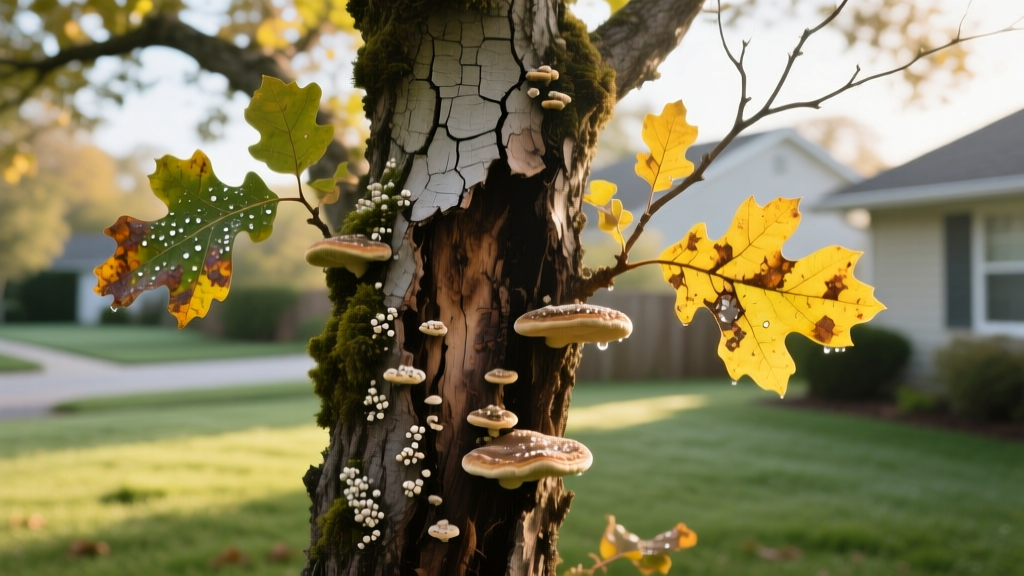
Oak Tree Diseases Photos: Visual Diagnosis & Rescue Fixes Guide
Homeowners frequently search for oak tree diseases photos because visual symptoms are the first indicator of systemic failure. However, matching a photograph to an accurate diagnosis requires understanding the specific progression of vascular and foliar pathogens. Misidentifying a surface-level fungal leaf spot as a fatal vascular wilt can lead to unnecessary tree removal or, conversely, fatal delays in treatment. This guide provides a visual diagnostic framework and exact rescue protocols for the most destructive oak pathogens active in 2026.
Visual Diagnostic Matrix: Matching Symptoms to Diseases
Before purchasing fungicides, cross-reference your tree's visual symptoms against this diagnostic matrix. The progression pattern is often more telling than the initial symptom.
| Disease / Pathogen | Initial Visual Cue (What Photos Show) | Progression Pattern | Primary Vector / Cause |
|---|---|---|---|
| Oak Wilt (Bretziella fagacearum) | Veinal necrosis: Leaves turn brown along veins while interveinal tissue remains green temporarily. | Starts at the top outer canopy and moves downward rapidly. Complete defoliation in 2-4 weeks (Red Oaks). | Sap-feeding nitidulid beetles; root graft transmission. |
| Sudden Oak Death (Phytophthora ramorum) | Tarry bleeding cankers on the lower bole; dark reddish-black exudate seeping through bark cracks. | Bole bleeding precedes canopy thinning. Canopy turns uniformly brown and remains attached (marcescence). | Splash dispersal from infected understory hosts (e.g., California bay laurel). |
| Oak Anthracnose (Apiognomonia quercina) | Marginal leaf scorch and irregular brown blotches; twig dieback on lower, shaded branches. | Confined to lower canopy and inner branches. Defoliation is partial and rarely fatal to mature trees. | Wind and rain splash during cool, wet spring weather. |
| Hypoxylon Canker (Hypoxylon atropunctatum) | Sloughing bark revealing black, gray, or brown crusty fungal stroma; conidial dust upon disturbance. | Appears on stressed trees. Bark falls off in patches, exposing decaying sapwood. Branches snap easily. | Opportunistic pathogen exploiting drought-stressed or root-damaged trees. |
Oak Wilt: Veinal Necrosis and Vascular Staining
Oak wilt is the most aggressive oak killer in North America. Red oaks (e.g., Texas Red Oak, Northern Red Oak) are highly susceptible and typically die within a month of symptom onset. White oaks (e.g., Bur Oak, White Oak) exhibit slower progression due to tyloses formation in their xylem, which restricts fungal movement.
Rescue Protocol: Propiconazole Injections & Trenching
If you identify veinal necrosis and suspect oak wilt, immediate systemic intervention is required. Soil drenches are ineffective for active vascular infections.
- Chemical: Propiconazole 14.3% (e.g., Alamo or generic equivalents).
- Application Method: Direct trunk injection using a pressurized system (e.g., ArborJet QUIK-jet or TREE I.V.).
- Dosage: 0.2 fluid ounces of formulated product per inch of Diameter at Breast Height (DBH) for prevention; up to 0.4 fl oz per inch DBH for active therapeutic treatment.
- Root Graft Trenching: To stop subterranean spread to adjacent oaks, sever root grafts using a vibratory plow. Trenches must be at least 48 inches deep and placed 100 feet beyond the outermost symptomatic tree. In 2026, professional trenching averages $14 to $22 per linear foot.
WARNING: Never prune oak trees between February 1 and June 30. Fresh pruning wounds emit volatile compounds that attract sap-feeding nitidulid beetles carrying oak wilt spores. If emergency pruning is required during this window, immediately seal all cuts with a commercial tree wound paint or latex-based sealant.
Sudden Oak Death (SOD): Tarry Cankers and Bole Bleeding
Prevalent primarily in coastal California and Oregon, Sudden Oak Death (Phytophthora ramorum) targets the phloem and cambium. The hallmark visual symptom is "bleeding"—a dark, tarry exudate oozing from vertical bark fissures on the lower trunk, often accompanied by a foamy white lather when mixed with rain.
Rescue Protocol: Phosphite Bark Applications
Unlike oak wilt, SOD is managed by boosting the tree's natural defense mechanisms rather than directly killing the pathogen.
- Chemical: Potassium phosphite (e.g., Agri-Fos).
- Surfactant: Must be mixed with a specialized bark-penetrating surfactant like Pentrabark (0.5% to 1% v/v) to ensure the active ingredient crosses the outer bark.
- Application Method: Basal bark spray. Apply to the lower 6 feet of the trunk until the point of runoff. Do not spray the foliage or soil.
- Timing: Late fall or early winter when the tree is dormant and soil moisture is adequate. Avoid application during severe drought stress, as the tree cannot translocate the phosphite effectively.
Oak Anthracnose: Marginal Leaf Scorch and Twig Dieback
Anthracnose is a cosmetic and moderate defoliating disease caused by Apiognomonia quercina. Photos of anthracnose often show leaves with irregular brown margins and necrotic patches that follow the leaf veins, frequently confused with drought stress or herbicide drift. The key differentiator is the presence of small, dark fruiting bodies (acervuli) on the underside of the affected leaves, visible under a 10x hand lens.
Rescue Protocol: Fungicide Timing and Canopy Pruning
Anthracnose rarely kills mature oaks, so aggressive chemical rescue is usually reserved for young trees or high-value specimen oaks experiencing severe, repeated defoliation.
- Chemical: Chlorothalonil (e.g., Daconil) or Thiophanate-methyl (e.g., Cleary's 3336F).
- Timing: The first application must occur exactly at bud break (when buds are 1/2 inch long). Follow up with two additional applications at 10 to 14-day intervals. Spraying after symptoms are already visible on mature leaves is entirely ineffective.
- Cultural Fix: Rake and destroy all fallen leaves in autumn to eliminate overwintering inoculum. Prune dead twigs in the lower canopy to increase airflow and reduce the humid microclimate the fungus requires.
Hypoxylon Canker: Sloughing Bark and Conidial Dust
Hypoxylon is an opportunistic pathogen. According to Penn State Extension, Hypoxylon atropunctatum does not attack healthy trees. The visual symptom is distinct: the outer bark sloughs off in large patches, revealing a crusty, gray-to-black fungal mat (stroma) underneath. If you rub this mat, it releases a cloud of dark brown conidial dust.
EXPERT INSIGHT: There is no chemical cure for Hypoxylon canker. Fungicides cannot penetrate the dead sapwood where the stroma resides. Finding Hypoxylon means your tree has suffered severe underlying stress (prolonged drought, construction soil compaction, or lightning strike) for at least 12 to 18 months prior to the bark sloughing.
Rescue Protocol: Cultural Stress Mitigation
Management focuses entirely on arresting the underlying stress to allow the tree's compartmentalization processes (CODIT) to wall off the decay.
- Deep Root Aeration: Use an AirSpade to excavate and decompact the soil within the dripline, incorporating organic compost to restore soil porosity.
- Moisture Management: Install slow-release drip irrigation to deliver 1.5 inches of water per week during dry spells, targeting the outer two-thirds of the root zone.
- Hazard Reduction: Because Hypoxylon degrades the structural integrity of the sapwood, hire an ISA Certified Arborist to perform a sonic tomography scan. If decay exceeds 30% of the trunk's cross-section at breast height, the tree poses a failure risk and should be removed.
Calculating DBH and Treatment Cost Framework
Professional trunk injections and systemic treatments are priced by Diameter at Breast Height (DBH). To calculate your tree's DBH:
- Measure the circumference of the trunk at exactly 4.5 feet above the ground using a flexible measuring tape.
- Divide the circumference by 3.14 (Pi).
- Example: A trunk circumference of 94 inches equals a 30-inch DBH.
As of 2026, professional Propiconazole trunk injections for oak wilt average $18 to $28 per DBH inch. A 30-inch oak will cost between $540 and $840 per treatment. Because Propiconazole degrades within the xylem, therapeutic injections must be repeated every 12 to 24 months, while preventative injections can be spaced to 24-month intervals.
Decision Tree: DIY Treatment vs. ISA Certified Arborist
Not all oak diseases require professional intervention. Use this framework to allocate your budget effectively:
- DIY Appropriate: Oak Anthracnose (foliar sprays on small trees), basic drought-stress irrigation, and preventative mulching. You can safely apply bark-applied phosphites for SOD on accessible lower trunks if you purchase commercial-grade surfactants.
- Professional Required: Oak Wilt (requires pressurized trunk injection equipment and precise xylem targeting), SOD on mature trees over 40 feet (requires canopy assessment), and Hypoxylon hazard assessments. Furthermore, the Texas Oak Wilt Information Partnership strongly advises that root graft trenching and therapeutic injections be handled by certified professionals to prevent accidental cross-contamination via unsanitized tools.
Accurate visual diagnosis is the cornerstone of oak preservation. By matching the specific necrotic patterns, canker formations, and progression speeds detailed above to your tree's symptoms, you can deploy targeted chemical and cultural rescue fixes before irreversible vascular failure occurs.

