
Pest Control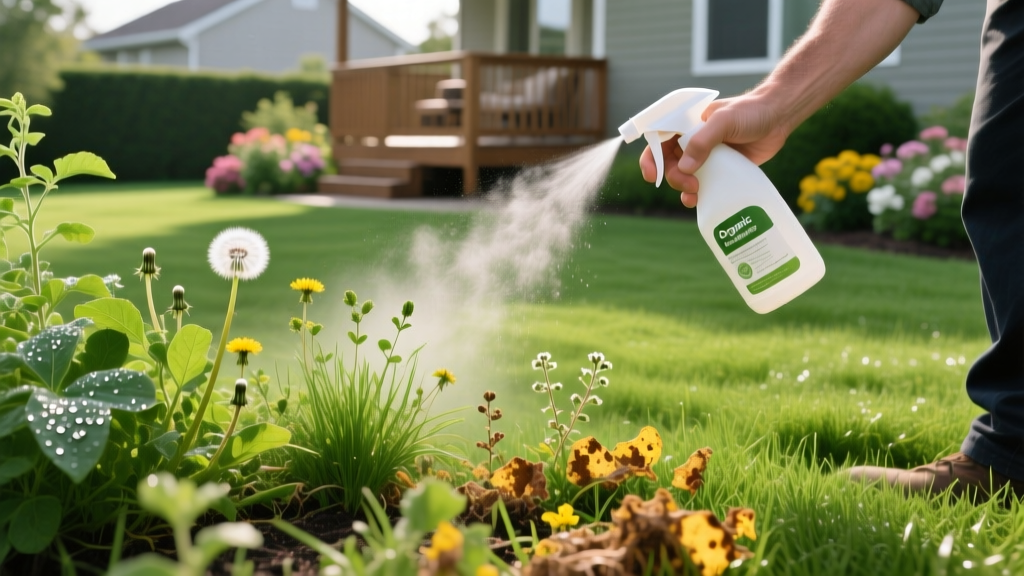
Top Organic Herbicides for Weeds: 2026 Efficacy Guide
The Reality of Organic Herbicides for Weeds
Transitioning to organic lawn care requires a fundamental shift in how you view weed management. Unlike synthetic systemic herbicides (such as glyphosate or 2,4-D), which are absorbed by the leaves and translocated to the roots to kill the entire plant, organic herbicides for weeds are strictly contact-based desiccants. They destroy the cellular structure of the foliage they touch, causing rapid dehydration and necrosis, but they do not travel through the plant's vascular system.
This biological limitation dictates your entire application strategy. When using organic herbicides, you are burning off the top growth to exhaust the root system's carbohydrate reserves over repeated applications. Understanding this mechanism is the difference between a successful organic lawn and a frustrating cycle of perpetual regrowth.
⚠️ Safety Warning: Horticultural Vinegar is Not Kitchen Vinegar
Grocery store vinegar contains 5% acetic acid, which is largely ineffective on mature weeds. Organic herbicides utilize 20% to 30% acetic acid concentrations. At these levels, the solution is highly corrosive and can cause severe corneal damage and chemical burns. Always wear ANSI Z87.1-rated splash goggles, nitrile gloves, and long sleeves when mixing and applying high-concentration organic acids.
Active Ingredients: Efficacy and Cost Matrix
The organic herbicide market in 2026 is dominated by four primary active ingredients, all of which qualify as EPA Minimum Risk Pesticides or are approved by the Organic Materials Review Institute (OMRI). Each compound interacts with plant tissue differently.
| Active Ingredient | Mode of Action | Optimal Temp | Avg. Cost (Per Gallon Conc.) |
|---|---|---|---|
| Acetic Acid (20-30%) | Cell membrane disruption via rapid pH drop | > 70°F | $35 - $45 |
| d-Limonene (Citrus Oil) | Strips waxy leaf cuticle, causing desiccation | > 65°F | $40 - $55 |
| Pelargonic Acid | Fatty acid synthesis inhibitor, rapid burn | > 60°F | $50 - $65 |
| Clove Oil (Eugenol) | Membrane disruption, strong residual scent | > 65°F | $45 - $60 |
Top 3 Commercial Organic Herbicides for Weeds
Based on field efficacy, emulsion stability, and cost-per-coverage, these are the top-performing organic formulations currently available.
1. Avenger Weed Killer (d-Limonene Base)
Avenger utilizes a high concentration of d-limonene extracted from citrus peels. It excels at dissolving the waxy cuticle of broadleaf weeds like plantain and dandelion. Because it breaks down the leaf's natural moisture barrier, it works slightly faster than acetic acid in high-humidity environments.
- Concentration: 70% d-limonene (needs 1:6 dilution for most weeds).
- Pricing: ~$28 for a 32 oz concentrate (yields ~14 gallons of spray).
- Best For: Broadleaf weeds in flower beds and driveway cracks.
- Drawback: Strong citrus odor lingers for 24-48 hours; can stain porous concrete if left to pool.
2. BurnOut II (20% Acetic Acid Base)
A staple in commercial organic landscaping, BurnOut II combines 20% horticultural vinegar with natural emulsifiers. It provides aggressive, same-day burn-down on annual grasses and young broadleaf weeds. According to research highlighted by the University of Minnesota Extension, acetic acid solutions at 20% provide near 100% top-growth kill on young seedlings, though mature perennials require repeat treatments.
- Concentration: 20% acetic acid (ready-to-use or light dilution).
- Pricing: ~$45 per 1-gallon ready-to-use jug.
- Best For: Large area clearance, patio pavers, and fence lines.
- Drawback: Highly corrosive; will rapidly degrade cheap pump sprayer seals and O-rings.
3. Captain Jack’s Deadweed Brew (Citric Acid + Clove Oil)
This formulation relies on a synergy of citric acid and eugenol (clove oil). It is slightly less aggressive than 20% acetic acid but is much safer for use in tight spaces near edible garden borders where accidental overspray is a concern.
- Concentration: Proprietary blend of citric acid and essential oils.
- Pricing: ~$22 for a 1-gallon ready-to-spray trigger bottle.
- Best For: Spot-treating weeds in vegetable garden pathways and raised bed edges.
- Drawback: Slower necrosis (takes 4-6 hours to see browning compared to 1-2 hours for acetic acid).
Application Protocols for Maximum Desiccation
The failure rate of organic herbicides for weeds is overwhelmingly tied to improper application. Because these products lack systemic action, your technique must compensate for their biological limitations.
- Mandatory Surfactant Use: Organic acids and oils will bead up and roll off waxy leaves (like purslane or mature crabgrass). You must add a surfactant. Use Methylated Seed Oil (MSO) at a rate of 1 teaspoon per gallon of spray. MSO penetrates the leaf cuticle, dragging the active ingredient into the plant tissue.
- Temperature and Solar Timing: Apply between 10:00 AM and 2:00 PM when the sun is at its peak and temperatures exceed 70°F. The heat accelerates the desiccation process. Spraying organic herbicides on a cloudy, 55°F morning will yield less than 40% efficacy.
- Saturation, Not Misting: Do not use a fine mist nozzle. Use a flat-fan nozzle to drench the foliage until it is dripping. You must physically coat every square inch of the leaf surface, as any untreated green tissue will continue to photosynthesize and rebuild the root reserves.
- The 7-Day Reapplication Rule: For perennial weeds, the top growth will die back in 24 hours, but the roots will push up new shoots within a week. You must spray the regrowth on day 7 or 8 before the new leaves have enough surface area to replenish the root's energy stores. Three to four cycles will eventually starve the root system.
Edge Cases: When Organic Herbicides Fail
While organic herbicides are highly effective for annual weeds and top-growth clearance, they hit a hard biological wall against certain invasive perennials.
Yellow Nutsedge (Cyperus esculentus)
Nutsedge reproduces via underground tubers (nutlets) that sit 8 to 14 inches deep in the soil profile. Burning the top growth with organic herbicides simply triggers the dormant nutlets to sprout. To manage nutsedge organically, you must rely on cultural controls: improving soil drainage, adjusting mowing heights to 3.5 inches to shade out the sedge, and manual excavation of the top 6 inches of soil in heavily infested beds.
Field Bindweed (Convolvulus arvensis)
Bindweed possesses a taproot system that can plunge up to 10 feet deep, with lateral roots spreading horizontally for 20 feet. Organic contact sprays will only burn the vine-like top growth. Controlling bindweed organically requires years of persistent physical removal and heavy smother-mulching using overlapping layers of corrugated cardboard topped with 4 inches of arborist wood chips.
Frequently Asked Questions
Will organic herbicides change my soil pH?
No. While 20% acetic acid is highly acidic in the bottle, it breaks down rapidly in the soil environment. Soil microbes and natural buffering capacity neutralize the acetic acid within 48 to 72 hours. It does not accumulate or permanently alter your soil's pH profile.
Can I use organic herbicides near my well water?
Yes. Because OMRI-listed organic herbicides break down into water, carbon dioxide, and basic organic compounds within days, they pose virtually zero risk of leaching into groundwater or contaminating well water, making them ideal for rural properties with shallow aquifers.
Do organic herbicides kill grass?
Yes. Organic herbicides are entirely non-selective. They cannot distinguish between a dandelion and your Kentucky Bluegrass. If you are treating weeds in a turf lawn, you must use a shielded spray head or a sponge applicator to paint the herbicide directly onto the weed leaves without contacting the surrounding turf.

