
Pest Control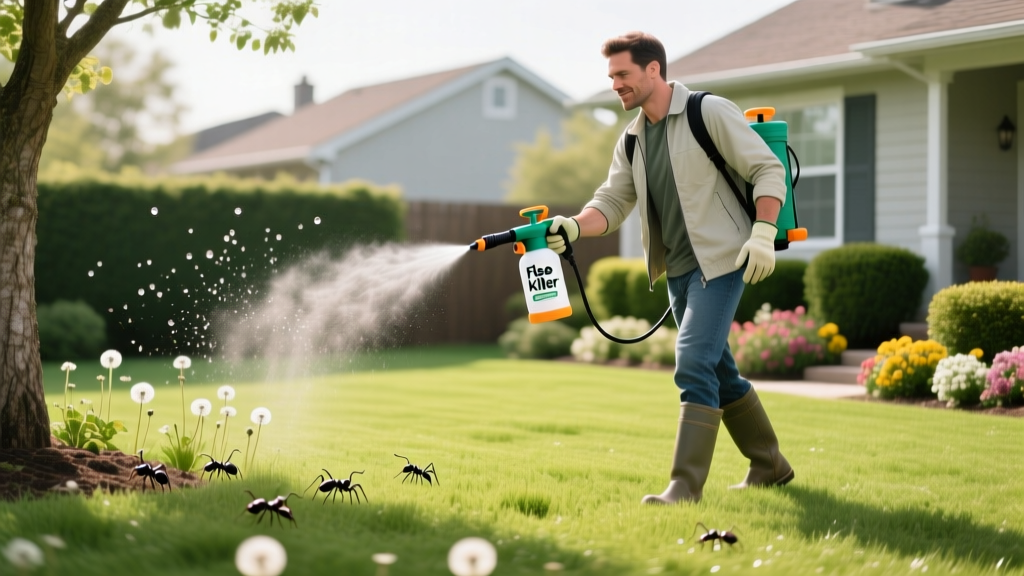
How to Apply an Outdoor Flea Killer for Total Yard Defense
The 5% Rule: Why Your Yard is the Real Battleground
When homeowners discover a flea infestation, the immediate reflex is to treat the pets and vacuum the carpets. However, entomological data reveals a harsh reality: adult fleas living on your pets represent only about 5% of the total flea population. The remaining 95%—comprising eggs, larvae, and pupae—are harbored in your yard, specifically in shaded, humid microclimates. If you do not deploy a targeted outdoor flea killer to break the life cycle in the landscape, your indoor treatments will inevitably fail as new adults continuously migrate inside.
Effective yard defense requires abandoning the 'spray everything' approach. Fleas are highly susceptible to ultraviolet (UV) light and desiccation. They cannot survive in direct sunlight or in grass where surface temperatures exceed 95°F. Therefore, an effective outdoor flea killer protocol focuses exclusively on shaded transition zones: under decks, along fence lines, beneath shrubbery, and in crawl spaces.
Expert Insight: Stop wasting expensive concentrates on your sunny front lawn. According to the University of California Agriculture and Natural Resources (UC ANR), flea larvae require high humidity and organic debris to survive. Map your yard's shade patterns and restrict your chemical applications strictly to these shaded havens.
Active Ingredients: Adulticides vs. IGRs
To achieve total yard defense, you must combine a fast-acting adulticide with an Insect Growth Regulator (IGR). Adulticides knock down the current biting population, while IGRs act as birth control, preventing eggs and larvae from maturing into adults. Not all IGRs are created equal for outdoor use; you must select photostable compounds that resist UV degradation.
| Active Ingredient | Class | Primary Function | Outdoor Residual Life | Best Use Case |
|---|---|---|---|---|
| Permethrin (36.8%) | Adulticide | Immediate contact kill of adults | 30–45 days | Heavy active infestations; rapid knockdown |
| Bifenthrin | Adulticide | Contact kill; broad-spectrum | 60–90 days | Perimeter defense and long-term barriers |
| Pyriproxyfen | IGR | Mimics juvenile hormone; stops molting | 150+ days | Highly photostable; essential for outdoor sunny/shade edges |
| Novaluron | IGR (CSI) | Chitin synthesis inhibitor | 90–120 days | Stops larval exoskeleton formation |
For a professional-grade outdoor flea killer mixture, combine Permethrin SFR (for immediate relief) with an IGR containing Pyriproxyfen (such as Tekko Pro or Nylar). Avoid Methoprene-based IGRs for outdoor applications, as they break down rapidly when exposed to direct sunlight.
Step-by-Step Application Protocol
Hose-end sprayers are popular but inherently flawed for flea control. They over-dilute the product and waste chemicals on sunny grass. Instead, use a 1-to-2-gallon compressed air pump sprayer to deliver a precise, concentrated application directly to the soil and thatch layer where larvae hide.
Phase 1: Landscape Preparation
- Mow and Bag: Mow shaded areas to a height of 2 inches. Bag the clippings immediately to remove organic debris and thatch where flea larvae feed on 'flea dirt' (adult flea feces).
- Pre-Water the Soil: Lightly irrigate the targeted shaded areas 24 hours before application. Moist soil forces flea pupae to hatch, exposing them to the adulticide, and prevents the soil from absorbing your chemical treatment too deeply.
- Clear the Perimeter: Rake away heavy leaf litter and mulch from the base of your home’s foundation and fence lines.
Phase 2: The Professional Mix
For a standard 2,000 square foot shaded treatment area, mix the following in a 2-gallon pump sprayer:
- 1.5 oz Permethrin SFR (36.8%) – Provides the adult knockdown.
- 0.5 oz Pyriproxyfen IGR – Provides 5-month growth regulation.
- 1/2 teaspoon of non-ionic surfactant – Breaks surface tension, allowing the mixture to penetrate the waxy cuticle of the flea and soak into the soil.
- Fill with water to the 2-gallon line and agitate thoroughly.
The Rodent Connection: Why Fleas Keep Coming Back
You can execute a flawless chemical application, but if your yard remains a highway for flea-carrying vectors, the infestation will return within weeks. The Centers for Disease Control and Prevention (CDC) notes that wild rodents and marsupials are primary vectors for introducing new flea colonies into residential landscapes.
Opossums, feral cats, and roof rats can drop thousands of flea eggs into your yard nightly as they traverse your property. Chemical treatments cannot keep pace with continuous biological re-introduction. You must implement physical exclusion:
Habitat Modification Checklist:
- Seal all crawl space vents and deck lattice with 1/4-inch galvanized hardware cloth.
- Install metal flashing around the bases of fruit trees to prevent rodent climbing.
- Remove brush piles and store firewood at least 20 feet from the home and elevated off the ground.
- Secure trash bins with bungee cords or locking lids to eliminate food sources for nocturnal vectors.
Biological Controls: Beneficial Nematodes
For homeowners who prefer organic methods or have sensitive ecosystems (such as koi ponds or pollinator gardens), chemical adulticides may be contraindicated. In these scenarios, beneficial nematodes (*Steinernema carpocapsae*) serve as a highly effective, living outdoor flea killer.
These microscopic, unsegmented worms actively hunt flea larvae in the soil. Once they penetrate the larva, they release bacteria (*Xenorhabdus nematophila*) that kills the host within 48 hours. The nematodes then reproduce inside the carcass and emerge to hunt again.
Application Specifications for Nematodes:
- Rate: Apply 10 million nematodes per 2,000 square feet of shaded yard.
- Temperature: Soil temperature must be consistently above 55°F. Applying in early spring or late fall will result in total failure.
- UV Protection: Apply at dusk. UV light kills exposed nematodes in minutes.
- Moisture: Water the lawn immediately before and after application to wash the nematodes down into the soil profile and prevent desiccation.
Safety and Environmental Considerations
Critical Pet & Wildlife Warning: Permethrin and Bifenthrin are highly toxic to aquatic life and felines. Never apply these products near storm drains, ponds, or streams. While safe for dogs once completely dry, liquid Permethrin is fatal to cats. Keep all cats indoors during application and until the treated surfaces are 100% dry (typically 3 to 4 hours).
Troubleshooting: Why Your Treatment Failed
If you are still seeing fleas after a thorough outdoor application, review these common failure modes:
- The Pupal Window: Flea pupae are encased in a sticky cocoon that is virtually impervious to chemical sprays. If you spray an area with heavy pupal presence, you will see emerging adults for up to 14 days post-treatment. This is normal. The IGR will prevent these new adults from reproducing, and they will die shortly after emerging.
- Rain Wash-Off: If a heavy rainstorm occurs within 24 hours of your liquid application, the product will be diluted and washed away before it can bind to the soil and vegetation. Reapply if washed out.
- Ignoring the Microclimates: Homeowners frequently treat the center of the lawn but miss the narrow strip of damp soil between the AC condenser unit and the fence, or the shaded dirt under a raised dog house. Fleas exploit these overlooked micro-habitats.
By combining a photostable IGR with a targeted adulticide, modifying the landscape to deter rodent vectors, and focusing your efforts strictly on shaded microclimates, you can establish a robust yard defense that permanently breaks the outdoor flea life cycle.

