
Pest Control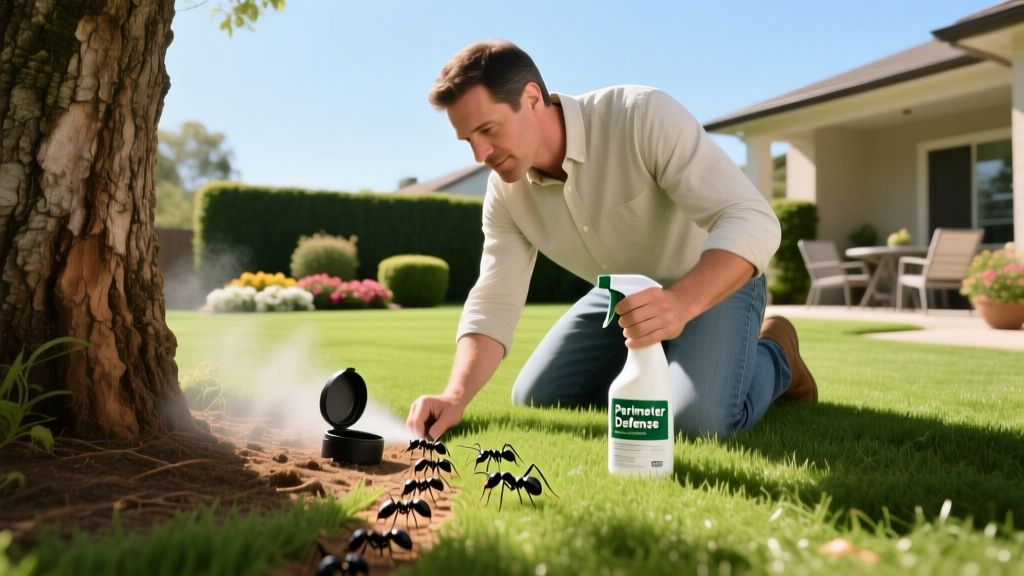
The Best Outdoor Remedy for House Ants: Perimeter Defense Guide
The most effective remedy for house ants does not begin inside your kitchen or bathroom; it begins in your yard. Species like the odorous house ant (Tapinoma sessile), Argentine ant (Linepithema humile), and pavement ant (Tetramorium caespitum) maintain massive, interconnected outdoor colonies that send thousands of foragers indoors seeking moisture and carbohydrates. Treating the interior symptoms without addressing the exterior source guarantees a recurring infestation. According to the University of California Integrated Pest Management (UC IPM) program, sustainable ant management requires altering the outdoor environment and utilizing targeted, slow-acting perimeter treatments.
The Flaw in Traditional Indoor Ant Sprays: The "Budding" Problem
Homeowners often reach for over-the-counter pyrethroid sprays (containing bifenthrin, permethrin, or deltamethrin) when they see an ant trail on their baseboards. This is a critical mistake for house ants. These species exhibit a survival behavior known as "budding." When a colony detects a fast-acting, repellent neurotoxin, the workers panic, split the colony into multiple smaller factions, and scatter into the walls. Instead of eliminating one nest, you have inadvertently created five satellite colonies that are now much harder to locate and treat.
⚠️ Pest Control Warning: Never use fast-acting aerosol sprays or "ant chalk" indoors for house ants. Repellents only kill the visible 5% of the foraging workforce while triggering colony fragmentation in the hidden 95%.
Phase 1: The Perimeter Trench and Non-Repellent Barrier
The gold-standard remedy for house ants relies on non-repellent liquid termiticides/insecticides. The active ingredient Fipronil (found in professional-grade products like Taurus SC or Termidor SC) is undetectable to ants. Foragers walk through the treated soil, pick up the microscopic residue, and carry it back to the nest. Through a process called trophallaxis (the sharing of food and fluids), the poison is transferred to the larvae, the workers, and ultimately the queens, collapsing the entire colony from the inside out.
Step-by-Step Trench Application
- Clear the Zone: Rake back mulch, dead leaves, and soil to expose the bare foundation. Ensure no wood or siding is touching the dirt (maintain a 6-inch visual gap).
- Dig the Trench: Using a trenching shovel, dig a continuous trench 6 inches deep and 6 inches wide directly against the home's concrete foundation.
- Mix the Solution: Mix 0.8 fluid ounces of 9.1% Fipronil concentrate per 1 gallon of water. (A standard 20 oz bottle costs roughly $110 and yields 25 gallons, treating approximately 62 linear feet of perimeter).
- Apply the Drench: Pour exactly 4 gallons of the finished solution into the trench for every 10 linear feet of foundation.
- Backfill and Treat: Push the excavated soil back into the trench. Spray the remaining mixture on the soil surface extending 18 inches outward from the foundation, and spray 18 inches up the foundation wall (avoiding windows and doors).
| Active Ingredient | Product Example | Action Type | Estimated Cost (2026) |
|---|---|---|---|
| Fipronil (9.1%) | Taurus SC / Termidor SC | Non-repellent, transfer effect | $90 - $120 / 20oz |
| Imidacloprid (0.05%) | Maxforce Complete Granular | Slow-acting bait matrix | $30 - $40 / 2lb |
| Abamectin (0.011%) | Advance 375A Select | Protein-based granular bait | $25 - $35 / 1lb |
| Bifenthrin (0.1%) | Ortho Home Defense | Fast-acting repellent | $15 - $20 / 1gal |
For a comprehensive breakdown of Fipronil's environmental profile and safety mechanisms around mammals, refer to the National Pesticide Information Center (NPIC) fact sheet. When applied correctly into a trench, Fipronil binds tightly to soil organic matter, minimizing runoff risks while remaining lethal to foraging insects for up to 90 days.
Phase 2: Strategic Outdoor Baiting for Colony Elimination
Liquid barriers stop ants from crossing the threshold, but granular baits actively hunt down the nest. The secret to baiting house ants is understanding their seasonal dietary shifts. In the spring and early summer, colonies are rearing brood (larvae) and demand proteins and fats. In late summer and fall, workers shift to carbohydrates and sugars to store energy for winter.
The Dual-Bait Rotation Strategy
Place bait stations or broadcast granules in mulch beds, near tree bases, and along fence lines where ant highways are visible. Do not place bait directly on top of the Fipronil trench, as the chemical may contaminate the food source.
- Spring/Early Summer (Protein): Use Advance 375A Select (Abamectin). Broadcast at a rate of 1.5 oz per 1,000 sq ft. The protein matrix appeals to nursing workers feeding the queens.
- Late Summer/Fall (Sweet): Use Maxforce Fleet or Optigard Ant Gel (Thiamethoxam/Indoxacarb). Place dime-sized drops on bait cards near entry points. The high-sugar content triggers aggressive foraging.
Phase 3: Organic and Botanical Yard Defenses
If you prefer to avoid synthetic neurotoxins near vegetable gardens or water features, organic remedies require more frequent application but can effectively disrupt ant trails and nesting sites.
🌿 Organic Remedies That Actually Work:
- Food-Grade Diatomaceous Earth (DE): Apply a 2-inch wide band of DE in dry, sheltered areas under decks or inside crawl spaces. DE destroys the ants' waxy exoskeleton, causing dehydration. Limitation: Must be reapplied after every rainfall.
- Boric Acid Sugar Bait: Mix 1 part Boric Acid powder with 3 parts sugar and 10 parts warm water. Soak cotton balls and place them in weather-proof PVC pipe traps outdoors. The low concentration ensures the ants survive long enough to carry the toxic sugar water back to the nest before the boric acid destroys their digestive tracts.
- Cedar Mulch: Replacing pine bark with thick cedar mulch around the foundation creates a natural aromatic barrier that deters nesting, though it will not eliminate an established colony.
Troubleshooting: Why Your Remedy for House Ants Failed
Even professional exterminators face callbacks when environmental factors override chemical treatments. Use this diagnostic framework to identify the failure point in your yard defense.
- Symptom: Ants are crossing the treated Fipronil trench but ignoring the bait.
- Cause: The soil in the trench is highly alkaline or heavily saturated with water, degrading the active ingredient. Alternatively, you are offering a protein bait during a carbohydrate-seeking season. Fix: Re-treat the trench during a dry weather window and switch to a sweet gel bait.
- Symptom: Ants are bypassing the ground entirely and entering through the roofline.
- Cause: Overhanging tree branches, vines, or utility wires are acting as "ant highways" over your chemical barrier. Fix: Trim all vegetation at least 3 feet away from the roofline and siding. Apply a botanical tree band (like Tanglefoot) around the base of the trunk to block upward movement.
- Symptom: Treated the perimeter, but ants are still emerging from the bathroom sink drain.
- Cause: Moisture intrusion. Odorous house ants are highly attracted to damp wood and plumbing leaks. If you have a slow leak under the sink, the colony may have moved entirely indoors into the wall void. Fix: Repair the leak, dry the area with a dehumidifier, and inject a non-repellent foam (like Alpine WSG or Termidor Foam) directly into the wall void behind the plumbing access panel.
"The biggest mistake homeowners make is viewing ants as an indoor problem. House ants are an outdoor ecological force that occasionally invades. By managing the moisture, vegetation, and soil chemistry immediately adjacent to your foundation, you remove the biological incentives that drive them inside." — Urban Entomology Extension Guidelines
Implementing a comprehensive outdoor remedy for house ants requires patience. Non-repellent liquids and slow-acting baits take 7 to 14 days to fully cycle through a polydomous colony. Avoid the temptation to spray visible foragers during this period; allow them to act as unwitting couriers delivering the remedy directly to the heart of the colony.

