
Pest Control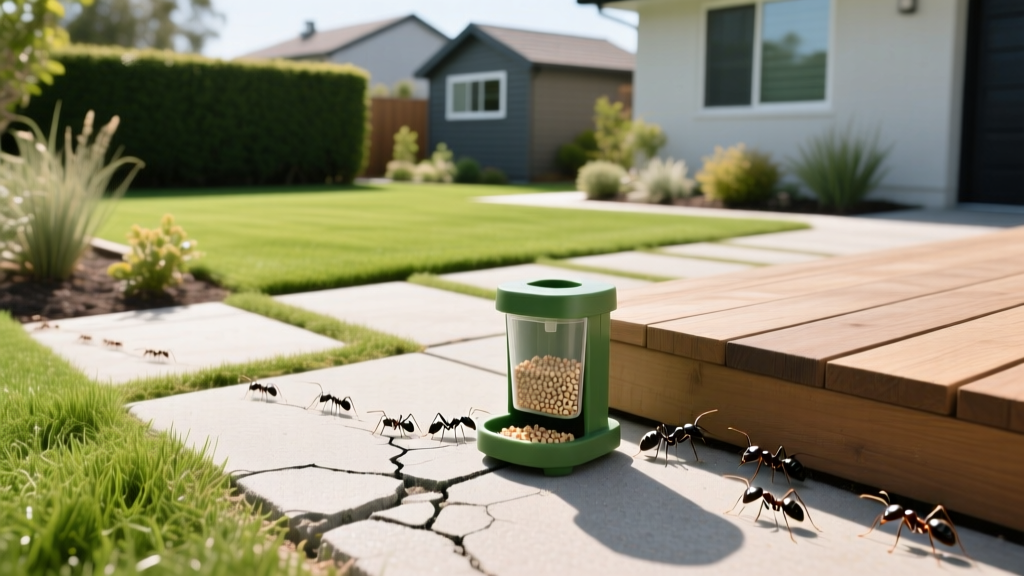
Proven Pavement Ant Control: Baiting and Perimeter Defense Tactics
The Biology of Hardscape Infestations
Pavement ants (Tetramorium immigrans) are uniquely adapted to exploit the thermal mass of human infrastructure. Unlike carpenter ants that destroy wood, or fire ants that build massive earthen mounds in open turf, pavement ants excavate intricate subterranean galleries directly beneath concrete slabs, asphalt driveways, and retaining walls. The concrete absorbs solar radiation during the day and releases it slowly at night, creating a microclimate that keeps the colony active even when ambient soil temperatures drop.
This preference for hardscapes makes standard lawn care pest management ineffective. When you see the telltale craters of displaced soil along your driveway joints or sidewalk seams, you are looking at the exhaust ports of a massive, decentralized supercolony. Effective pavement ant control requires abandoning surface-level contact sprays in favor of systemic colony elimination through transfer-effect chemistry and strategic baiting matrices.
⚠️ The Repellent Spray Trap: Never use over-the-counter pyrethroid contact sprays (like bifenthrin or permethrin) directly on pavement ant mounds. These chemicals kill on contact but act as a spatial repellent to the survivors. The colony will detect the chemical barrier, trigger an alarm response, and undergo "budding"—splitting into three or four satellite colonies that migrate deeper under your foundation, exponentially worsening the infestation.
The 3-Phase Pavement Ant Control Protocol
To eradicate a pavement ant supercolony, you must attack their foraging trails, their perimeter entry points, and their subterranean nesting zones simultaneously. This protocol utilizes professional-grade, non-repellent active ingredients that leverage the ants' social grooming and trophallaxis (food sharing) behaviors.
Phase 1: Targeted Gel Baiting (Days 1-5)
Before applying any outdoor perimeter defenses, you must eliminate indoor foragers and establish a poisoned food supply. Pavement ants have shifting dietary requirements based on the season. In early spring, they aggressively seek carbohydrates (sugars) to fuel foraging workers. By late summer and early fall, they shift to proteins and lipids (fats) to rear reproductive alates.
- Product Selection: Use Advion Ant Gel (Active ingredient: 0.05% Indoxacarb) for sugar-based trails, or Optigard Ant Gel (Active ingredient: 0.01% Thiamethoxam) for a delayed-action transfer effect.
- Application Technique: Apply pea-sized drops (approximately 0.1 grams) every 12 to 18 inches directly adjacent to active trails, baseboards, and window sills. Do not smear the gel; pavement ants will avoid disrupted bait matrices.
- Cost Expectation: A standard box of four 30g Advion tubes costs between $28 and $35 in 2026, which is sufficient to treat an average 2,500 sq. ft. home's interior and immediate exterior thresholds.
Phase 2: Non-Repellent Perimeter Trenching (Days 7-14)
Once indoor baiting has reduced visible traffic, establish an invisible chemical barrier around the home's foundation and hardscape perimeters. The goal is to use a non-repellent liquid that the ants walk through, picking up a lethal dose that they carry back to the subterranean queen.
- Mix the Solution: Use Termidor SC or Taurus SC (Active ingredient: 9.1% Fipronil). The exact dilution rate is 0.8 fluid ounces of concentrate per 1 gallon of water. A 20oz bottle ($45 to $55) yields roughly 24 gallons of finished solution.
- Trench and Rod: Dig a narrow trench 6 inches wide and 6 inches deep against the concrete foundation. For every 10 linear feet of trench, apply 1 gallon of the mixed solution. If the soil is heavy clay, use a soil probe to inject the solution to ensure it reaches the ant galleries.
- Hardscape Drilling: For severe driveway infestations, professional exterminators use a hammer drill with a 3/16-inch masonry bit to drill holes through the concrete expansion joints every 18 inches, injecting the fipronil solution directly into the sub-slab voids where the primary queens reside.
Phase 3: Granular Broadcast Defense (Ongoing)
To protect the broader lawn and garden beds from satellite colonies, broadcast a dual-action granular bait. Maxforce Fleet (1 lb jug, $35-$45) or Advance 375A (1 lb jug, $40-$50) provide a protein-based matrix that outdoor foragers will carry back to the nest. Apply at a rate of 1.5 to 2.0 lbs per acre using a rotary spreader, focusing on the edges of mulch beds and retaining walls.
Active Ingredient Comparison Matrix
Choosing the right chemistry is critical. The table below outlines the primary professional active ingredients used in pavement ant control and their specific mechanical advantages.
| Active Ingredient | Product Example | Speed of Kill | Transfer Effect | Best Application Scenario |
|---|---|---|---|---|
| Fipronil (9.1%) | Termidor SC / Taurus SC | Slow (24-72 hrs) | Exceptional (Secondary & Tertiary) | Foundation trenching, sub-slab injection |
| Indoxacarb (0.05%) | Advion Ant Gel | Delayed (Bio-activation required) | High | Indoor foraging trails, sugar-feeding phases |
| Thiamethoxam (0.01%) | Optigard Ant Gel | Slow (Up to 7 days) | Exceptional | Bait-averse colonies, outdoor crevices |
| Abamectin (0.011%) | Maxforce Fleet | Moderate (24-48 hrs) | Moderate | Broadcast lawn defense, protein-feeding phases |
Troubleshooting Common Treatment Failures
Even with professional-grade chemistry, pavement ant control can fail if environmental variables are ignored. Review these common edge cases if your colony remains active after 14 days.
1. Bait Aversion and Matrix Fatigue
If you placed Advion gel and the ants are walking around it rather than consuming it, the colony has likely shifted its dietary preference, or the gel has dried out and lost its moisture appeal. The Fix: Switch immediately to a protein/lipid bait like Advance 375A granules, or rehydrate the gel by placing a damp cotton ball adjacent to the bait station to increase local humidity.
2. Premature Perimeter Washout
Fipronil requires roughly 24 hours to bind to soil organic matter and become rainfast. If you apply a Termidor SC trench treatment and your automated irrigation system runs that night, the active ingredient will be diluted and washed away from the critical foundation zone. The Fix: Always disable zone-1 irrigation systems for 48 hours post-application and check the weather forecast to ensure no heavy rainfall is imminent.
3. Ignoring the Mulch Interface
Pavement ants frequently nest in the transitional zone where concrete meets organic mulch. If you spray the foundation but leave 4 inches of moisture-retaining wood mulch piled against the siding, you create a protected highway that bypasses your chemical trench. The Fix: Rake mulch back to maintain a strict 12-inch bare-soil or gravel buffer zone between any vegetation and the concrete foundation.
Expert Insights on Structural Prevention
Chemical control is only half the battle. According to entomologists at Penn State Extension, pavement ants are heavily driven indoors by the search for moisture and overwintering refuge. To permanently seal your hardscapes:
- Joint Sealing: Use a high-quality, self-leveling polyurethane sealant (like Sikaflex) to fill all expansion joints in driveways and sidewalks. This physically blocks the ants' ability to push soil to the surface and limits their access to the sub-slab thermal zone.
- Moisture Diversion: Ensure downspout extenders discharge at least 6 feet away from hardscape edges. Saturated soil beneath a concrete slab creates the exact humidity profile pavement ant queens require to establish a new nuptial chamber.
For comprehensive regulatory data on the environmental safety and soil-binding properties of non-repellent termiticides used in these protocols, refer to the EPA's Fipronil fact sheet. By combining targeted nutritional baiting with non-repellent transfer chemistry and physical hardscape exclusion, you can dismantle pavement ant supercolonies and reclaim your outdoor living spaces.

