Pest Control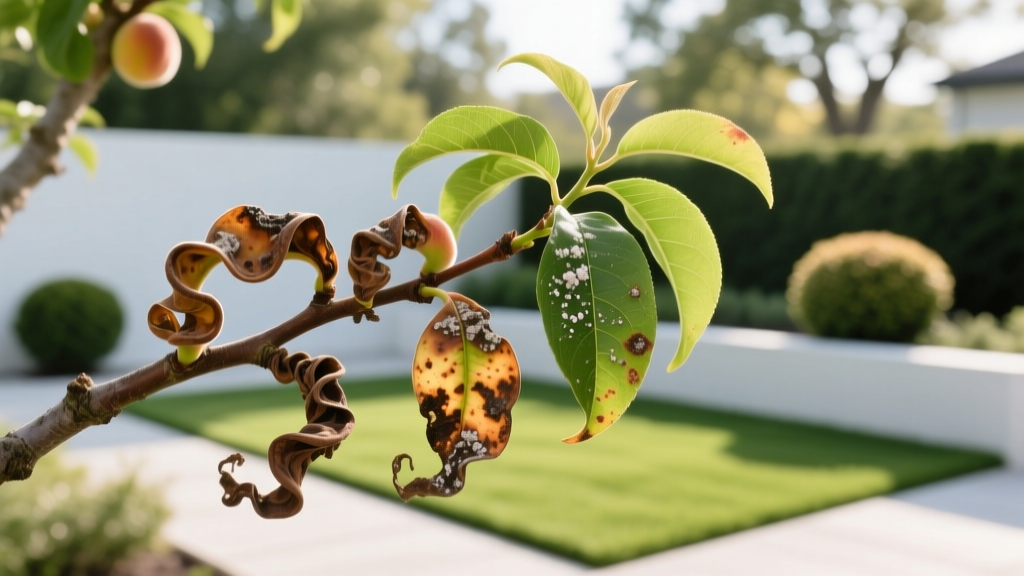
Peach Tree Fungicide Guide: Diagnose and Treat Leaf Curl & Brown Rot
The Diagnostic Matrix: Identifying the Fungal Culprit
Peach trees (Prunus persica) are notoriously vulnerable to fungal pathogens, particularly in regions with wet, cool springs. Selecting the correct peach tree fungicide requires precise identification of the disease. Applying a contact fungicide when a systemic treatment is required, or spraying after the infection window has closed, will result in total crop failure and wasted chemicals.
| Disease | Pathogen | Primary Symptoms | Optimal Fungicide Class |
|---|---|---|---|
| Peach Leaf Curl | Taphrina deformans | Red, blistered, thickened, and curled leaves in early spring; premature leaf drop. | Fixed Copper, Chlorothalonil |
| Brown Rot | Monilinia fructicola | Blossom blight, twig cankers, and mummified fruit covered in gray/brown powdery spores. | Myclobutanil, Captan, Thiophanate-methyl |
| Peach Scab | Venturia carpophila | Velvety olive-green to black spots on fruit and twigs; fruit cracking and stunting. | Captan, Myclobutanil, Sulfur |
Critical Diagnostic Rule: If you see the red, blistered leaves of Peach Leaf Curl in the spring, it is already too late to spray. The Taphrina deformans fungus infects the buds during winter and grows inside the leaf tissue as it expands. Fungicides for leaf curl are strictly preventative and must be applied during the dormant season.
Active Ingredients: What to Buy and What to Avoid
The market is saturated with generic sprays, but commercial-grade results require specific active ingredients. Below is a breakdown of the most effective compounds, their exact use cases, and current retail pricing.
1. Fixed Copper (Preventative Dormant Spray)
Copper disrupts fungal enzyme systems. It is the gold standard for Peach Leaf Curl and bacterial spot. However, not all copper is equal. You need 'fixed copper' (like copper octanoate or basic copper sulfate) which adheres to bark and resists rain wash-off better than copper sulfate alone.
- Top Product: Monterey Liqui-Cop (8% metallic copper equivalent) or Bonide Liquid Copper.
- Cost: $14 - $18 per 16 oz bottle.
- Mixing Rate: 1 to 4 tablespoons per gallon of water. Use the higher rate for dormant applications.
- Edge Case Warning: Copper can cause phytotoxicity (leaf burn and fruit russeting) if applied in slow-drying, cool, wet weather, or if mixed with acidic foliar fertilizers which increase the release of free copper ions.
2. Chlorothalonil (Broad-Spectrum Contact)
A multi-site contact fungicide that prevents spore germination. It is highly effective against leaf curl and scab but must be applied before bud break.
- Top Product: Ferti-lome Broad Spectrum Landscape and Garden Fungicide (29.6% Chlorothalonil).
- Cost: $18 - $22 per 16 oz concentrate.
- Mixing Rate: 3 to 4 teaspoons per gallon.
- Restriction: Do not apply chlorothalonil after petal fall. It can cause severe fruit russeting and is generally restricted during the fruit development stage on peaches.
3. Myclobutanil (Systemic Curative & Preventative)
A sterol inhibitor (SI) fungicide that penetrates plant tissue and stops fungal growth from the inside. This is your primary weapon against Brown Rot during the growing season.
- Top Product: Spectracide Immunox Multi-Purpose Fungicide (1.55% Myclobutanil).
- Cost: $12 - $15 per 14 oz concentrate.
- Mixing Rate: 1 to 2 tablespoons per gallon.
- Pre-Harvest Interval (PHI): 14 days. You must stop spraying at least 14 days before you intend to harvest the peaches.
The 4-Stage Peach Tree Fungicide Application Schedule
Timing is vastly more important than the volume of spray. Fungal spores require specific moisture and temperature thresholds to infect tissue. Follow this phenological schedule rather than a calendar schedule, as local weather dictates bud break.
Stage 1: Dormant Season (Late November – January)
Target: Peach Leaf Curl, Bacterial Spot, Scab overwintering spores.
Action: Apply a heavy drench of Fixed Copper or Chlorothalonil. The tree should be completely bare. Spray the trunk, all scaffolding branches, and the soil line where infected leaf litter harbors spores. Ensure the temperature is above 40°F (4°C) and no rain is forecast for 24 hours.
Stage 2: Swelling Bud / Pink Bud (February – Early March)
Target: Late-germinating Leaf Curl spores, early Brown Rot blossom blight.
Action: This is the most critical spray for Leaf Curl. As the leaf buds begin to swell and show a hint of pink tissue, apply a second round of Fixed Copper. If your area is highly prone to Brown Rot blossom blight, tank-mix with a low rate of Captan, but never mix copper with horticultural oils or sulfur.
Stage 3: Petal Fall (April)
Target: Brown Rot fruit infection, Peach Scab.
Action: Once 90% of the flower petals have dropped, the developing fruit is highly susceptible to Brown Rot. Switch to a systemic like Myclobutanil or a contact protectant like Captan. Do not use copper or chlorothalonil at this stage. Avoid spraying while bees are actively foraging on remaining blossoms; spray at dusk.
Stage 4: Fruit Development & Shuck Split (May – Pre-Harvest)
Target: Brown Rot, Scab, Rusty Spot (Powdery Mildew).
Action: Apply Captan or Myclobutanil every 10 to 14 days. If rainfall exceeds 1 inch, the protectant barrier is washed away, and you must reapply Captan once the foliage dries. Respect the 14-day PHI for Myclobutanil. For the final two sprays before harvest, switch to Captan (which has a 0 to 3-day PHI) to ensure chemical residues degrade before consumption.
Pro-Tip for Tank Mixing: Never mix Sulfur and Horticultural Oil within 30 days of each other. The chemical reaction produces sulfuric acid compounds that will defoliate a peach tree in 48 hours. Always read the label constraints on both products before combining.
Common Application Failures and Troubleshooting
Even experienced orchardists make application errors that compromise the entire season's crop. Review these failure modes to audit your own spray program.
Failure 1: Rain Wash-Off and Poor Adhesion
Fungicides require time to dry and bind to the plant cuticle. If it rains within 2 to 4 hours of applying Captan or Copper, the treatment is void. Solution: Add a non-ionic surfactant or a spreader-sticker (like Bonide Turbo Spreader Sticker) at a rate of 1/2 teaspoon per gallon. This reduces the surface tension of the water, allowing the fungicide to coat the waxy peach leaves evenly and resist light wash-off.
Failure 2: Ignoring the 'Green Tissue' Rule for Copper
Fixed copper is safe on dormant wood but highly phytotoxic to expanding green leaves. If your spring warms up unexpectedly and buds break early, spraying copper will burn the new foliage, stunting the tree's vigor for the entire year. Solution: Monitor local extension service alerts. If green tissue is visible, abandon copper and rely on cultural controls (removing infected leaves by hand) for leaf curl, accepting the cosmetic damage to save the tree's structural health.
Failure 3: Poor Canopy Penetration
Peach trees require an open-center (vase) pruning structure. If the canopy is dense, fungicide sprays will only coat the outer leaves, leaving the inner fruit vulnerable to Brown Rot. Solution: Prune heavily during winter dormancy to remove crossing branches. When spraying, use a pump sprayer with an adjustable nozzle set to a fine mist, and spray from the inside of the canopy outward, ensuring the trunk and inner scaffolds are coated.
Expert Resources and Further Reading
For localized spray schedules and resistance management guidelines, consult your regional agricultural extensions. Pathogens like Monilinia fructicola can develop resistance to single-site fungicides like Myclobutanil if used repeatedly without rotating modes of action.
- The UC Davis Integrated Pest Management program offers exhaustive, climate-specific phenology models for stone fruit diseases.
- The Clemson University Home & Garden Information Center provides detailed visual guides for distinguishing between bacterial and fungal peach infections.
- For post-harvest Brown Rot management, review the Penn State Extension guidelines on orchard sanitation and mummy removal.
Effective peach tree fungicide management is a year-round discipline. By accurately diagnosing the specific pathogen, selecting the correct chemical class, and adhering strictly to phenological timing, you can protect your orchard and secure a heavy, blemish-free harvest.