
Pest Control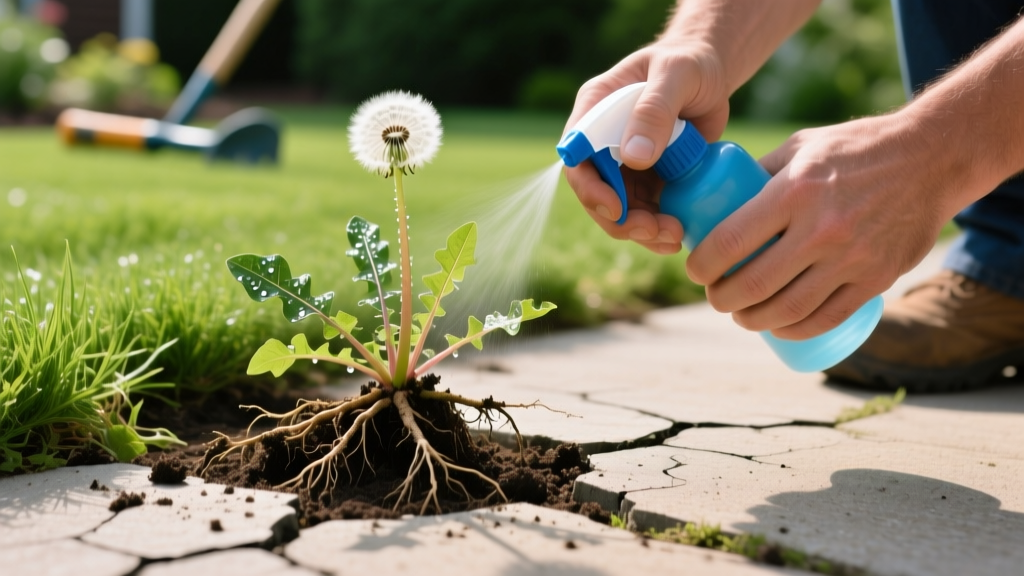
Permanent Weed Killer Guide: Spot-Treating Deep-Rooted Weeds
The Myth vs. Reality of Permanent Weed Killers
When homeowners search for a 'permanent weed killer,' they are usually reacting to the frustration of recurring infestations. In weed science, true permanence depends entirely on the environment you are treating. If you are treating a hardscape, gravel driveway, or patio crack, permanent eradication is achievable using soil sterilants that render the earth barren for up to 12 months. However, if you are spot-treating a lawn, 'permanent' is a misnomer; applying a soil sterilant to turfgrass will destroy your lawn's root system and leave bare dirt that invites worse invasive species.
For turfgrass, the goal of a spot-treatment is systemic root eradication. You must use selective, translocating herbicides that travel through the phloem down to the taproot or rhizomes, killing the specific weed permanently without harming the surrounding grass. As of 2026, modern formulations integrating fast-acting burn-down agents with slow-acting systemics offer the most reliable results for stubborn perennials.
Hardscapes and Gravel: True Soil Sterilants
For areas where no plant growth is desired—such as fence lines, driveway cracks, and gravel paths—you need a non-selective herbicide paired with a soil residual. The most effective active ingredient for this is Imazapyr, often combined with Prometon or Glyphosate.
CRITICAL WARNING: Root Zone Drift
Imazapyr is highly mobile in soil and can be absorbed by the roots of nearby desirable trees and shrubs. Never apply soil sterilants within the drip line (canopy edge) of oak, pine, or fruit trees. A single application near a mature tree's root zone can cause fatal chlorosis and death 12 to 18 months later.
Imazapyr is highly mobile in soil and can be absorbed by the roots of nearby desirable trees and shrubs. Never apply soil sterilants within the drip line (canopy edge) of oak, pine, or fruit trees. A single application near a mature tree's root zone can cause fatal chlorosis and death 12 to 18 months later.
Top Hardscape Sterilant Formulations
- GroundClear Vegetation Killer (Imazapyr + Glyphosate): Priced around $35 per gallon of concentrate. Provides visible burn-down in 24 hours and soil sterilization for up to 12 months. Mix rate: 2.5 oz per gallon of water.
- Pathfinder III (Triclopyr + Diesel base): Used primarily for woody brush and stump treatment in non-turf areas. Excellent for preventing resprouting from cut stumps in fence lines. Priced at $45 per gallon.
Turfgrass Spot-Treatments: Eradicating the Root System
In lawns, you cannot use sterilants. Instead, you must match the specific systemic active ingredient to the weed species' biology. Contact herbicides (like pelargonic acid or standard 2,4-D without additives) only burn the foliage; the weed will resprout from its rhizomes or taproot within three weeks.
1. Creeping Charlie (Ground Ivy)
Creeping Charlie spreads via aggressive stolons and is notoriously resistant to basic 2,4-D. The most effective permanent spot-treatment requires Triclopyr combined with Chelated Iron or Carfentrazone-ethyl. Products like SpeedZone Broadleaf Herbicide ($48/gallon) contain carfentrazone, which provides rapid visual necrosis, while the triclopyr translocates to the roots. According to the University of Minnesota Extension, applying triclopyr-based products in the fall when the weed is actively storing carbohydrates in its roots yields a 95% eradication rate, compared to just 40% in mid-summer.
2. Yellow Nutsedge (Nutgrass)
Nutsedge is not a grass or a broadleaf; it is a sedge that reproduces via underground tubers (nutlets). Standard lawn weed killers will not touch it. You must use Halosulfuron-methyl (e.g., SedgeHammer+, approx. $25 for a 5-pack of 13.5g water-soluble packets). Halosulfuron inhibits the ALS enzyme, stopping cell division in the tubers. It takes 14 to 21 days to see complete yellowing and death, but it permanently destroys the tuber chain.
3. Dandelion and Broadleaf Plantain
These taproot weeds require Quinclorac or a three-way ester formulation (2,4-D ester + MCPP + Dicamba). Esters penetrate the thick, waxy cuticle of mature plantain leaves far better than amine formulations. Apply at a rate of 1.5 oz per 1,000 sq ft.
Active Ingredient Spot-Treatment Matrix
| Target Weed | Active Ingredient | Time to Root Kill | Surfactant Required? |
|---|---|---|---|
| Creeping Charlie | Triclopyr + Carfentrazone | 14-21 Days | No (if ester-based) |
| Yellow Nutsedge | Halosulfuron-methyl | 21-28 Days | Yes (NIS at 0.25% v/v) |
| Dallisgrass | MSMA (Professional only) or Fluazifop | 10-14 Days | Yes (Crop Oil Concentrate) |
| Gravel/Driveway Weeds | Imazapyr + Glyphosate | 7-14 Days (12-mo barrier) | No |
The 4-Step Precision Application Protocol
The failure of most DIY spot-treatments is not the chemical, but the application technique. Follow this protocol to ensure the herbicide reaches the root system.
- Mow and Wait: Mow the lawn, then wait 48 hours. This allows the weeds to push out fresh, unblemished foliage that will readily absorb the chemical. Never spray immediately after mowing; the weed's natural healing response will seal off the cut stems, blocking translocation.
- Mix with a Non-Ionic Surfactant (NIS): Unless the label explicitly states otherwise, add a high-quality NIS (like DyneAmic or generic NIS, approx. $15/pint) at a rate of 0.25% v/v. This equals roughly 0.5 ounces of surfactant per gallon of mixed solution. The surfactant breaks the surface tension of the water, allowing the droplets to spread across the waxy leaf cuticle rather than beading up and rolling off.
- Use a Low-Pressure, Fine-Mist Nozzle: Adjust your pump sprayer to deliver a fine mist, not a heavy stream. You want the leaves to look 'glistening wet' but not dripping. Dripping means the chemical is hitting the soil, where it may be deactivated or harm grassroots.
- Monitor the Weather Window: Apply only when temperatures are between 65°F and 85°F. According to NC State Extension guidelines, applying systemic herbicides when temperatures exceed 90°F causes rapid volatilization. The chemical turns into a gas before it can translocate to the roots, resulting in severe turf burn and incomplete weed death.
Pro-Tip for Deep Taproots: For mature dandelions with taproots exceeding 6 inches, use a 'weed injection tool' or a standard syringe to inject 2ml of concentrated glyphosate directly into the crown of the plant. This bypasses foliage absorption entirely and guarantees 100% root necrosis within 48 hours without risking drift to surrounding grass.
Sealing the Area: The Pre-Emergent Follow-Up
Killing the existing weed is only half the battle. The decaying root system leaves a void in the soil profile, and the disturbance of the soil microbiome invites new seeds. To create a truly 'permanent' solution for your lawn's health, you must follow up your spot-treatment with a targeted pre-emergent.
For cool-season lawns, apply Prodiamine 65 WDG (approx. $80 for a 5lb bag) in early spring when soil temperatures hit 50°F. Prodiamine creates a chemical barrier in the top 1/2 inch of soil that inhibits cell division in germinating seeds. For warm-season lawns battling summer annuals like crabgrass, Dithiopyr (e.g., Dimension) is superior because it offers early post-emergent control of crabgrass up to the tillering stage, acting as both a pre-emergent and a spot-treatment safety net.
By combining systemic translocating herbicides for existing deep-rooted perennials with a strict pre-emergent schedule, you effectively close the life cycle of the weed, achieving the closest thing to permanent eradication possible in turfgrass management.

