
Pest Control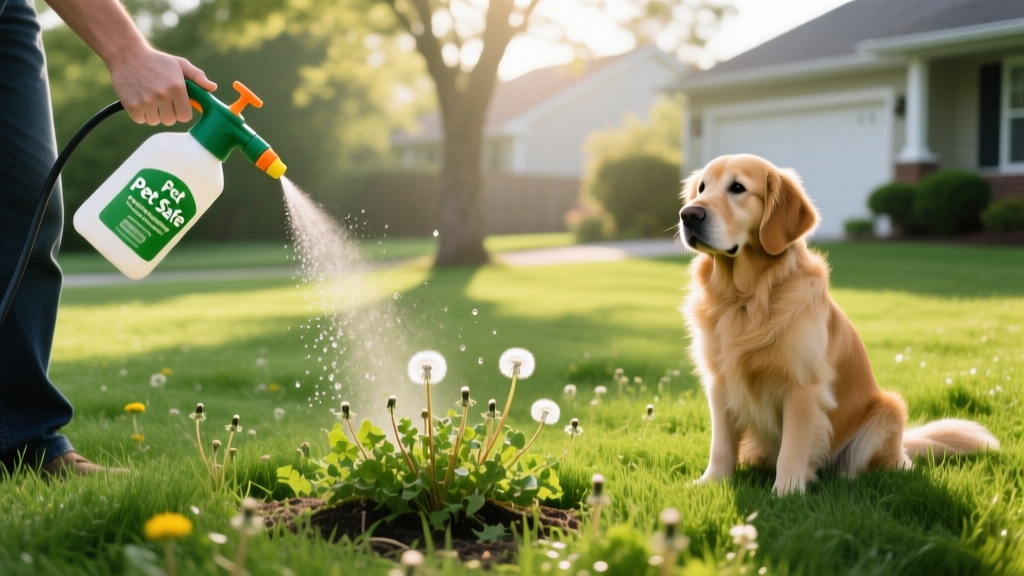
Spot-Treatment Guide: Finding a Lawn Weed Killer Safe for Pets
Homeowners managing broadleaf weeds face a critical dilemma when dogs and cats share the yard. Traditional synthetic herbicides containing 2,4-D, dicamba, or MCPP are highly effective at killing weeds, but they pose documented risks to pets ranging from paw pad irritation to long-term health complications. When you need to eliminate isolated dandelions, clover, or plantain without broadcasting toxic chemicals across your turf, finding a lawn weed killer safe for pets requires understanding active ingredient chemistry, precise spot-treatment mechanics, and strict re-entry timelines.
This guide bypasses generic "natural" advice and provides a technical framework for spot-treating specific weed species using pet-safe active ingredients, complete with exact mixing ratios, nozzle specifications, and real-world product costs for 2026.
The Toxicity Problem: Why Traditional Spot-Treatments Fail Pet Owners
The primary danger of conventional broadleaf herbicides is not just the initial application, but the residual transfer. According to the National Pesticide Information Center (NPIC), 2,4-D can remain on grass blades for days after application. Dogs and cats absorb these chemicals through their paw pads when walking on treated grass, and ingest them during normal grooming behaviors. Furthermore, tracking these residues indoors on paws contaminates carpets and floors where pets spend the majority of their time.
⚠️ Warning on "Weed and Feed" Products: Never use granular Weed and Feed products in households with pets. The fertilizer component attracts dogs, leading to direct ingestion of the herbicide-coated granules before they have a chance to water in and dissolve into the soil.
Active Ingredients Matrix: What is Actually Safe?
Not all "organic" or "natural" labels mean a product is safe for pets while wet. Horticultural vinegar, for example, is highly corrosive. Below is a technical comparison of the three primary pet-safe active ingredients used for spot-treatment.
| Active Ingredient | Mechanism of Action | Pet Safety Profile (Wet) | Pet Safety Profile (Dry) | Best Target Weeds |
|---|---|---|---|---|
| Iron HEDTA (FeHEDTA) | Systemic iron toxicity; overwhelms broadleaf cellular processes while grasses tolerate it. | Low toxicity; mild irritant. | Completely safe. | Dandelion, Plantain, Thistle |
| Acetic Acid (20-30%) | Contact desiccant; strips leaf cuticle causing rapid dehydration. | High Hazard: Causes severe eye/skin burns. | Safe (neutralizes in soil). | Young annuals, moss |
| Pelargonic Acid | Contact herbicide; disrupts cell membranes causing rapid tissue collapse. | Low toxicity; mild skin/eye irritant. | Completely safe. | Clover, Chickweed |
Source: Efficacy and toxicity data synthesized from NPIC Iron HEDTA Fact Sheet and EPA biopesticide registrations.
Weed Species Spot-Treatment Protocols
Spot-treating requires matching the active ingredient to the specific morphology of the weed. Broadcasting Iron HEDTA over the entire lawn is wasteful and expensive; precision targeting yields a 90%+ kill rate while preserving turf health.
1. Dandelions (Taraxacum officinale)
Dandelions possess a deep, brittle taproot that can regenerate if the crown is left intact. The Protocol: Use a 24% Iron HEDTA ready-to-use (RTU) formulation. Do not use vinegar; contact desiccants will only burn the top leaves, leaving the taproot to resprout in 14 days. Apply Iron HEDTA directly to the center rosette until the liquid pools slightly in the crown, allowing the systemic chemical to translocate down the taproot. Expect visible blackening of the leaves within 3 to 6 hours.
2. White Clover (Trifolium repens)
Clover spreads laterally via stolons (runners) that root at the nodes. The Protocol: Iron HEDTA is effective, but Pelargonic Acid offers a faster visual burn-down for young clover patches. Because clover leaves are waxy, add a non-ionic surfactant (like a drop of dish soap or a commercial silicone spreader) at a rate of 0.25 oz per gallon to break the surface tension. Spray the stolon nodes directly, not just the leaves, to prevent lateral regrowth.
3. Broadleaf Plantain (Plantago major)
Plantain features a dense, fibrous root system and a thick crown that sits flush with the soil surface, making it highly resistant to mowing. The Protocol: Use Iron HEDTA, but apply it in two distinct passes. The first application weakens the fibrous roots. Wait 14 days, then apply a second, lighter dose to the new, pale-green growth emerging from the crown. This two-pass method prevents the thick leaves from shedding the liquid before absorption occurs.
Step-by-Step Application Framework for Iron HEDTA
To maximize efficacy and minimize drift onto desirable ornamental plants, follow this exact application sequence:
- Calibrate the Sprayer: Use a 1-gallon or 2-gallon pump sprayer equipped with a flat fan nozzle (not a cone or jet nozzle). Set the pump pressure to exactly 20–30 PSI. Higher pressures atomize the droplets, creating drift that can damage nearby pet-safe garden beds.
- Check Environmental Conditions: Apply only when ambient temperatures are between 65°F and 80°F. Iron HEDTA efficacy drops significantly below 60°F because plant translocation slows down. Do not apply if rain is forecast within 12 hours.
- Mow First: Mow the lawn 24 hours before treatment. This removes excess grass blade competition and exposes the weed crowns for direct chemical contact.
- Execute the Spray: Hold the wand 12 to 18 inches above the weed. Spray just enough to wet the foliage uniformly. Do not spray to the point of runoff. Excess liquid dripping into the soil wastes the product and increases the drying time.
- Monitor the Burn: Susceptible broadleaves will show chlorosis (yellowing) and necrosis (browning/blackening) within 24 to 48 hours. Full plant death occurs in 14 to 21 days.
💡 Pro Tip for Turf Safety: Iron HEDTA can cause temporary, harmless darkening of the grass blades immediately surrounding the treated weed. This is a localized iron accumulation and will fade after the next mowing cycle. It is not chemical burn.
Real-World Costs and Product Recommendations (2026)
Pricing for pet-safe herbicides varies wildly based on concentration and packaging. Here is a breakdown of the most reliable commercial and consumer options currently on the market:
- Fiesta Turf Weeder (Commercial/Prosumer): The gold standard for Iron HEDTA. Sold primarily as a 2.5-gallon RTU jug.
Cost: ~$45.00 - $55.00.
Yield: Treats up to 10,000 sq. ft. of spot-weed coverage. Best for large properties with heavy broadleaf pressure. - Natria Lawn Weed Control (Consumer RTU): Readily available at big-box hardware stores. Contains Iron HEDTA. Comes with a trigger sprayer.
Cost: ~$16.00 - $19.00 per 32 oz bottle.
Yield: Ideal for urban lawns or isolated weed clusters. The included trigger sprayer lacks the precision of a pump wand, so use it only for large, isolated dandelions. - BioAdvanced Natria Weed & Grass Killer (Consumer RTU): Uses a blend of Pelargonic Acid and Maleic Hydrazide.
Cost: ~$22.00 per 1-gallon RTU.
Note: This is a non-selective contact killer. It will kill your turf grass if you overspray. Use only for weeds in driveway cracks or mulch beds, not for lawn spot-treatment.
Post-Treatment Lawn Recovery and Pet Re-entry Timelines
The most common question regarding pet-safe herbicides is: "When can my dog go back outside?"
According to Penn State Extension guidelines on alternative weed management, the critical metric for re-entry is not a specific number of hours, but the physical state of the foliage.
"Pets should be restricted from treated areas until the liquid application has completely dried on the leaf surface. Once dry, the active ingredient is locked into the plant tissue or bound to the soil matrix, eliminating the risk of paw-pad transfer."
Standard Re-Entry Timelines:
- Low Humidity / High Sun (Under 40% RH): 1.5 to 2 hours.
- Average Conditions (50-60% RH): 3 to 4 hours.
- High Humidity / Overcast (Over 75% RH): 5 to 6 hours.
If you must let your dog out before the drying window has closed, keep them on a leash and restrict them to hardscapes (patios, driveways) or untreated zones of the yard. Never allow pets to drink from puddles that may have formed from herbicide runoff immediately after application, regardless of the product's "safe" labeling.
By shifting from broadcast synthetic applications to precision Iron HEDTA spot-treatments, you maintain a dense, weed-free turf while entirely eliminating the toxicological risks associated with traditional lawn care chemicals.

