
Pest Control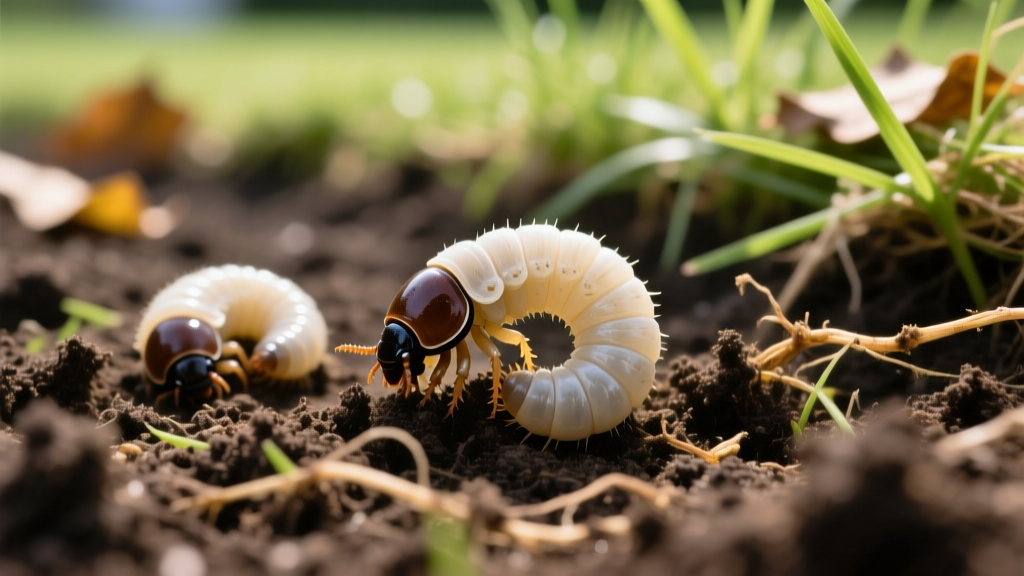
Pic of Grubs: Visual Identification and Treatment Guide
When you dig into your turf and find a white, C-shaped larva, your first instinct is likely to grab your phone and snap a picture. However, a generic pic of grubs rarely provides enough detail to determine whether you are looking at a harmless native species or a turf-destroying invader. Proper identification dictates everything from your damage threshold to the specific chemical or biological control you should deploy.
White grubs are the larval stage of scarab beetles. While they all share a similar morphology—plump, cream-colored bodies with six legs near the head and a brown head capsule—their feeding habits, reproductive cycles, and susceptibility to insecticides vary wildly. This guide breaks down how to analyze your grub photos, identify the species using microscopic markers, and execute targeted treatments based on current 2026 integrated pest management (IPM) standards.
Decoding Your Pic of Grubs: The Raster Pattern
The most critical error homeowners make when photographing grubs is only capturing the dorsal (top) side. To accurately identify the species, your pic of grubs must show the ventral (underside) surface of the last abdominal segment. This area contains the raster pattern—a specific arrangement of tiny hairs, spines, and bare patches that acts as a biological fingerprint.
According to University of Kentucky Entomology, the raster pattern is the only definitive visual metric for separating the four most destructive turfgrass grubs in North America without DNA testing. When examining your photo, zoom in on the underside of the grub's tail end and look for these distinct formations:
- V-Shaped Raster: Two distinct rows of spines converging toward the rear. This is the hallmark of the Japanese Beetle (Popillia japonica).
- Y-Shaped or Zipper Raster: A continuous medial row of spines flanked by parallel, slightly diverging rows. This indicates the European Chafer (Rhizotrogus majalis).
- Parallel Rows: Two distinct, widely spaced parallel rows of spines running down the center. This points to the June Bug or May/June Beetle (Phyllophaga spp.).
- Transverse Row: A short, horizontal row of spines just above the anal slit, with a bare patch below. This identifies the Oriental Beetle (Exomala orientalis).
Pro-Tip for Macro Photography: To capture a clear raster pattern, place the grub on a piece of white printer paper. Use your smartphone's macro lens or a clip-on 15x macro attachment. Ensure your flash is diffused (cover it with a thin tissue) to prevent glare on the grub's moist cuticle, which washes out the fine spine details.
Species Identification and Damage Matrix
Once you have deciphered the raster pattern in your pic of grubs, cross-reference it with the behavioral matrix below. Not all grubs require immediate eradication; the decision to treat depends on the species' destructive capacity and your turf type.
| Species | Raster Pattern | Life Cycle | Damage Threshold | Primary Threat |
|---|---|---|---|---|
| Japanese Beetle | V-Shape | 1 Year | 10-12 per sq. ft. | Root pruning in late summer |
| European Chafer | Y-Shape / Zipper | 1 Year | 5-7 per sq. ft. | Severe winter root destruction |
| June Bug | Parallel Rows | 2-3 Years | 3-5 per sq. ft. | Deep root feeding over multiple years |
| Oriental Beetle | Transverse Row | 1 Year | 8-10 per sq. ft. | Localized patchy turf die-off |
Note that the European Chafer has a significantly lower damage threshold. Because they are physically larger and continue feeding deeper into the soil profile later in the autumn than Japanese beetles, a smaller population can cause catastrophic turf loss. Penn State Extension emphasizes that misidentifying a European Chafer infestation as a Japanese Beetle population often leads to under-treatment and subsequent lawn failure.
Assessing the Threat: The Square-Foot Peel Test
A single pic of grubs in your hand does not indicate an infestation. Grubs are a natural part of the soil food web, and a healthy lawn can easily outgrow the root-feeding of a few larvae. To determine if your lawn requires intervention, you must quantify the population density.
- Select Test Sites: Choose three to five areas in your lawn where the grass is thinning, spongy, or showing drought-stress symptoms despite adequate irrigation.
- Cut the Turf: Using a flat spade or a specialized sod cutter, cut a 12-inch by 12-inch square (exactly 1 square foot) into the soil to a depth of 3 inches.
- Peel and Inspect: Roll back the turf like a carpet. Examine the exposed soil and the root zone on the underside of the grass.
- Count and Record: Count every white grub in that square foot. Repeat this across all test sites and calculate the average.
Warning: Secondary Pest Damage
Often, the grubs themselves do not cause the most visible damage. If your pic of grubs was taken in an area where the lawn looks like it has been tilled by a rototiller, you are likely dealing with secondary foraging damage. Skunks, raccoons, armadillos, and crows will tear through the root zone to feed on grubs. If you observe animal digging, treat the grubs immediately to remove the food source, and use heavy-duty bird netting or motion-activated sprinklers to deter mammals while the turf recovers.
Often, the grubs themselves do not cause the most visible damage. If your pic of grubs was taken in an area where the lawn looks like it has been tilled by a rototiller, you are likely dealing with secondary foraging damage. Skunks, raccoons, armadillos, and crows will tear through the root zone to feed on grubs. If you observe animal digging, treat the grubs immediately to remove the food source, and use heavy-duty bird netting or motion-activated sprinklers to deter mammals while the turf recovers.
2026 Treatment Protocols: Preventative vs. Curative
Once your square-foot peel confirms that grub populations exceed the species-specific thresholds outlined in the matrix above, you must select a treatment strategy. Timing is the single most critical variable in grub control; applying the wrong chemistry at the wrong time of year is a waste of capital and an unnecessary environmental risk.
Preventative Chemistry (Spring to Early Summer)
Preventative treatments target newly hatched, first-instar grubs in mid-to-late summer before they can cause significant root damage. These chemicals have long soil residual activity but are largely ineffective against large, mature grubs.
- Chlorantraniliprole (e.g., Syngenta Acelepryn): The current gold standard for preventative control. It acts on the ryanodine receptors in the insect's muscles. It is highly effective against all four major species and has an excellent environmental profile, posing minimal risk to pollinators when watered into the soil. Application Window: April through May. Cost: Approximately $140 for a 100 lb bag of granular (0.08% AI), covering roughly 10,000 sq. ft.
- Imidacloprid (e.g., Bayer Advanced Grub Control): A neonicotinoid that provides reliable control of Japanese beetles and European chafers but can struggle with larger June bug larvae. Application Window: June through mid-July. Cost: Approximately $45 for a 30 lb bag covering 15,000 sq. ft. Crucial Step: You must mow the lawn to remove any blooming clover or dandelions before application to prevent foraging bees from contacting the active ingredient.
Curative Chemistry (Late Summer to Early Autumn)
If you missed the preventative window and your late-summer pic of grubs reveals large, third-instar larvae actively severing roots, you need a fast-acting curative insecticide. Curative products have short soil half-lives and break down rapidly, meaning they will not protect your lawn the following spring.
- Trichlorfon (e.g., Dylox 6.2): An organophosphate that paralyzes the grub's nervous system within 24 to 48 hours of ingestion or contact. It is the only reliable chemical option for killing mature grubs in September. Application Window: August through September. Cost: Approximately $25 for a 10 lb bag covering 5,000 sq. ft. Limitation: Trichlorfon degrades rapidly in soils with a high pH (above 7.2). If your soil is alkaline, increase the application rate by 20% or switch to a biological control.
Biological and Organic Controls
For homeowners adhering to strict organic lawn care standards, biological controls offer highly effective, albeit slower, population suppression.
- Beneficial Nematodes (Heterorhabditis bacteriophora): These microscopic worms actively hunt grubs in the soil, entering their bodies and releasing symbiotic bacteria that kill the host within 48 hours. Application Protocol: Must be applied in the late afternoon or evening to avoid UV degradation. Soil temperature must be above 60°F, and the area must be irrigated with at least 0.25 inches of water immediately after application to wash the nematodes off the grass blades and into the soil profile. Cost: ~$45 for a sponge formulation containing 10 million nematodes (covers 2,000 sq. ft.).
- Milky Spore (Paenibacillus popilliae): A bacterial disease specific only to Japanese Beetle grubs. It is applied in a grid pattern across the lawn and takes 2 to 3 years to build up sufficient spore density in the soil to provide control. Once established, it can persist for 10 to 15 years. It is useless against European chafers and June bugs.
Submitting Your Pic to Diagnostic Labs
If your macro photography fails to clearly reveal the raster pattern, or if you suspect you are dealing with an invasive species like the Asiatic Garden Beetle, do not guess. Most state university cooperative extension services offer free or low-cost digital diagnostic services.
When submitting your pic of grubs to an entomology lab via email or their digital portal, include three specific angles:
- A dorsal (top-down) shot with a standard reference object (like a dime) next to the grub to establish scale.
- A ventral (bottom-up) shot focused entirely on the last abdominal segment for raster analysis.
- A lateral (side profile) shot showing the overall C-shape and the relative length of the legs compared to the body.
Accurate identification from a clear picture prevents the misuse of broad-spectrum insecticides, protects local pollinator populations, and ensures your lawn care budget is spent on chemistry that actually targets the pest in your soil.

