
Pest Control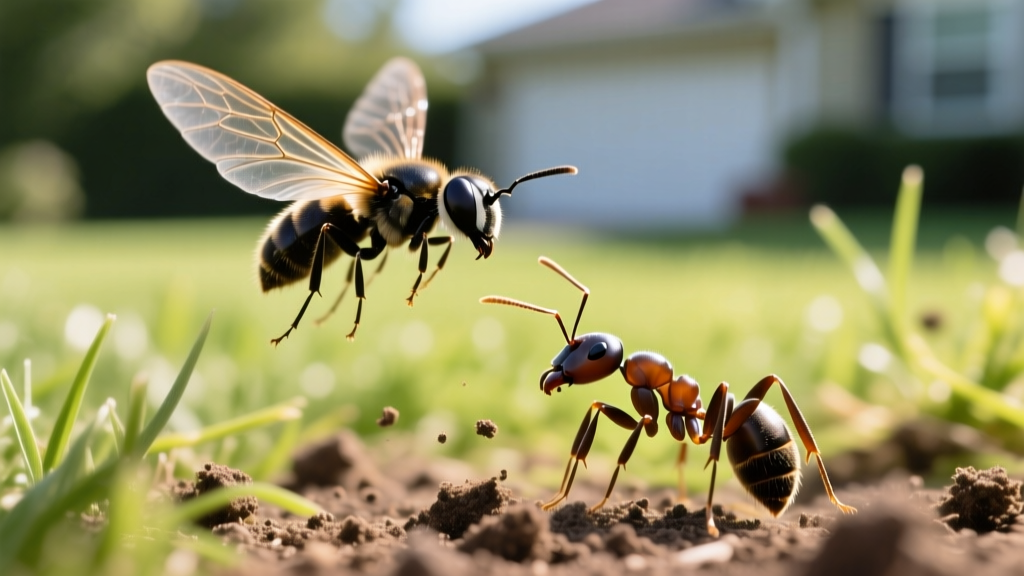
Picture of Flying Termite vs Ant: Identification & Yard Defense
When a sudden cloud of winged insects erupts from your mulch beds or crawls out from behind your baseboards, the immediate reaction is to snap a photo and search for a picture of flying termite to confirm your worst fears. Misidentification is incredibly common, as reproductive termites (alates) share the spring and summer skies with carpenter ants. However, confusing the two can lead to disastrous financial consequences; while carpenter ants excavate existing moist wood, subterranean termites consume structurally sound timber, causing over $5 billion in property damage annually in the United States.
This guide provides a definitive framework for analyzing your picture of a flying termite, understanding the biological implications of a swarm, and executing a precise, professional-grade yard defense protocol to protect your property's perimeter.
The Anatomy of a Swarm: Decoding Your Insect Photo
Before purchasing termiticides, you must confirm the species. Termites belong to the order Blattodea (specifically the former order Isoptera, meaning 'equal wings'), while ants belong to Hymenoptera. When examining a picture of a flying termite side-by-side with a carpenter ant, focus strictly on three morphological landmarks: the waist, the antennae, and the wing venation.
| Morphological Feature | Flying Termite (Alate) | Flying Carpenter Ant |
|---|---|---|
| Waist (Thorax-Abdomen) | Broad and uniform; no constriction between thorax and abdomen. | Pinched, narrow petiole (distinct hourglass shape). |
| Antennae | Straight and moniliform (bead-like). | Elbowed (geniculate) with a distinct bend. |
| Wings | Two pairs of equal-length, translucent, milky-white wings. | Two pairs; front wings are longer and darker than hind wings. |
| Body Color | Typically dark brown to black, but the body is often obscured by wings. | Black, red, or multi-colored with a visible, distinct abdomen. |
⚠️ The 'Shed Wing' Indicator: Termites are fragile flyers. Shortly after their nuptial flight, they deliberately shed their wings to burrow into the soil. If your picture of a flying termite was taken indoors, look at the windowsills. A pile of identical, translucent wings is a definitive hallmark of a termite swarm, as ants rarely shed wings in mass piles inside the home.
Biological Context: Why Alates Mean Your Yard is at Risk
Seeing a picture of a flying termite swarm indicates that a mature colony is actively reproducing in your immediate vicinity. Subterranean termite colonies typically require three to five years to produce alates. A single mature colony can release hundreds of thousands of swarmers in a single season, usually triggered by a combination of soil temperatures reaching 70°F (21°C) and a drop in barometric pressure following a heavy spring rain.
According to University of Kentucky Entomology, the vast majority of these alates will die from desiccation or predation within hours. However, the presence of the swarm confirms that an established, wood-destroying worker caste is already foraging in your soil, likely feeding on your fence posts, deck supports, or the sill plate of your home's foundation.
Step-by-Step Yard Defense Protocol
Once you have verified the insect via a picture of a flying termite, immediate perimeter defense is required. Over-the-counter 'bug sprays' are entirely ineffective against subterranean colonies, which can number in the millions and forage up to 300 feet from the nest. You must create a continuous, non-repellent chemical barrier or deploy a targeted bait matrix.
Phase 1: Liquid Trenching (The Taurus SC Method)
For immediate, long-lasting perimeter defense, a non-repellent termiticide like Taurus SC (9.1% Fipronil) is the industry standard. Because it is non-repellent, termites cannot detect it, allowing them to tunnel through the treated soil, pick up a lethal dose, and transfer it to the colony via trophallaxis (grooming and food sharing).
- Calculate Linear Footage: Measure the exact perimeter of your foundation. A standard 2,000 sq. ft. home typically has 160 to 200 linear feet of exterior foundation.
- Dig the Trench: Using a trenching shovel, dig a continuous trench 6 inches wide and 6 inches deep directly against the foundation wall. Pro Tip: Do not trench under concrete slabs like patios; those require sub-slab rodding, which is best left to professionals.
- Mix the Solution: The dilution rate for a 0.06% active ingredient barrier is 0.8 fluid ounces of Taurus SC per gallon of water. You must apply 4 gallons of finished solution per 10 linear feet of trench.
- Backfill and Treat: Pour the solution into the trench. As you backfill the soil, treat every few inches of soil to ensure a continuous vertical chemical wall.
Cost Breakdown: A 20 oz. bottle of Taurus SC costs approximately $130 and yields enough chemical to treat 60 linear feet at the 0.06% rate. For a 200-linear-foot home, expect to spend roughly $450 on chemical and $40 on a 4-gallon pump sprayer and trenching tools.
Phase 2: Bait Station Deployment (For Sensitive Landscaping)
If your yard features extensive hardscaping, koi ponds, or edible garden beds adjacent to the foundation where trenching is impossible, deploy an in-ground bait system like the Advance Termite Bait System.
- Placement: Install bait stations every 10 linear feet around the perimeter, no more than 2 feet from the foundation edge.
- Inspection Matrix: The stations contain a wood monitoring base. Inspect these monthly. Once termite feeding is confirmed, replace the monitoring wood with a 0.25% Diflubenzuron bait cartridge.
- Mechanism: Diflubenzuron is a chitin synthesis inhibitor. When worker termites molt, they die, eventually collapsing the colony's population structure.
When to Call a Professional: Cost vs. DIY Thresholds
While DIY liquid trenching is highly effective for exterior perimeter defense, certain architectural features render DIY treatments incomplete. The EPA guidelines on termite control emphasize that structural protection requires treating both the exterior and interior soil contact points.
Decision Matrix: DIY vs. Professional Remediation
Choose DIY ($150 - $400 total) if:
- The swarm originated from an exterior mulch bed or detached fence post.
- Your home sits on a monolithic concrete slab with no interior plumbing penetrations.
- You are treating a detached shed, detached garage, or landscaping timbers.
Hire a Licensed Professional ($1,200 - $2,500+) if:
- The swarm emerged from inside your home (baseboards, interior drywall, or bathtub drains).
- Your home has a crawlspace with interior support piers that require drilling and sub-slab injection.
- You have a well, cistern, or municipal water line within 5 feet of the foundation trenching zone.
Frequently Asked Questions
Does seeing one picture of a flying termite mean my house is being eaten?
Not necessarily. Alates are strong fliers and can be blown in from a neighboring property or a decaying stump in the woods up to a half-mile away. However, if the swarm is emerging directly from the soil touching your foundation, or from wood inside your structure, active infestation is highly probable.
Can I use Bora-Care on my exterior fencing to stop them?
Yes, but only on raw, unpainted, unsealed wood. Bora-Care (a disodium octaborate tetrahydrate solution) penetrates deeply into cellulose and remains toxic to termites permanently. A single gallon of Bora-Care, mixed 1:1 with water and glycol, costs around $110 and treats roughly 800 square feet of wood surface. It is an excellent preventative for cedar fencing and deck joists.
Are 'bug zappers' effective against termite swarms?
No. The National Pest Management Association notes that UV light traps are largely ineffective against termites. Alates are not strongly phototactic (attracted to light) in the same way moths or beetles are; they are driven by pheromones and mating instincts. Relying on zappers will leave the surviving mated pairs to burrow into your yard.
Accurately identifying the insect in your picture of a flying termite is the critical first step in yard defense. By combining rigorous morphological identification with targeted, non-repellent soil treatments, homeowners can effectively sever the foraging pathways of subterranean colonies and protect their property's structural integrity for decades.

