
Pest Control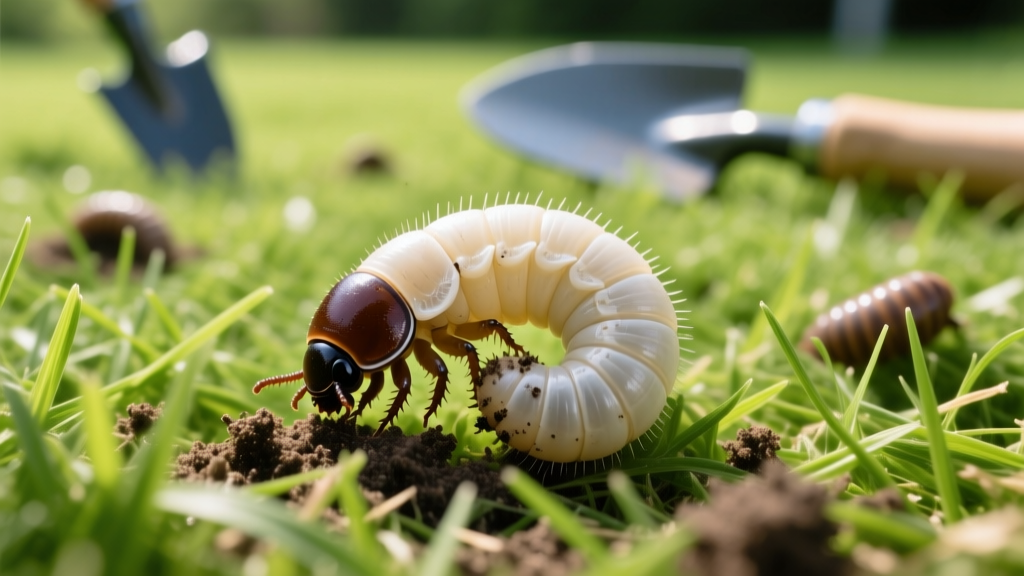
Pictures of Grubs: Identify and Eliminate Lawn-Damaging Larvae
The Visual Identification Matrix: Decoding Pictures of Grubs
When homeowners search for pictures of grubs, they usually see a generic, fat, white, C-shaped larva. However, treating your lawn effectively requires knowing exactly which scarab beetle larva is eating your turfgrass roots. Different species have varying life cycles, damage thresholds, and chemical susceptibilities. While pictures of grubs can show size and color, true identification relies on examining the raster pattern—the microscopic arrangement of tiny hairs and spines on the grub's tail segment (the anal slit area).
Use a 10x jeweler's loupe to inspect the raster. Here is how the three most destructive North American lawn grubs compare:
| Species | Raster Pattern (Tail) | Size at Maturity | Damage Threshold (per sq. ft.) | Peak Feeding Window |
|---|---|---|---|---|
| Japanese Beetle (Popillia japonica) |
V-Shaped: Two distinct rows of spines forming a 'V' pointing toward the head. | ~1.25 inches | 8 - 10 grubs | Mid-August to October |
| European Chafer (Rhizotrogus majalis) |
Y-Shaped (Zipper): Two parallel rows of spines that split into a 'Y' near the anal slit. | ~1.0 inch | 5 - 7 grubs | September to November (and early spring) |
| June Beetle (Phyllophaga spp.) |
P-Shaped (No Pattern): Scattered, random spines with no distinct geometric shape. | ~1.5 to 2.0 inches | 3 - 5 grubs | Multi-year cycle; peaks in late summer |
💡 Pro Identification Tip: When comparing your live specimens to pictures of grubs online, look at the head capsule. Japanese beetle grubs have a distinct dark brown, almost black head capsule, while European chafers have a lighter, reddish-brown head. June beetles are noticeably larger and thicker than both.
Decoding the Damage: Is It Grubs or Environmental Stress?
Grub damage is frequently misdiagnosed as drought stress, dollar spot fungus, or dog urine burn. Because grubs sever the roots just below the thatch layer, the grass loses its ability to uptake water. However, unlike drought stress, grub-damaged turf will not respond to deep irrigation.
The Secondary Symptom: Animal Excavation
Often, the first visual cue isn't the dead grass, but the aftermath of foraging wildlife. Skunks, raccoons, and crows will tear up your lawn like loose carpet to get to the protein-rich larvae. If you see 2-to-3-inch deep, cone-shaped holes (skunks) or large, flipped-over chunks of sod (raccoons), you have an active, mature grub infestation. According to Penn State Extension, animal digging is most prevalent in late September and October when grubs are fully grown and closest to the surface.
The 'Tug Test' and Soil Sampling Protocol
Before purchasing any chemicals, you must quantify the infestation. Do not guess based on a few brown patches. Follow this exact sampling protocol to determine if your lawn has crossed the economic damage threshold.
- Timing: Sample in late August or early September when larvae are in the second and third instar stages and feeding heavily near the surface.
- The Tug Test: Grab a handful of brown, damaged grass and pull straight up. If the turf rolls back like a loose carpet with no soil attached to the roots, grubs have severed the root system.
- The 1-Square-Foot Cut: Using a flat-head spade, cut three sides of a 12x12-inch square, about 3 inches deep. Leave the fourth side attached as a hinge.
- Peel and Count: Fold the sod back. Sift through the top 2 inches of soil. Count every C-shaped white larva.
- Calculate Density: Repeat this in 3 to 5 areas across the lawn (especially near driveways and sidewalks where soil is warmer). Average the count. If you exceed the thresholds listed in the matrix above, treatment is required.
Targeted Treatment Arsenal: Preventative vs. Curative
Treating grubs requires matching the active ingredient to the grub's life stage. Applying a preventative insecticide in October will fail, just as applying a fast-acting curative in May will degrade before the eggs hatch.
Preventative Controls (Apply May 15 – July 15)
Preventatives target newly hatched, first-instar grubs. They require time to move into the soil profile and have a long residual life.
- Chlorantraniliprole (e.g., Scotts GrubEx1, Acelepryn): The gold standard for modern turf management. It is highly effective against all scarab larvae and is remarkably safe for pollinators and earthworms. Cost: ~$35 for 10,000 sq. ft.
- Imidacloprid (e.g., Bayer Advanced Season Long Grub Control): An older neonicotinoid. Effective, but carries higher risks for non-target pollinators if applied to flowering weeds like clover or dandelions. Cost: ~$28 for 10,000 sq. ft.
Curative Controls (Apply Mid-August – October)
Curatives are contact poisons designed to knock down large, actively feeding third-instar grubs that are actively destroying roots.
- Trichlorfon (e.g., Bayer Advanced 24 Hour Grub Killer / Dylox): Works within 24 to 48 hours. It degrades rapidly in high-pH soils (above 7.2), meaning it won't linger to harm spring ecosystems, but it also won't provide season-long control. Cost: ~$45 for 5,000 sq. ft.
⚠️ Ecological & Safety Warning: Trichlorfon is highly toxic to aquatic invertebrates and earthworms. Never apply Dylox near storm drains, bodies of water, or on saturated soil where runoff is imminent. Always sweep stray granules off driveways and back onto the lawn before watering.
Biological Controls: Beneficial Nematodes
For organic lawn care, Heterorhabditis bacteriophora (Hb) nematodes are microscopic worms that seek out grubs, enter their bodies, and release fatal bacteria.
- Application Rules: Hb nematodes are living organisms. They must be applied when soil temperatures are between 60°F and 85°F. They are highly sensitive to UV light, so apply them at dusk or on a heavily overcast day.
- Hydration: The soil must be moist before application and kept moist for 7 days after. Water in immediately with at least 0.25 inches of irrigation.
- Cost: ~$45 for a pouch containing 10 million nematodes (covers ~3,000 sq. ft.).
Research from University of Kentucky Entomology confirms that when applied correctly during the late summer window, Hb nematodes can achieve 80% to 90% grub mortality, rivaling synthetic curatives.
Calibration and Watering: The Make-or-Break Step
The most common reason grub treatments fail is improper watering. Granular insecticides sit in the thatch layer and degrade in the sun if they are not washed down to the soil-root interface where the grubs are feeding.
Spreader Settings & Irrigation Requirements
- For Chlorantraniliprole (GrubEx1): Use a rotary spreader (e.g., Scotts EdgeGuard Mini set to Setting 6). After application, you must apply 0.5 inches of water immediately. Use empty tuna cans placed around the lawn to measure when you've hit the 0.5-inch mark.
- For Trichlorfon (Dylox): Requires a slightly lighter watering to activate—about 0.25 inches—because it is highly water-soluble and you want to avoid pushing it entirely past the root zone in sandy soils.
Frequently Asked Questions
Do milky spore disease treatments work for all grubs?
No. Paenibacillus popilliae (Milky Spore) is a biological bacterium that only affects Japanese beetle grubs. It will not control European chafers or June bugs. Furthermore, it takes 2 to 4 years to build up in the soil to effective levels, making it a poor choice for an active, severe infestation.
Will winter freeze kill the grubs in my lawn?
Do not rely on winter weather for pest control. European chafer and Japanese beetle grubs overwinter by migrating 4 to 8 inches below the frost line. They enter a state of diapause and will resume feeding on your turf roots as soon as the soil thaws in early April.
How do I repair the lawn after the grubs are dead?
Once the curative treatment has taken effect (wait 14 days), rake out the dead, detached grass. Aerate the compacted soil, apply a starter fertilizer (high in phosphorus, like a 10-18-10 NPK), and overseed with a resistant turfgrass blend. For high-grub-pressure areas, consider planting Epichloë endophyte-enhanced perennial ryegrass or tall fescue, which naturally deter surface-feeding insects and recover faster from root pruning.

