
Pest Control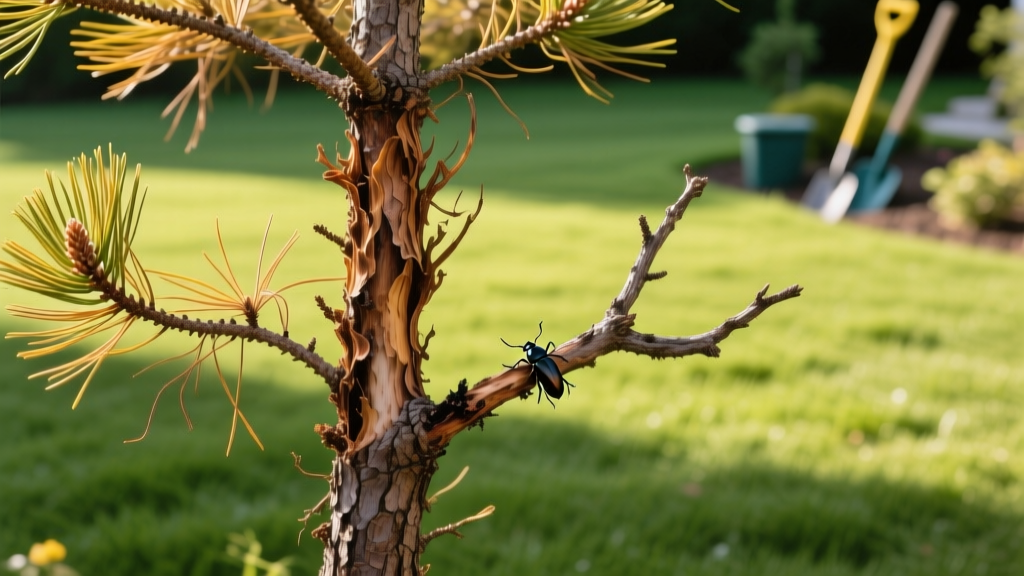
Diagnosing Pine Wilt Disease: Symptoms and Rescue Fixes
The Brutal Reality of Pine Wilt Pathology
Pine wilt disease is not a fungal infection you can spray away, nor is it a nutrient deficiency you can fertilize. It is a lethal vascular blockage caused by the pinewood nematode (Bursaphelenchus xylophilus), a microscopic worm vectored by the pine sawyer beetle (Monochamus spp.). When the beetle feeds on young shoots, nematodes enter the tree's resin canals, multiply by the hundreds of thousands, and migrate to the xylem. The tree responds by producing traumatic resin and tyloses to wall off the invaders, effectively choking its own water transport system.
The most critical E-E-A-T reality check for property managers and homeowners in 2026: there is no chemical cure for a symptomatic, infected pine tree. Once the canopy shows systemic chlorosis (fading) and resin flow ceases, the tree is dead, even if the needles remain attached for months. Therefore, 'rescue fixes' in pine wilt management strictly refer to two actions: preventative chemical rescue for high-value asymptomatic trees, and rapid sanitation rescue to protect the surrounding canopy from beetle transmission.
⚠️ CRITICAL WARNING: Do not waste money on systemic fungicides like propiconazole or thiophanate-methyl for pine wilt. While these treat fungal pathogens like Diplodia tip blight or Dothistroma needle blight, they have zero efficacy against nematodes. Misdiagnosis and incorrect chemical application is the most common financial mistake in pine management.
Symptom Matrix: Pine Wilt vs. Environmental Stress
Drought stress, root rot, and bark beetle attacks mimic early pine wilt symptoms. Misidentifying the stressor leads to fatal delays in sanitation. Use this differential diagnosis matrix to isolate pine wilt disease in the field.
| Symptom Indicator | Pine Wilt Disease | Severe Drought Stress | Southern Pine Beetle |
|---|---|---|---|
| Needle Coloration | Rapid fade from grey-green to yellow, then brown. Entire canopy browns uniformly. | Needles turn brown starting at the tips. Older inner needles drop first. | Fading starts in patches; needles turn reddish-brown while bark shows pitch tubes. |
| Resin Exudation | Zero to minimal resin flow when trunk is wounded. | Sluggish but present resin flow when wounded. | Heavy, white 'pitch tubes' visible on the outer bark. |
| Wood Core Appearance | Blue-stain fungus (Ophiostoma) visible in xylem; wood feels unusually dry. | Wood is pale, no blue staining, normal moisture content. | S-shaped galleries under bark; sawdust (frass) at the base. |
| Progression Speed | Lethal. Complete canopy fade in 3 to 8 weeks during summer. | Slow decline over months; recovers if deep watered. | Tree death in 2 to 4 months; mass attacks on neighboring trees. |
The 48-Hour Field Diagnostic Protocol
If you suspect pine wilt, you must confirm it before mobilizing expensive removal crews. Follow this sequence to verify nematode presence without waiting weeks for a lab culture.
Step 1: The Resin Exudation Test
Using a 1/2-inch spade bit on a cordless drill, bore a hole 1.5 inches deep into the lower trunk (about 3 feet above grade). Remove the drill bit and wait 60 seconds. A healthy pine will immediately well up with sticky, amber resin. A tree in the advanced stages of pine wilt will produce a dry hole or a few watery, non-sticky drops. This happens because the xylem and resin canals are entirely blocked by nematodes and tyloses.
Step 2: Blue-Stain Fungus Verification
Extract a wood core using an increment borer or examine the wood shavings from your drill bit. Look for a distinct blue or grey-black streaking in the sapwood. The pinewood nematode has a symbiotic relationship with Ophiostoma blue-stain fungi. While blue-stain can occasionally occur from other injuries, its combination with a dry drill hole and fading canopy is a 95% positive field indicator for pine wilt.
Step 3: Laboratory Nematode Extraction
For absolute legal and municipal confirmation (often required for quarantine compliance), cut a 2-inch thick disc from a recently dead, symptomatic branch. Keep the sample cool and ship it overnight to a state university plant diagnostic clinic. Lab technicians will use the Baermann funnel technique to extract and count live nematodes under a microscope. According to the USDA APHIS pinewood nematode guidelines, finding the specific morphology of B. xylophilus confirms the diagnosis and triggers local sanitation mandates.
Rescue Fix 1: Preventative Macro-Infusion (Saving Asymptomatic Trees)
You cannot cure a dying tree, but you can chemically fortify high-value, asymptomatic pines (like mature Japanese Black Pines or heritage Scots Pines) against beetle transmission. The industry standard in 2026 is trunk injection of emamectin benzoate (e.g., Arborjet's TREE-äge G4) or abamectin (e.g., ReVive).
💡 COST & DOSING DATA: Preventative injection pricing averages $18 to $25 per inch of Diameter at Breast Height (DBH) when hired out to a certified arborist. A 20-inch DBH Scots Pine will cost roughly $400 to $500 per treatment. Emamectin benzoate provides up to 3 years of residual protection, whereas abamectin requires annual or bi-annual reapplication.
Application Timing: Injections must be performed in early spring (post-bud break, before summer beetle flight) or early fall. Injecting during peak summer drought causes severe phytotoxicity because the tree cannot translocate the chemical through water-stressed xylem. Use the Arborjet QUIK-jet Air or TREE I.V. systems to drill 4 to 8 ports around the root flare, delivering the nematicide directly into the sapwood.
Rescue Fix 2: Sanitation Felling (Saving the Surrounding Stand)
When a tree is confirmed infected, it becomes a breeding ground for pine sawyer beetles. The beetles will pupate under the bark and emerge in late spring, carrying millions of nematodes to your remaining healthy trees. The 'rescue' here is the immediate, meticulous removal of the infected biomass.
- Felling Height: Cut the tree as close to ground level as possible. Do not leave stumps higher than 2 inches, as beetles can breed in the remaining root collar.
- Chipping Specifications: All branches and trunk wood must be fed through a commercial drum chipper calibrated to produce chips no larger than 1 inch in any dimension. This physically destroys the beetle pupal chambers.
- Wood Disposal: Do not stack infected pine logs for firewood. The nematodes and beetles can survive in stacked logs for over a year. If chipping is impossible, the wood must be burned on-site (where local ordinances permit) or buried in a landfill.
- Stump Treatment: Immediately after felling, apply a borate-based stump treatment or cover the cut stump with 4-mil black polyethylene plastic, burying the edges 6 inches deep in the soil to solarize and trap any emerging insects.
Post-Removal Soil and Replanting Strategy
The pinewood nematode does not persist in the soil; it requires the beetle vector and the living/dead pine host to survive. Therefore, you do not need to fumigate the soil after removing an infected tree. However, replanting requires strategic selection. Avoid highly susceptible species like Scots pine (Pinus sylvestris), Japanese black pine (Pinus thunbergii), and Austrian pine (Pinus nigra). Instead, opt for resistant conifers such as Eastern white pine (Pinus strobus), spruce species, or non-coniferous shade trees to break the disease cycle in your landscape.
'Effective pine wilt management is an exercise in triage. The arborist's primary job is not to save the dying tree, but to ruthlessly eliminate the vector breeding sites before the June beetle emergence.' — Adapted from current integrated pest management (IPM) protocols for municipal forestry.
For further diagnostic resources and regional quarantine maps, consult your local university extension office or review the latest forestry health bulletins from the Iowa State University Plant and Insect Diagnostic Clinic. Always verify current chemical labels and injection restrictions via the Arborjet TREE-äge G4 technical guide before purchasing nematicides.

