
Pest Control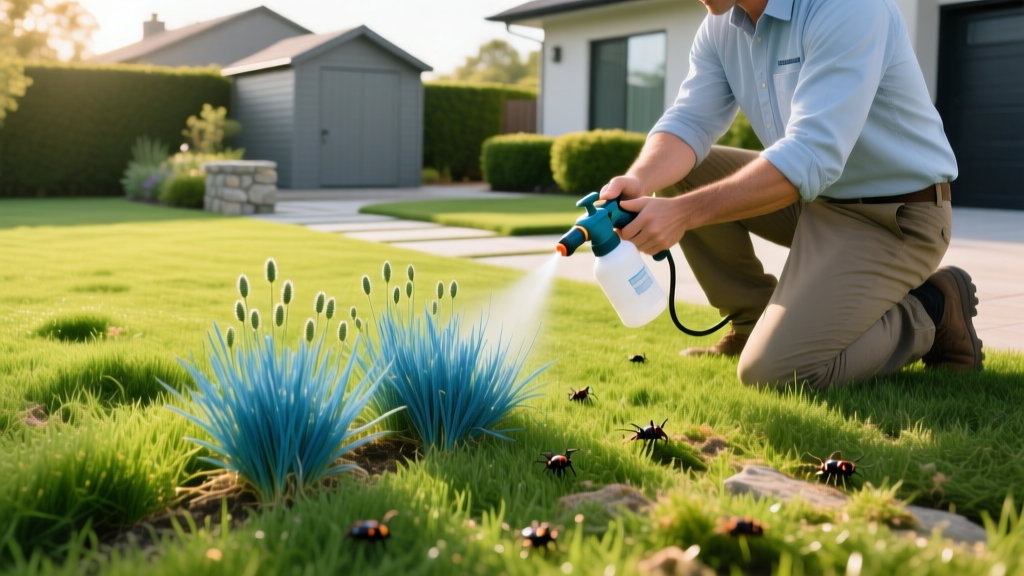
Poa Annua Pre Emergent Guide: Timing and Spot-Treatment Tactics
Annual bluegrass (Poa annua) is arguably the most frustrating winter annual weed in turfgrass management. Unlike broadleaf weeds that can be easily spot-sprayed with post-emergent herbicides, Poa annua shares a similar biology and appearance with desirable cool-season turfgrasses, making selective post-emergent control nearly impossible in fescue or bluegrass lawns. The most effective defense is a strategically timed Poa annua pre emergent application. However, broadcast spraying entire properties is often wasteful and expensive. By utilizing targeted spot-treatment and banding tactics, homeowners and turf managers can intercept germination at high-risk invasion zones—such as hardscape edges, compacted pathways, and ornamental bed perimeters—while minimizing chemical use and cost.
The Germination Trigger: Soil Temperature Over Calendar Dates
The most common mistake in pre-emergent herbicide application is relying on calendar dates rather than environmental data. Poa annua germination is triggered by a specific thermal threshold. According to NC State University TurfFiles, the primary germination window opens when soil temperatures at a 2-inch depth drop to 70°F for two to three consecutive days. In most transitional and cool-season zones, this occurs between late August and mid-September.
Applying a pre-emergent too early (e.g., early August) risks the chemical barrier degrading via microbial activity and UV photolysis before the main flush of germination occurs. Applying too late (after the first visible seedheads appear) means the weed has already bypassed the vulnerable single-cell germination stage. To track this accurately, use a digital soil probe thermometer inserted 2 inches deep into the soil in a shaded, representative area of your lawn during the early morning hours.
Active Ingredient Comparison Matrix
Not all pre-emergent herbicides perform equally against annual bluegrass. The selection of your active ingredient should be dictated by your specific turf type, the longevity required, and whether you need early post-emergent 'reach-back' activity. Below is a comparison of the three industry-standard active ingredients used for Poa annua control.
| Active Ingredient | Common Brand | Application Rate (per 1k sq ft) | Longevity | Early Post-Emergent Activity |
|---|---|---|---|---|
| Prodiamine | Barricade 65 WDG | 0.23 - 0.55 oz | 4 - 6 months | None |
| Dithiopyr | Dimension 2EW | 0.75 - 1.5 fl oz | 3 - 4 months | Yes (up to 1-tiller stage) |
| Pendimethalin | Pendulum AquaCap | 1.1 - 2.2 fl oz | 3 - 4 months | None |
For targeted spot-treatments along driveway edges where heat retention delays germination, Dithiopyr (Dimension) is often the superior choice. Its unique 'reach-back' capability allows it to kill Poa annua seedlings that have already germinated but have not yet developed tillers, providing a wider margin of error for timing along heat-sink hardscapes.
Calibrating Spot-Treatment Sprayers for Accurate Banding
When executing a spot-treatment or banding strategy, you are not using a broadcast spreader. You are using a backpack or pump sprayer to apply a liquid pre-emergent to a specific 12-to-24-inch wide perimeter. Accurate calibration is critical to avoid phytotoxicity to desirable turf or ornamental root zones.
The 1/128th Acre Calibration Method
- Mark off a test area of exactly 18.5 feet by 18.5 feet (which equals 340 square feet, or exactly 1/128th of an acre).
- Fill your sprayer with plain water and spray the test area using your intended walking speed and nozzle pressure.
- Measure the volume of water required to refill the sprayer back to the original fill line in fluid ounces.
- The number of fluid ounces used equals the exact gallons per acre (GPA) your sprayer is delivering. For pre-emergent banding, a target of 20 to 30 GPA is ideal to ensure the chemical penetrates the thatch layer without excessive runoff.
Strategic Banding and Spot-Treatment Tactics
Poa annua thrives in highly compacted soils, areas with poor drainage, and microclimates created by hardscapes. Instead of treating an entire 10,000-square-foot lawn, you can achieve 80% of the visual control by targeting the 20% of the property where the weed actually proliferates.
Pro-Tip: The Split-Application Strategy
Rather than applying the maximum labeled rate of Prodiamine in a single late-August pass, split the application into two doses. Apply 50% of the annual rate in late August to target the early flush, and the remaining 50% in late October. This extends the chemical barrier's half-life deep into the winter months, effectively neutralizing late-germinating Poa annua cohorts that often emerge during warm winter spells.
Rather than applying the maximum labeled rate of Prodiamine in a single late-August pass, split the application into two doses. Apply 50% of the annual rate in late August to target the early flush, and the remaining 50% in late October. This extends the chemical barrier's half-life deep into the winter months, effectively neutralizing late-germinating Poa annua cohorts that often emerge during warm winter spells.
Hardscape Edge Banding
Concrete driveways and sidewalks absorb solar radiation and release it slowly, keeping the adjacent soil temperatures artificially high well into September. This delays Poa annua germination in these specific zones. Apply a 2-foot wide liquid band of Dithiopyr along all hardscape edges in early September, two weeks after your primary turf application.
Ornamental Bed Perimeter Defense
Poa annua frequently invades mulch beds and creeps under landscape edging. For these zones, utilize a granular pre-emergent like Pendimethalin. Spot-apply the granules directly to the soil surface inside the bed perimeter, ensuring they do not accumulate on the exposed surface roots of shallow-rooted ornamentals like azaleas or dogwoods. Water the granules in with exactly 0.25 inches of irrigation to move the active ingredient into the top inch of the soil profile.
Diagnosing Pre-Emergent Failure Modes
If you applied a Poa annua pre emergent and still see a massive flush of annual bluegrass, the failure is rarely due to the chemical itself. It is almost always a mechanical or environmental application error. According to Texas A&M AgriLife Extension, understanding these failure modes is critical for long-term turf health.
- Thatch Binding: If your lawn has a thatch layer exceeding 0.5 inches, the pre-emergent molecules will bind to the organic matter and never reach the soil surface where germination occurs. You must core aerate or dethatch before applying the pre-emergent.
- Over-Watering: Pre-emergents need to be watered in to create a barrier in the top 1 to 1.5 inches of soil. If you apply 1 inch of water all at once, you risk pushing the chemical barrier too deep, below the germination zone, rendering it useless.
- Soil Disturbance: Aerating, dethatching, or heavy foot traffic after the application breaks the continuous chemical barrier, creating microscopic windows for Poa annua seeds to slip through and establish roots.
- UV Degradation: If a liquid pre-emergent is applied to a drought-stressed, dormant brown lawn with no canopy cover, the chemical sits exposed to direct UV radiation. Without turf leaves to intercept and wash the chemical down to the soil base, photolysis can destroy the active ingredient in a matter of days.
Frequently Asked Questions
Can I mix a pre-emergent with a fall fertilizer application?
Yes, but only if using a granular combination product. If using liquid spot-treatments, do not tank-mix liquid pre-emergents with liquid nitrogen fertilizers. High nitrogen salts can alter the pH and solubility of the herbicide, causing it to precipitate out of the solution and clog your sprayer nozzles.
Will a pre-emergent stop Poa annua if I already see it in my lawn?
No. Once Poa annua has developed a visible leaf and root system (the 1-tiller stage or beyond), standard pre-emergents like Prodiamine will not kill it. Only Dithiopyr offers limited early post-emergent control (up to the 1-tiller stage). For mature plants, you must wait for them to die off naturally in late spring or use non-selective spot treatments like glyphosate, which will also kill your desirable turf.
Is it safe to apply pre-emergent near vegetable gardens?
Exercise extreme caution. Prodiamine and Pendimethalin have long soil half-lives and can persist for months, potentially stunting the root development of future vegetable crops. Maintain a strict 10-foot buffer zone between your pre-emergent banding applications and any edible garden beds.

