
Pest Control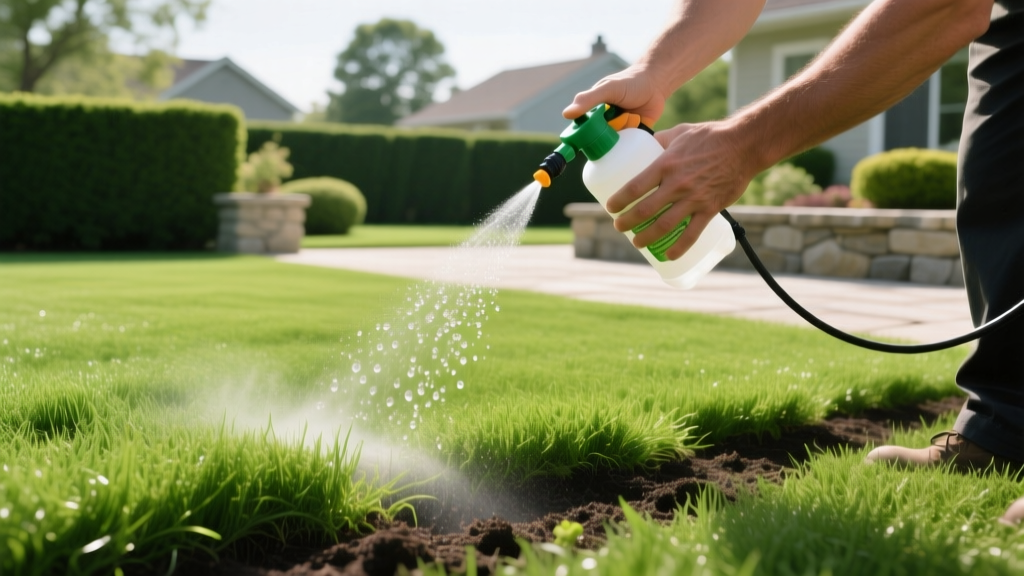
Pre Emergence Herbicide for Crabgrass: Targeted Guide
The Microclimate Approach to Crabgrass Prevention
Crabgrass (Digitaria sanguinalis) is a prolific annual weed that exploits thin turf, compacted soil, and heat-radiating hardscapes. While many homeowners rely on expensive, blanket broadcast applications across their entire lawn, a targeted microclimate approach is vastly more efficient. By identifying high-risk germination zones and applying a pre emergence herbicide for crabgrass specifically to those areas, you reduce chemical load, lower costs, and maintain a robust defensive barrier where it matters most.
Crabgrass seeds require specific environmental triggers to break dormancy: consistent soil temperatures of 55°F to 60°F at a 2-inch depth for three consecutive days, combined with adequate soil moisture and light penetration. Hardscape edges absorb and radiate solar heat, creating localized microclimates that reach these germination thresholds weeks before the center of the lawn. Targeting these perimeter zones with pre-emergents optimizes your pest control budget and prevents the initial flush of crabgrass before it can establish a seed bank.
⚠️ Critical Timing Warning: Do not rely on air temperature or blooming indicator plants (like forsythia) to time your application. Air temperature fluctuates wildly in early spring. You must use a soil thermometer inserted 2 inches into the ground at the edge of your driveway or sidewalk. According to Michigan State University Extension, applying pre-emergents before the soil reaches 50°F risks chemical degradation and UV breakdown before the actual germination window opens.
Active Ingredient Breakdown: Prodiamine vs. Dithiopyr
Not all pre-emergents function identically at the cellular level. Choosing the right active ingredient depends on your application timing, lawn history, and whether you need early post-emergent corrective action.
| Active Ingredient | Common Trade Name | Target Application Rate (per 1,000 sq ft) | Early Post-Emergent Activity | Approx. 2026 Cost |
|---|---|---|---|---|
| Prodiamine | Barricade 65 WDG | 1.15 oz (for split apps) | None (Strictly Pre-Emergent) | $150 / 5 lb jug |
| Dithiopyr | Dimension 2EW | 0.5 oz | Yes (Up to 1-tiller stage) | $120 / 2.5 L bottle |
| Pendimethalin | Pendulum AquaCap | 1.7 oz | None | $95 / 1 gal jug |
When to Choose Prodiamine
Prodiamine is a root inhibitor that creates a highly stable, long-lasting chemical barrier in the top half-inch of soil. It binds tightly to organic matter and resists leaching. It is the superior choice for a strict, early-spring preventative program where you are confident no crabgrass has yet germinated. For a 5,000 sq ft lawn, a single 5lb jug of Barricade (yielding roughly 43,000 sq ft at the standard rate) will last the average homeowner several years, bringing the annual cost down to under $20.
When to Choose Dithiopyr
Dithiopyr (Dimension) is unique because it offers both pre-emergent barrier properties and early post-emergent control. If you miss the early spring window and soil temperatures have already hovered around 60°F for a week, crabgrass seedlings may be emerging. Dithiopyr will kill crabgrass up to the 1-tiller (early vegetative) stage while still laying down a residual barrier. According to Penn State Extension, this dual-action capability makes dithiopyr the most forgiving option for homeowners who struggle with exact spring timing.
Step-by-Step Targeted Application Protocol
Spot-treating high-risk zones requires precise calibration to avoid under-applying (which leaves gaps in the chemical barrier) or over-applying (which can stunt the root growth of desirable turfgrass).
- Map the High-Risk Zones: Identify all south-facing and west-facing lawn edges, areas within 3 feet of asphalt driveways, concrete sidewalks, and patios. Include areas where the turf is visibly thin or where soil compaction is evident.
- Calibrate Your Sprayer: Fill a backpack or pump sprayer with exactly 1 gallon of water. Spray a 100 sq ft test area (e.g., 10x10 ft) at your normal walking pace. Measure the remaining water to determine your output per 1,000 sq ft. Most pre-emergents require 1 to 2 gallons of carrier water per 1,000 sq ft for proper soil deposition.
- Add a Tracer Dye: Pre-emergent liquids are often clear or milky white, making overlap tracking impossible. Add 0.5 oz of blue turf marker dye per gallon of mix. This ensures you do not accidentally double-apply to the same driveway edge, which could cause localized turf phytotoxicity.
- Apply the Barrier: Spray a uniform 3-to-4-foot wide band along all mapped hardscape edges. Maintain a steady walking pace of roughly 3 feet per second, keeping the nozzle 18 inches above the turf canopy.
- Water-In Immediately: Pre-emergents must be moved off the grass blades and into the top 0.5 inches of soil to be effective. Apply exactly 0.25 to 0.5 inches of irrigation within 24 hours of application. Use a tuna can placed on the lawn to measure water accumulation; running sprinklers blindly often leads to under-watering or excessive runoff.
💡 Pro Tip: The Split-Application Strategy
Instead of applying the full annual rate of prodiamine in April, apply half the rate (0.57 oz per 1,000 sq ft) in early spring, and the second half 8 weeks later in early June. This extends the chemical barrier's half-life deep into late summer, protecting against the late-summer crabgrass flush and smooth crabgrass (Digitaria ischaemum) which often germinates later than its hairy counterpart.
Instead of applying the full annual rate of prodiamine in April, apply half the rate (0.57 oz per 1,000 sq ft) in early spring, and the second half 8 weeks later in early June. This extends the chemical barrier's half-life deep into late summer, protecting against the late-summer crabgrass flush and smooth crabgrass (Digitaria ischaemum) which often germinates later than its hairy counterpart.
Troubleshooting Pre-Emergent Failures
If you applied a pre emergence herbicide for crabgrass but still see aggressive breakthrough in July, the failure is rarely due to the chemical itself. Investigate these common agronomic edge cases:
Excessive Thatch Accumulation
Pre-emergents bind tightly to organic matter. If your lawn has a thatch layer thicker than 0.5 inches, the chemical will bind to the thatch rather than reaching the soil surface where crabgrass seeds actually germinate. The Fix: Perform a core aeration or aggressive dethatching in the fall prior to your spring pre-emergent application. Never apply pre-emergent immediately before a planned aeration, as the physical pulling of soil cores will fracture the chemical barrier and create unprotected pathways for weed seeds.
Improper Watering and UV Degradation
Prodiamine and pendimethalin are susceptible to photodegradation if left on the soil surface or grass blades exposed to direct sunlight. If your irrigation system has broken heads or poor head-to-head coverage in perimeter zones, the chemical will break down within 7 to 10 days. The Fix: Audit your sprinkler system in March. If perimeter zones are dry, use a hose-end sprinkler to manually deliver the required 0.25 inches of water immediately after spraying.
Mowing Too Low
Crabgrass requires light to trigger germination. If you scalp your lawn (mowing below 2 inches), you allow sunlight to penetrate the turf canopy and reach the soil, overwhelming the pre-emergent barrier with massive germination pressure. Maintain cool-season turfgrasses at a minimum of 3.0 to 3.5 inches during the spring and summer months to naturally shade the soil and synergize with your chemical controls.
"A pre-emergent herbicide is only as effective as the turf canopy above it. Chemical barriers stop the weed, but a dense, properly fertilized, and high-mowed turf canopy prevents the seed from ever receiving the light trigger it needs to wake up."
By shifting from a blanket-spray mentality to a targeted, data-driven microclimate approach, you maximize the efficacy of your pre emergence herbicide for crabgrass. Monitor soil temperatures closely, calibrate your equipment precisely, and leverage split applications to maintain an unbroken barrier from early spring through the peak heat of late summer.

