
Pest Control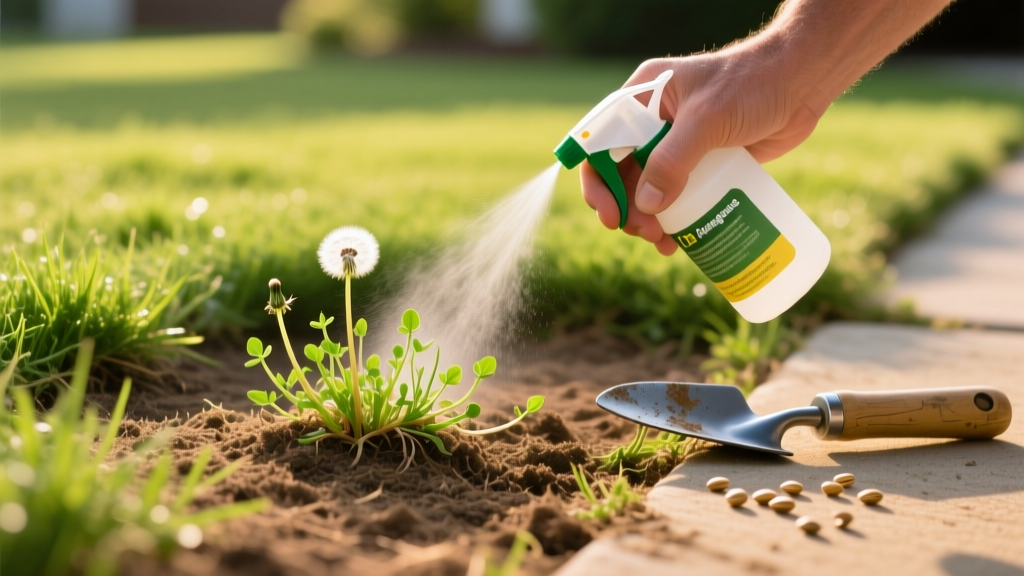
Pre Emergent Weed Killer Spot-Treatment Guide for Lawn Hotspots
Applying a blanket pre emergent weed killer across an entire 10,000-square-foot lawn consumes significant chemical volume, time, and budget. Yet, weed germination is rarely uniform. Invasive species exploit specific micro-environments—heated concrete edges, compacted shade, and poor-drainage swales. By shifting from broadcast applications to targeted spot-barrier treatments, homeowners can neutralize high-risk zones with surgical precision.
This guide details how to map lawn hotspots, select the correct active ingredients, and calibrate equipment for localized pre emergent weed killer applications, ensuring maximum efficacy while minimizing chemical footprint and cost.
The Science of Targeted Pre-Emergent Barriers
Pre-emergent herbicides do not kill seeds; they inhibit cell division in the radicle (root) or coleoptile (shoot) as the seed germinates and pushes through the top 0.5 to 1 inch of soil. To work, the chemical must form a continuous, unbroken barrier in that specific soil layer.
When you spot-treat a 3-foot perimeter along a driveway, you are creating a localized chemical trench. Because heat sinks like concrete and asphalt raise adjacent soil temperatures by 5°F to 10°F, these edges trigger crabgrass germination weeks before the center of the lawn. Spot-applying a pre emergent weed killer to these thermal edges allows you to deploy higher-concentration barriers exactly where the biological pressure is highest, without wasting product on the cool, low-risk center of your turf.
The 0.5-Inch Watering Rule: A pre-emergent barrier fails if it remains on the thatch or surface. You must apply exactly 0.25 to 0.5 inches of irrigation or rainfall within 48 hours of application to move the active ingredient into the top inch of soil. Use a flat tuna can placed in the spot-treatment zone to measure water volume accurately.
Weed Species Hotspot Mapping
Different weed species require distinct environmental triggers to break dormancy. Mapping your property allows you to match the weed to its preferred micro-climate. According to turfgrass researchers at University of Minnesota Extension, understanding these micro-climates is the first step in integrated pest management.
| Weed Species | Primary Hotspot Location | Germination Trigger | Recommended Active Ingredient |
|---|---|---|---|
| Crabgrass | Driveway edges, south-facing curbs, thin turf areas | Soil temp 55°F at 2" depth for 3 days | Prodiamine or Dithiopyr |
| Poa Annua (Annual Bluegrass) | Shaded zones, compacted pathways, damp low spots | Soil temp drops below 70°F in late summer | Prodiamine or Isoxaben |
| Nutsedge (Yellow/Purple) | Irrigation leaks, drainage swales, heavy clay depressions | Soil temp 60°F+ with high moisture | Sulfentrazone (Pre/Post mix) |
| Goosegrass | Highly compacted areas, heavy foot traffic zones | Soil temp 60°F to 65°F (later than crabgrass) | Oxadiazon or Prodiamine |
Crabgrass: The Thermal Edge Threat
Crabgrass thrives in heat. The 18-inch strip of soil bordering your sidewalk acts as a thermal battery. Spot-treating this perimeter with Prodiamine 65 WDG at a rate of 0.5 oz per 1,000 sq ft creates a robust barrier that lasts up to six months. Because you are only treating the perimeter, a single 5-pound jug (averaging $140 to $160 in 2026) can protect the edges of a multi-acre property for years.
Poa Annua: The Shade and Compaction Exploiter
Unlike summer annuals, Poa Annua germinates in late summer and early fall when soil temperatures drop below 70°F. It aggressively colonizes shady, compacted areas where desirable turf struggles. Spot-treating these specific micro-zones in mid-August with Isoxaben 75 WP (Gallery) provides excellent broadleaf and grassy weed prevention without inhibiting the root growth of your existing turf.
Top Active Ingredients for Spot-Barrier Treatments
Choosing the right chemistry depends on your specific weed pressure and your overseeding schedule. Data from Texas A&M AgriLife Extension highlights the importance of matching the herbicide's residual half-life to your lawn care calendar.
- Prodiamine (Barricade): A root inhibitor with a long soil half-life. Excellent for crabgrass and Poa Annua. Drawback: Prevents grass seed germination for 4 to 6 months. Do not use in spot-zones where you plan to overseed.
- Dithiopyr (Dimension): Inhibits both roots and early shoots. Unique among pre-emergents because it offers early post-emergent control (it will kill crabgrass up to the 1-tiller stage). Best for: Late spring applications when you might have missed the initial germination window.
- Isoxaben (Gallery): Primarily targets broadleaf weeds (like spurge and henbit) but also suppresses Poa Annua. Advantage: Safe to use over newly seeded turf once it has been mowed twice, making it ideal for spot-treating garden bed edges near new grass.
Step-by-Step Spot Application Protocol
Calibrating a broadcast spreader for a 3-foot wide strip is difficult and leads to overlapping errors. For spot-treatments, use a high-quality handheld spreader or a pump sprayer for liquid formulations.
- Measure the Zone: Use a measuring wheel to calculate the exact square footage of your hotspot perimeter (Length x Width). A 100-foot driveway edge treated 3 feet wide equals 300 square feet.
- Calculate the Dose: If your Prodiamine label dictates 0.5 oz per 1,000 sq ft, you need exactly 0.15 oz for a 300 sq ft strip. Use a digital gram scale for precise measurement of dry granules or wettable powders.
- Mark the Boundary: Use landscaping marking paint or a physical string line to define the inner edge of your treatment zone. This prevents accidental overlap into areas designated for overseeding.
- Apply with Overlap: Walk at a consistent pace of 3 feet per second. If using a liquid spray, maintain a nozzle pressure of 30 PSI to ensure uniform droplet size and soil penetration.
- Water In Immediately: Attach an oscillating sprinkler to deliver 0.25 to 0.5 inches of water. This activates the chemical and pulls it into the top inch of the soil profile.
Warning: Thatch Interference
If your lawn's thatch layer exceeds 0.5 inches, the pre emergent weed killer will bind to the dead organic matter and never reach the soil surface. You must core aerate or dethatch the hotspot zone before applying the pre-emergent barrier, or the treatment will fail entirely.
If your lawn's thatch layer exceeds 0.5 inches, the pre emergent weed killer will bind to the dead organic matter and never reach the soil surface. You must core aerate or dethatch the hotspot zone before applying the pre-emergent barrier, or the treatment will fail entirely.
Common Failure Modes and Edge Cases
Even with precise spot-treatments, environmental and mechanical factors can compromise the chemical barrier. Understanding these failure modes is critical for long-term weed suppression.
1. UV Degradation from Delayed Watering
Prodiamine and Dithiopyr are susceptible to photodegradation. If you apply the pre emergent weed killer to a hot spot but fail to water it in within 48 hours, UV radiation will break down the active ingredient on the soil surface, reducing efficacy by up to 40%. Always check the local weather forecast and time your application just before a guaranteed 0.5-inch rain event, or irrigate manually.
2. Soil Disturbance and Barrier Breakage
A pre-emergent barrier is a physical layer in the soil. Any mechanical disturbance breaks the seal. Edging your lawn with a steel blade, aggressive raking, or heavy foot traffic in the treated hotspot will fracture the barrier, allowing weed seeds to germinate in the exposed soil cracks. If you must edge your driveway, do it before applying the pre-emergent, or plan to re-apply a light dose to the disturbed soil immediately after edging.
3. Organic Matter Binding
As noted by NC State Extension, soils with exceptionally high organic matter or thick thatch layers can bind pre-emergent molecules, rendering them unavailable to the germinating seed. In heavily amended garden bed edges or compost-rich zones, you may need to increase the application rate by 20% to overcome this binding effect.
By treating your lawn as a collection of distinct micro-environments rather than a single monolithic space, you can deploy pre emergent weed killer with surgical accuracy. Spot-treating thermal edges, compacted swales, and shaded depressions not only drastically reduces your annual chemical expenditure but also builds a highly resilient, targeted defense against the most aggressive invasive weed species.

