
Pest Control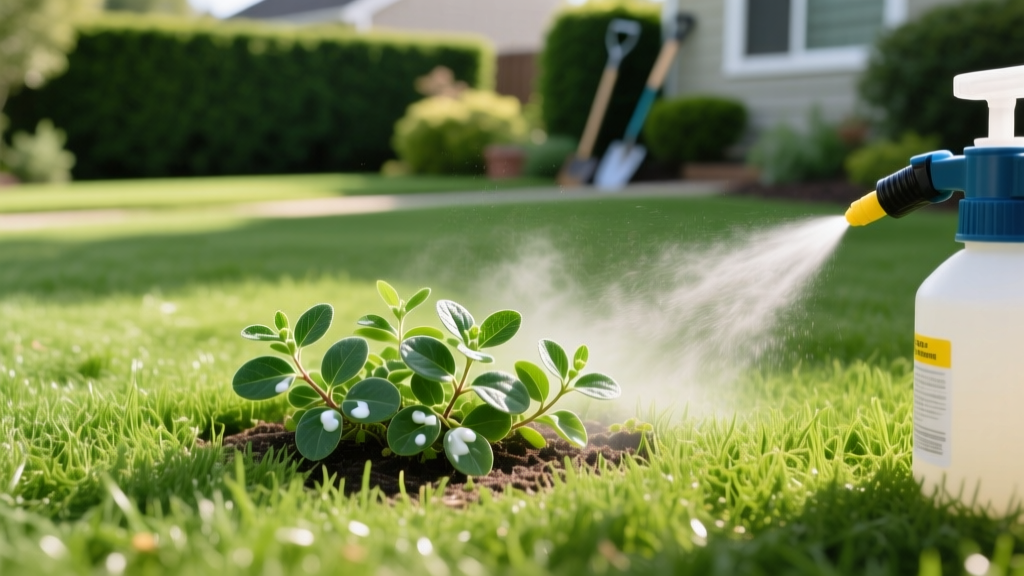
Best Spurge Weed Herbicide Selection for Spot Treatment
The Challenge of Spurge in Managed Turf
Spurge (Euphorbia species) is a aggressive summer annual broadleaf weed that exploits thin, compacted, and heat-stressed lawns. Unlike deep-rooted perennials, spurge relies on rapid seed production and a low-growing, mat-forming habit to choke out desirable grass. Selecting the right spurge weed herbicide for spot treatment requires understanding the plant's waxy leaf cuticle, its growth stage, and the specific active ingredients that can penetrate its defenses without harming the surrounding turf.
According to the University of California Integrated Pest Management program, prostrate spurge (Euphorbia maculata) and spotted spurge (Euphorbia prostrata) can germinate continuously from late spring through early fall, making a single application strategy insufficient for long-term control.
Identifying Spurge Before You Spray
Accurate identification prevents the misuse of expensive chemicals. Spurge is frequently confused with knotweed or purslane, but it possesses distinct biological markers:
- Stem Structure: Stems are highly branched, radiating from a central taproot, and hug the ground closely (prostrate).
- The Sap Test: Break a stem. Spurge exudes a distinct, sticky, white milky latex sap. Knotweed and purslane do not.
- Leaf Markings: Spotted spurge features a distinct maroon or purple spot in the center of each small, oval leaf.
- Root System: A shallow but tough central taproot anchors the mat. If you pull it, the stem usually breaks before the root releases.
Pre-Emergent vs. Post-Emergent Spurge Weed Herbicide Strategies
Spot-treating visible weeds is only half the battle. Because spurge germinates in waves when soil temperatures reach 60°F to 90°F, integrating a pre-emergent is critical. Below is a comparison of the two primary chemical strategies.
| Strategy | Primary Active Ingredients | Application Timing | Target Stage | Est. Cost per 1,000 sq ft (2026) |
|---|---|---|---|---|
| Pre-Emergent | Prodiamine, Dithiopyr | Early Spring (Soil > 55°F) | Seed Germination | $0.08 - $0.14 |
| Post-Emergent | Carfentrazone, 2,4-D, Dicamba | Early Summer (Weed < 3 inches) | Active Vegetative Growth | $0.12 - $0.22 |
Top Active Ingredients for Post-Emergent Spot Treatment
When spurge has already established a mat, you need a post-emergent spurge weed herbicide that offers both rapid burndown and systemic translocation. Single-active-ingredient products (like standard 2,4-D) often fail against mature spurge due to leaf waxiness. Professional-grade combination products yield the highest kill rates.
1. Carfentrazone-ethyl Mixtures (e.g., SpeedZone)
Products combining carfentrazone with 2,4-D, MCPP, and dicamba (such as PBI Gordon's SpeedZone) are the industry standard for spurge. Carfentrazone provides rapid contact burn (visible wilting within 24 hours), while the systemic hormones kill the taproot. Expect to pay $45 to $60 for a 2.5-gallon jug, which treats over 4 acres, making the per-application cost negligible for residential spot treatments.
2. Fluroxypyr (e.g., Spotlight)
Fluroxypyr is exceptionally effective on tough, waxy broadleaves. It is often used in cooler spring temperatures where 2,4-D might be sluggish. It is slightly more expensive per ounce but requires lower mixing rates.
3. Sulfentrazone (e.g., Dismiss)
While primarily known for nutsedge, sulfentrazone has strong activity against spurge when mixed with other broadleaf herbicides. It is highly effective in warm-season grasses like Bermuda and Zoysia where 2,4-D can cause temporary stunting.
⚠️ Temperature Warning: Never apply herbicides containing 2,4-D or dicamba when daytime temperatures are forecast to exceed 85°F. At high temperatures, these chemicals volatilize (turn into gas) and drift, causing severe twisting and cupping damage to desirable turf and nearby ornamental plants.
The Surfactant Factor: Why Herbicides Fail on Spurge
The most common reason a spurge weed herbicide fails is the omission of a surfactant. Spurge leaves are covered in a waxy cuticle and fine hairs that cause water-based herbicide droplets to bead up and roll off. According to University of Minnesota Turfgrass Science, adding a Non-Ionic Surfactant (NIS) reduces the surface tension of the spray solution, forcing it to spread evenly across the leaf and penetrate the cuticle.
Mixing Rule: Always add 0.25% v/v of NIS to your tank mix. In practical terms, this equals roughly 1/2 teaspoon of surfactant per 1 gallon of mixed herbicide.
Step-by-Step Spot-Treatment Application Protocol
Follow this exact protocol to maximize kill rates while minimizing chemical waste and turf stress.
- Calibrate the Sprayer: Use a 1-gallon or 2-gallon pump sprayer. Ensure the nozzle is set to a fine fan pattern, not a pinpoint jet stream.
- Mix the Solution: For SpeedZone, mix 1.5 fl oz of herbicide per 1 gallon of water. Add the 1/2 teaspoon of NIS last to prevent excessive foaming.
- Target the Foliage: Spray the spurge mat until the leaves are uniformly wet, but do not spray to the point of runoff. Drenching the soil does not improve post-emergent efficacy and wastes chemical.
- Observe the 24-Hour Rule: Do not irrigate the lawn or allow rainfall for at least 24 hours post-application. The herbicide needs this time to translocate from the leaves down to the taproot.
- Delay Mowing: Wait 48 hours before mowing the treated area to ensure maximum chemical absorption.
Common Application Mistakes and Failure Modes
Even with the right spurge weed herbicide, environmental and mechanical errors can result in survival and reseeding.
- Treating Mature Plants: Once spurge flowers and sets seed (which happens just weeks after germination), herbicides will kill the plant but may not prevent the seeds from maturing. Treat spurge when it is young and vegetative (under 2 inches in diameter).
- Ignoring Soil Compaction: Spurge is an indicator weed for compacted soil. If you kill the spurge but do not core aerate and amend the soil, the spurge will simply return the following year. Herbicides treat the symptom; aeration treats the cause.
- Overlapping Sprays: When spot-treating, overlapping passes can double the chemical dose on the surrounding desirable grass, leading to phytotoxicity (yellowing or burning of the turf).
Frequently Asked Questions
Will glyphosate (Roundup) kill spurge?
Yes, glyphosate will kill spurge, but it is a non-selective herbicide. It will also kill the surrounding desirable grass, leaving a dead patch that is highly vulnerable to new weed invasion. Only use glyphosate for spot treatment if the spurge is growing in gravel, sidewalk cracks, or non-turf areas.
How long does it take for the spurge to die after spraying?
With a carfentrazone-based mix, you will see wilting and necrosis (browning) within 24 to 48 hours. Complete death of the taproot and total plant collapse typically takes 7 to 14 days, depending on ambient temperatures and soil moisture.
Can I use a pre-emergent and post-emergent at the same time?
Yes, many professionals use a 'push' strategy in late spring, applying a pre-emergent (like Dimension) to stop new seeds while simultaneously spot-spraying a post-emergent on any early breakthroughs. Ensure the pre-emergent is watered in immediately, while the post-emergent is left to dry on the foliage.

