
Pest Control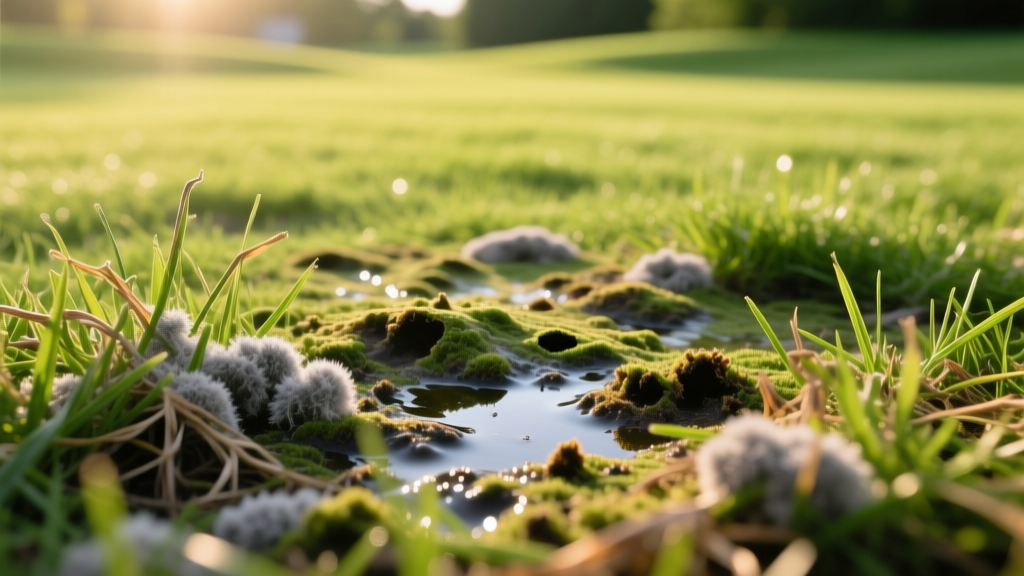
Pythium Blight Disease: Symptom Diagnosis and Emergency Rescue Fixes
The 24-Hour Threat: Understanding Pythium Blight Disease
Pythium blight disease (historically called cottony blight) is one of the most destructive and fast-moving turfgrass pathogens in existence. Under optimal conditions, this water mold can destroy an entire putting green or high-value lawn in less than 24 hours. Unlike common lawn fungi, Pythium aphanidermatum and Pythium ultimum are oomycetes—water molds that thrive in saturated environments and require free moisture to infect plant tissues.
The most critical mistake homeowners and turf managers make is treating Pythium with standard broad-spectrum fungicides. Because oomycetes have cell walls made of cellulose rather than chitin, standard DMI (triazoles) and QoI (strobilurins) fungicides are completely ineffective. Successful rescue requires immediate identification and the deployment of oomycete-specific chemistries.
⚠️ CRITICAL WARNING: If you observe greasy, water-soaked grass blades that mat together and smell faintly of rotting vegetation, do not apply propiconazole or azoxystrobin. You will waste time and money while the pathogen consumes your turf. You must use an oomycete-targeted product immediately.
Symptom Diagnosis: What to Look For
Accurate diagnosis is the first step in any rescue protocol. Pythium blight disease presents distinct visual cues that separate it from other summer turf diseases like Brown Patch or Dollar Spot.
- Early Morning Mycelium: Between 4:00 AM and 7:00 AM, look for a white, cottony, or cobweb-like mycelium covering the grass blades. This is the active reproductive stage of the pathogen.
- Water-Soaked Lesions: Individual grass blades will appear dark green, greasy, and water-soaked before rapidly collapsing into a slimy brown mass.
- Patch Formation: Infected areas form irregular, dark brown or black matted patches ranging from 1 to 12 inches in diameter. These patches often coalesce into large, continuous dead zones.
- Smoke Rings: In the early stages, the advancing margin of the patch may feature a dark, purple-black border known as a 'smoke ring,' indicating active mycelial growth.
Differential Diagnosis Matrix
Misdiagnosis leads to treatment failure. Use this matrix to confirm Pythium blight disease against look-alike summer pathogens.
| Feature | Pythium Blight | Brown Patch (Rhizoctonia) | Summer Patch |
|---|---|---|---|
| Pathogen Type | Oomycete (Water Mold) | True Fungus | True Fungus |
| Leaf Appearance | Greasy, slimy, matted down | Tan lesions with dark borders | Root/crown rot; leaves wilt |
| Morning Mycelium | Thick, white, cottony | Sparse, grayish-white smoke ring | None visible |
| Speed of Kill | Extremely fast (12-24 hours) | Moderate (3-5 days) | Slow (Weeks) |
Environmental Triggers: The Pythium Triangle
According to NC State University TurfFiles, Pythium blight disease outbreaks require a specific convergence of environmental stressors. Monitor your local weather data closely for the following thresholds:
- Daytime Temperatures: Consistently above 85°F (29°C).
- Nighttime Temperatures: Remaining above 65°F (18°C), preventing the turf canopy from cooling and drying.
- Canopy Moisture: Relative humidity exceeding 90%, or continuous leaf wetness for 12 to 14 hours (often caused by evening irrigation or heavy summer thunderstorms).
Pro Tip: If the sum of your daytime high and nighttime low temperatures exceeds 150°F, and rain is in the forecast, your turf is in the highest risk category for an outbreak.
Emergency Rescue Protocol: Chemical Interventions
When an active outbreak is confirmed, you have a 12-to-24-hour window to halt the pathogen's spread. You must utilize fungicides specifically labeled for oomycetes. Below are the industry-standard rescue chemistries, complete with exact application rates and estimated costs for residential and commercial turf managers.
| Product (Brand) | Active Ingredient | Rescue Rate (per 1,000 sq ft) | Est. Cost |
|---|---|---|---|
| Segway | Cyazofamid | 0.3 to 0.9 fl oz | ~$350 / 16oz bottle |
| Subdue MAXX | Mefenoxam | 0.5 to 1.0 fl oz | ~$180 / 1 gallon |
| Banol | Propamocarb hydrochloride | 4.0 to 8.0 fl oz | ~$160 / 2.5 gallons |
| Stellar | Fluopicolide + Propamocarb | 4.0 to 6.0 fl oz | ~$220 / 2.5 gallons |
The Watering-In Rule
Application technique dictates success. Systemic products like Subdue MAXX and Segway must be watered in immediately after application with 0.1 to 0.2 inches of irrigation to move the active ingredient into the crown and root zone where the pathogen attacks. Conversely, contact/penetrant products like Banol should not be watered in heavily; allow them to remain on the foliage to protect the leaf blades from spore germination.
Step-by-Step Rescue Application Guide
Follow this exact sequence when an outbreak is detected at dawn:
- Mow and Bag: Carefully mow the affected area at a slightly raised height. Bag the clippings immediately to physically remove millions of sporangia (spores) from the site. Do not mulch.
- Dry the Canopy: If the grass is wet, use a bamboo pole or a dew whip to physically knock the free moisture off the grass blades. Pythium requires water to swim to the plant stoma (pores) to infect.
- Mix and Apply: Mix your chosen oomycete-specific fungicide at the highest labeled curative rate. Apply using a backpack sprayer calibrated to deliver 2 gallons of water per 1,000 square feet for maximum canopy penetration.
- Targeted Irrigation: Water in systemic products lightly. If using a contact product, delay irrigation until the evening.
- Halt Nitrogen: Stop all nitrogen fertilization immediately. High nitrogen levels create soft, succulent tissue that Pythium penetrates with zero resistance.
Long-Term Cultural Defenses and Recovery
Chemical rescues stop the bleeding, but cultural practices prevent the next hemorrhage. UMass Extension emphasizes that managing the microclimate is the only sustainable defense against Pythium blight disease.
Syringing vs. Deep Watering
During peak summer heat, avoid deep, late-evening irrigation that leaves the canopy wet all night. Instead, practice syringing: applying a very light amount of water (just enough to wet the leaves) during the hottest part of the day (12:00 PM - 3:00 PM). This utilizes evaporative cooling to drop the canopy temperature below the 85°F danger threshold without saturating the soil profile.
Post-Outbreak Recovery
If the pathogen has already killed the turf down to the soil, chemical intervention will not bring it back. You must initiate recovery:
- Aeration: Core aerate the dead patches to relieve soil compaction and improve drainage, removing the saturated environment Pythium loves.
- Overseeding: Sow resistant cultivars. For cool-season lawns, specific Tall Fescue varieties (like 'Titan Ultra' or 'Firecracker') show moderate resistance. For creeping bentgrass greens, look for newer cultivars bred for Pythium tolerance.
- Starter Fertilizer: Apply a high-phosphorus starter fertilizer (e.g., 10-18-10) at 1 lb of nitrogen per 1,000 sq ft to encourage rapid root establishment in the bare patches, but avoid high-nitrogen quick-release products on the surrounding mature turf.
💡 Expert Insight on Resistance Management: Pythium species are notorious for developing resistance to Mefenoxam (Subdue). If you rely solely on Subdue MAXX for multiple applications in a single season, you will select for resistant strains. Always rotate your chemistry. Follow a Mefenoxam application with Cyazofamid (Segway) or Fluopicolide (Stellar) to attack the pathogen through different modes of action.
Frequently Asked Questions
Can Pythium blight disease spread via lawn mower wheels?
Yes. The sticky, water-soaked mycelium and spores easily cling to mower tires, boots, and maintenance equipment. If you mow an infected area, you must power-wash the undercarriage of your mower with a 10% bleach solution or a commercial turf disinfectant before moving to a healthy section of the lawn. Always mow healthy turf first, and infected turf last.
Does thatch buildup contribute to Pythium outbreaks?
Absolutely. A thatch layer thicker than 0.5 inches acts like a sponge, holding moisture against the grass crowns and creating a perpetual microclimate of high humidity. Regular dethatching and topdressing with sand (for bentgrass/bermudagrass) or compost (for tall fescue) are mandatory preventative steps.
Is there an organic treatment for active Pythium blight?
Biological controls like Bacillus subtilis (e.g., Companion) or Trichoderma harzianum can be used as preventative soil drenches to outcompete Pythium in the root zone. However, once an active, aggressive foliar outbreak is occurring, biologicals are too slow to act as a rescue cure. You must use synthetic oomycetes-specific fungicides to halt an active epidemic, then transition to biologicals for long-term maintenance.

