
Pest Control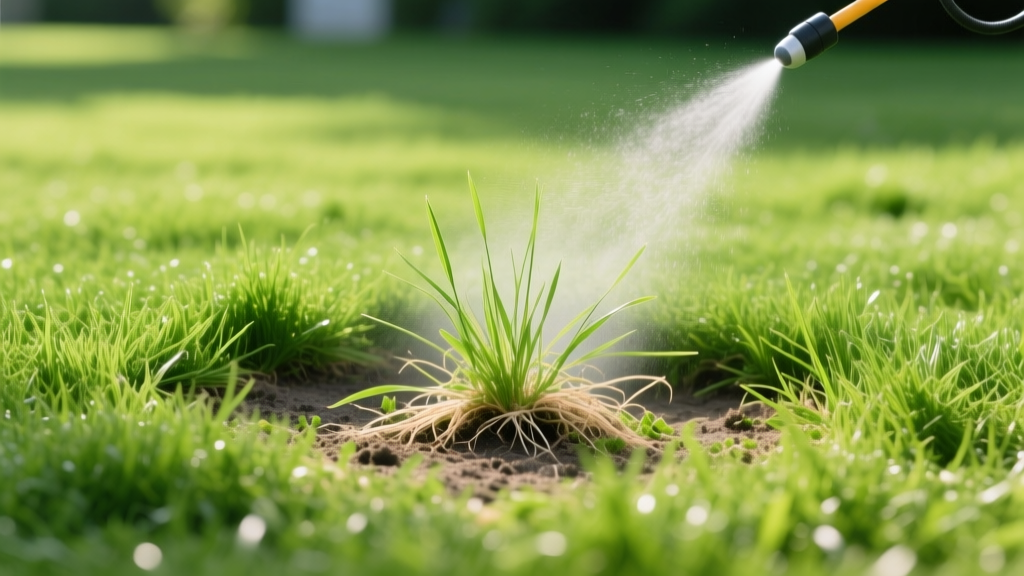
Best Quackgrass Herbicide Options for Lawn Spot Treatment
The Biological Challenge of Elymus repens
Quackgrass (Elymus repens) is a perennial grassy weed that plagues both cool-season and warm-season lawns. Unlike annual weeds that die off in winter, quackgrass survives through an aggressive, deep-penetrating rhizome system. These underground stems can grow up to 6 feet deep and feature sharp, scale-like nodes that store massive energy reserves. When you pull or till quackgrass, every fragmented node can sprout a new plant, making mechanical removal counterproductive. Effective eradication requires a targeted chemical approach that translocates systemic active ingredients down to the deepest rhizomes.
Identifying Quackgrass Before You Spray
Applying a quackgrass herbicide to the wrong species wastes time and damages desirable turf. Before mixing any chemicals, verify the weed's anatomy. Quackgrass is frequently confused with tall fescue or crabgrass, but it possesses distinct morphological markers:
- Clasping Auricles: This is the most reliable identifier. Pull the leaf blade away from the stem. Quackgrass features distinct, finger-like projections (auricles) that clasp the stem at the collar. Tall fescue lacks these entirely.
- Prominent Ligule: A short, membranous ligule sits at the base of the leaf blade, typically measuring 1 to 3 millimeters.
- Leaf Texture: The upper surface of the leaf blade is distinctly rough to the touch, while the underside is smooth and often glossy.
- Growth Habit: It grows in isolated, aggressive patches rather than spreading uniformly, often exhibiting a bluish-green hue that stands out against dark green Kentucky bluegrass.
The Chemistry of Quackgrass Herbicides
The primary challenge with quackgrass herbicide selection is biological similarity. Because quackgrass is a grass, broadleaf herbicides (like 2,4-D, dicamba, or MCPP) are entirely ineffective. Furthermore, selective grassy-weed herbicides that work in cool-season lawns are virtually non-existent for quackgrass because the chemical pathways required to kill it will simultaneously kill Kentucky bluegrass, perennial ryegrass, and fine fescues.
Cool-Season Lawns: The Non-Selective Reality
If you maintain a cool-season lawn, there is no selective quackgrass herbicide available to homeowners or commercial applicators. You must use a non-selective systemic herbicide, specifically glyphosate, applied via precision spot treatment. Glyphosate inhibits the EPSP synthase enzyme, halting amino acid production and causing the plant to starve from the inside out. For quackgrass, the chemical must translocate through the foliage down into the rhizome network, which requires leaving the weed unmowed for at least 48 hours prior to application.
Warm-Season Lawns: The Selective Advantage
Homeowners with Bermuda, Zoysia, or Centipede grass have a distinct advantage. The active ingredient fluazifop-butyl (commonly sold as Ortho Grass B Gon) is highly selective. It targets grassy weeds like quackgrass and crabgrass while leaving warm-season turf unharmed. Fluazifop works by inhibiting lipid biosynthesis in susceptible grasses, causing cellular collapse within 7 to 14 days.
Quackgrass Herbicide Comparison Matrix
| Active Ingredient | Brand Example | Turf Compatibility | Application Method | Avg. Cost (2026) |
|---|---|---|---|---|
| Glyphosate (41%) | Ranger Pro, Roundup Pro | None (Non-selective) | Sponge wick / Spot spray | $45 - $65 / gal |
| Fluazifop-butyl (0.48%) | Ortho Grass B Gon | Warm-season only | Ready-to-use spray | $18 - $22 / bottle |
| Sethoxydim (13%) | Segment | Warm-season / Centipede | Diluted broadcast | $90 - $110 / pint |
Precision Spot-Treatment Protocol (Cool-Season Lawns)
To eliminate quackgrass in cool-season turf without destroying the surrounding lawn, follow this exact wick-application framework. This method minimizes herbicide drift and limits collateral damage to desirable grass.
CRITICAL WARNING: Never use a rototiller or mechanical dethatcher on a lawn infested with quackgrass. Fragmenting the rhizomes will multiply the infestation exponentially, turning a 10-square-foot problem into a 100-square-foot nightmare within a single growing season.
- Isolate and Mow: Mow the surrounding desirable turf to a height of 2.5 inches. Do not mow the quackgrass patch. Allow the quackgrass to grow at least 2 inches taller than the surrounding lawn to create a distinct canopy for targeted application.
- Mix the Solution: Use a professional-grade 41% glyphosate concentrate. Mix 2.5 fluid ounces of glyphosate per 1 gallon of water. Add 1 tablespoon of ammonium sulfate (AMS) to the water before adding the glyphosate; this conditions the water and prevents hard-water minerals from binding to the active ingredient, increasing foliar uptake by up to 30%.
- Apply via Sponge Wick: Do not use a pressurized pump sprayer, as wind drift will kill surrounding turf. Instead, wear heavy-duty nitrile gloves and use a dedicated foam sponge brush. Dip the sponge into the solution until saturated but not dripping. Wipe the sponge directly onto the quackgrass blades, ensuring coverage from the tip down to the collar.
- Wait and Monitor: Allow 7 to 10 days for translocation. The quackgrass will turn yellow, then brown. If the center of the patch remains green after 14 days, the rhizomes were not fully saturated. Reapply the sponge treatment only to the surviving green tissue.
For authoritative guidance on regional quackgrass variants and localized herbicide resistance, consult resources like the Penn State Extension Turfgrass Program or the University of Minnesota Turfgrass Science department, which provide updated extension bulletins on perennial grassy weed management.
Post-Eradication Lawn Recovery
Once the quackgrass is completely brown and dead, the soil will be temporarily bare. Glyphosate binds tightly to soil particles and becomes inert upon contact with the earth, meaning it will not prevent new seeds from germinating.
Overseeding Timeline
- Day 14-17: Rake out the dead quackgrass thatch aggressively to expose the bare soil.
- Day 18: Core aerate the bare patch to relieve compaction and create seed-to-soil contact channels.
- Day 19: Overseed with a competitive, rhizomatous cool-season grass blend. Kentucky bluegrass (e.g., 'Midnight' or 'Award' cultivars) is highly recommended because its dense lateral growth habit naturally suppresses future weed seedling establishment.
- Day 20-35: Keep the top inch of soil consistently moist. Avoid applying pre-emergent herbicides (like prodiamine) in this zone, as they will prevent your new grass seed from germinating.
Frequently Asked Questions
Can I use vinegar or horticultural acetic acid to kill quackgrass?
No. While 20% horticultural vinegar will burn the foliage of quackgrass, it is strictly a contact herbicide. It lacks systemic translocation properties, meaning the deep rhizome network will remain entirely unaffected and push up new shoots within 10 to 14 days. Stick to systemic options like glyphosate for perennial grassy weeds.
Will pre-emergent herbicides stop quackgrass from spreading?
Pre-emergents (such as dithiopyr or prodiamine) are highly effective at stopping quackgrass from spreading via seed. However, quackgrass primarily spreads laterally through underground rhizomes. Pre-emergents have zero effect on rhizome expansion. They should be used as a supplementary defense, not a primary treatment for an existing infestation.
How long does it take for fluazifop to work in warm-season lawns?
When applied to quackgrass in a Bermuda or Zoysia lawn, fluazifop-butyl typically shows initial yellowing within 5 to 7 days. Complete necrosis of the weed takes 14 to 21 days. Do not mow the lawn for 48 hours before or 48 hours after application to ensure maximum foliar absorption.

