
Pest Control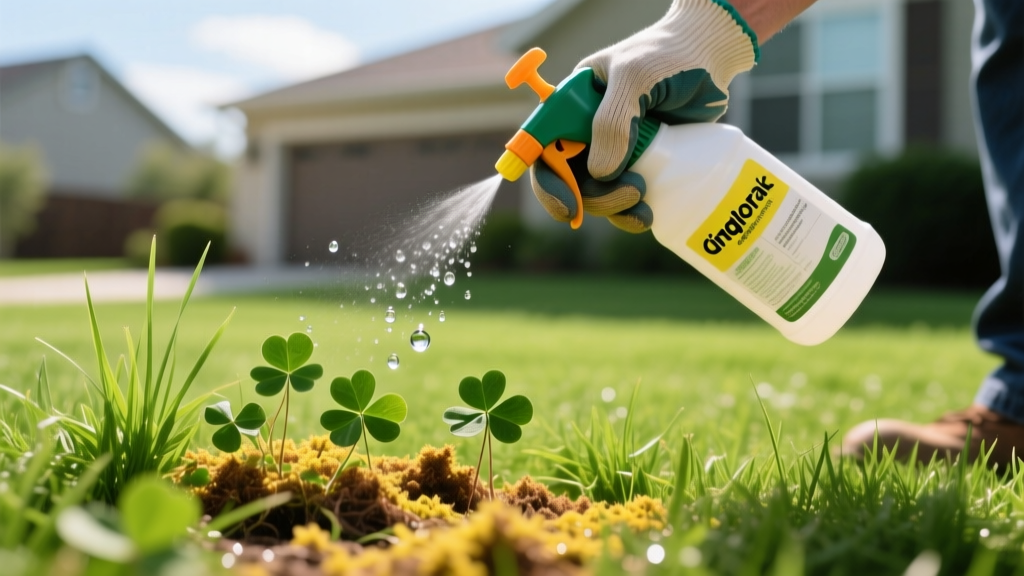
Quinclorac Weed Killer Guide: Spot Treating Crabgrass and Clover
The Dual-Action Chemistry of Quinclorac
Most post-emergent herbicides force a compromise: they either excel at killing broadleaf weeds or grassy weeds, but rarely both. Quinclorac weed killer breaks this rule. Classified as an arylpicolinic acid (Group 4 synthetic auxin), quinclorac mimics natural plant hormones to induce uncontrolled, lethal cell division. However, unlike standard auxins like 2,4-D or dicamba, quinclorac also inhibits cellulose biosynthesis in certain grassy species, making it the undisputed gold standard for post-emergent crabgrass control in residential lawns.
When executing spot treatments, understanding this dual-action mechanism is critical. Broadleaf weeds like white clover and dandelion typically show visible leaf cupping and epinasty (twisting) within 24 to 48 hours. Grassy weeds like smooth crabgrass and foxtail take longer, often requiring 7 to 14 days to exhibit severe chlorosis (yellowing) and necrosis as their cell walls fail to develop properly.
Target Weed Efficacy Matrix
Not all weeds respond equally to quinclorac. Use this matrix to determine if a spot-treatment approach will yield complete eradication or if a secondary active ingredient is required.
| Weed Species | Efficacy Rating | Visual Response Time | Required Applications |
|---|---|---|---|
| Smooth & Large Crabgrass | Excellent (95-100%) | 7-14 Days | 1 (2 if mature/tillered) |
| White Clover | Good (80-90%) | 3-5 Days | 1 |
| Dandelion | Moderate (60-75%) | 5-7 Days | 1-2 (Pair with 2,4-D) |
| Yellow Nutsedge | Poor (10-20%) | N/A | N/A (Use Sulfentrazone) |
| Goosegrass | Poor (15-30%) | N/A | N/A (Use Fenoxaprop) |
For complex infestations where crabgrass and dandelions overlap, professional-grade formulations like PBI Gordon's Quincept blend quinclorac with 2,4-D and dicamba to guarantee broad-spectrum control in a single spot-treatment pass.
Turfgrass Compatibility: Know Your Grass
WARNING: Severe Phytotoxicity Risk
Quinclorac is highly selective. While exceptionally safe for cool-season turfgrasses, it causes severe stunting, yellowing, and potential death in specific warm-season grasses. Never apply quinclorac to St. Augustinegrass or Centipedegrass. If you are managing a Dichondra or Bahia lawn, avoid this active ingredient entirely. Always verify your turf species before mixing a spot-treatment batch.
Safe Turfgrass Profiles
- Kentucky Bluegrass: Highly tolerant. No discoloration expected.
- Tall Fescue: Highly tolerant. Ideal for transition-zone spot treatments.
- Bermudagrass: Tolerant, but may experience temporary, mild chlorosis during peak summer heat (above 85°F).
- Zoysiagrass: Tolerant, though slower to recover from any minor herbicide stress.
Precision Spot-Treatment Protocol
Broadcast spraying wastes product and increases the risk of landscape drift. For isolated patches, a calibrated 1-gallon or 2-gallon pump sprayer is the most efficient tool. Professional formulations like BASF's Drive XLR8 (liquid) or Quinclorac 75 DF (dry flowable) are the industry benchmarks. As of 2026, an 18 oz bottle of Drive XLR8 retails between $85 and $95, yielding enough concentrate to treat over 12,000 square feet, making the cost per spot-treatment negligible.
Step 1: Calibrate and Mix
The standard broadcast rate for Drive XLR8 is 1.45 fluid ounces per 1,000 square feet. For spot treatments, you must match the water volume to your sprayer's output. Most homeowners spray roughly 1 gallon of water per 1,000 square feet when walking at a moderate pace.
- Fill your pump sprayer halfway with clean water.
- Add 1.5 fluid ounces (approx. 3 tablespoons) of quinclorac concentrate per gallon of water.
- Agitate the tank gently to begin suspension.
Step 2: The Surfactant Requirement
PRO TIP: Do Not Skip the Adjuvant
Crabgrass leaves are coated in a thick, waxy cuticle that repels water-based sprays. Quinclorac requires a Methylated Seed Oil (MSO) surfactant to penetrate this barrier. Standard dish soap or basic non-ionic surfactants (NIS) are insufficient for mature crabgrass. Add 1 to 2 teaspoons of a high-quality MSO (like Preference or Prime Oil) per gallon of mixed solution to ensure the active ingredient reaches the plant tissue.
Step 3: Application Technique
Adjust your sprayer nozzle to a coarse droplet pattern (flat fan or cone). Fine mists increase vapor drift, which can damage nearby ornamental plants. Spray the target weed until the leaves are uniformly wet, but stop before the solution begins to drip onto the soil. Quinclorac has excellent soil residual activity and will be absorbed by the roots, but foliar absorption initiates the fastest kill.
Edge Cases and Failure Modes
Even with perfect chemistry, environmental variables can cause spot treatments to fail. According to NC State TurfFiles, recognizing these edge cases separates amateur applications from professional results.
- Temperature Volatilization: Never apply quinclorac when ambient temperatures exceed 85°F. The chemical can vaporize and drift, causing severe leaf-curling damage to sensitive ornamentals, particularly tomato plants and grapevines within a 50-foot radius.
- Mature Crabgrass Tillering: If the crabgrass has already produced seed heads and thick, multi-branched stems (tillers), a single spot treatment will only burn back the foliage. You must schedule a second application 14 to 21 days after the first to kill the regenerating root crown.
- Soil Moisture Deficits: Weeds experiencing drought stress close their stomata and halt translocation. Applying quinclorac to drought-stressed crabgrass results in poor systemic movement. Irrigate the lawn lightly 24 hours before your planned spot treatment to ensure the weeds are actively growing and pulling the herbicide down to their roots.
Frequently Asked Questions
How long until I can reseed after using quinclorac?
Quinclorac possesses significant soil residual activity. For most turfgrass species, you must wait a minimum of 21 days after application before overseeding. If you applied a higher rate or multiple spot treatments to the same area, extend this waiting period to 45 days to prevent seedling stunting.
Can I mix quinclorac with liquid fertilizer?
It is not recommended for spot treatments. Mixing quinclorac with nitrogen-rich liquid fertilizers can accelerate the weed's metabolism, causing the foliage to burn off before the herbicide has time to translocate to the roots. Furthermore, combining them increases the risk of turfgrass phytotoxicity during warm weather. Keep your spot-treatment tank strictly dedicated to herbicide and MSO.
Will quinclorac kill creeping charlie (ground ivy)?
While quinclorac has some activity against ground ivy, it is highly inefficient compared to triclopyr-based products. For creeping charlie spot treatments, you will achieve faster, more complete eradication by utilizing a triclopyr and 2,4-D combination rather than relying on quinclorac. Consult the University of Georgia Extension guidelines for specific broadleaf alternative recommendations.

