
Pest Control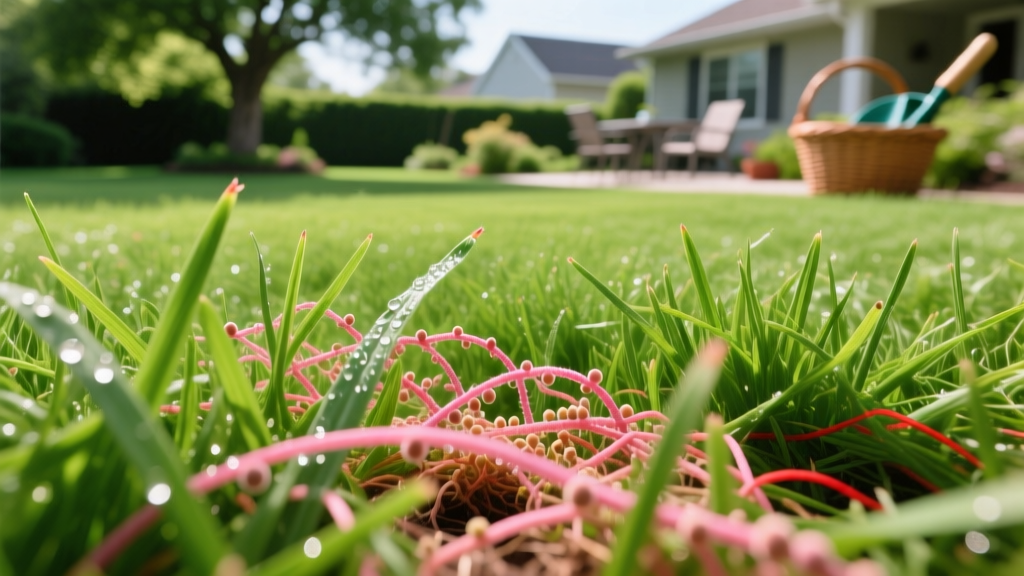
Red Thread Lawn Disease: Diagnosis and Fast Rescue Fixes
The Visual Diagnostic Checklist: Confirming the Pathogen
Red thread lawn disease, caused by the basidiomycete fungus Laetisaria fuciformis, is one of the most visually alarming turf ailments a homeowner can encounter. Unlike soil-borne root rots that silently kill grass from the bottom up, red thread announces itself with striking, almost gelatinous pink and red structures that literally bind the grass blades together. However, visual panic often leads to misdiagnosis and wasted chemical treatments. Before deploying fungicides, you must confirm the specific biological markers of this pathogen.
Key Diagnostic Markers:
- Sclerotia Threads: Look for gelatinous, pinkish-red fungal threads (sclerotia) extending 1/4 to 1 inch from the tips of the grass blades. In the early morning dew, these look like tiny pink spiderwebs.
- Foliar Blighting: The grass blades themselves will exhibit a bleached, tan, or straw-colored appearance starting from the tip and moving downward. The roots and crown remain completely healthy and intact.
- Patch Geometry: Affected areas typically form irregular, circular patches ranging from 2 inches to 3 feet in diameter. These patches often coalesce into large, blighted zones.
- Binding Effect: Because the sclerotia act like a biological glue, affected grass blades will stick together in clumps rather than standing upright individually.
Confounding Factors: Differential Diagnosis
Homeowners frequently confuse red thread with other cool-season turf diseases. Applying a broad-spectrum contact fungicide when a systemic is required, or treating for dollar spot when nitrogen is the actual cure, will result in treatment failure. Use this matrix to isolate the exact pathogen.
| Disease | Thread/Webbing Presence? | Lesion Shape on Blade | Optimal Temp Range |
|---|---|---|---|
| Red Thread | Yes, pink/red sclerotia | No distinct lesions; tip-down blighting | 60°F - 75°F |
| Dollar Spot | White cobweb mycelium (morning only) | Hourglass-shaped, bleached bands | 60°F - 85°F |
| Pink Snow Mold | White/pink mycelium at patch edges | Entire blade matted, no distinct lesion | 32°F - 50°F |
The 48-Hour Rescue Protocol: Immediate Fixes
Once Laetisaria fuciformis is confirmed, you must act quickly. Red thread is primarily a disease of nitrogen-deficient turf. The fungus thrives when the grass lacks the nutritional resources to rapidly push new growth and outpace the foliar blight. Your rescue protocol relies on a two-pronged approach: nutritional shock and targeted chemical intervention.
Step 1: The Quick-Release Nitrogen Shock
The most effective, immediate cure for mild to moderate red thread lawn disease is a targeted application of quick-release nitrogen. This forces the grass to rapidly produce new, uninfected tissue from the crown, effectively 'growing out' of the disease. According to NC State Turf Pathology, applying 0.2 to 0.5 lbs of actual nitrogen per 1,000 square feet will usually halt the disease progression within 7 to 10 days.
Crucial Application Math: Do not confuse 'product weight' with 'actual nitrogen'. If you are using a standard Urea (46-0-0) fertilizer, the nitrogen content is 46%. To deliver 0.2 lbs of actual N per 1,000 sq ft, you must apply exactly 0.43 lbs of Urea product per 1,000 sq ft. For a standard 5,000 sq ft lawn, calibrate your spreader to distribute exactly 2.15 lbs of Urea. Over-applying quick-release nitrogen can cause severe fertilizer burn, especially if soil temperatures exceed 75°F.
Step 2: Targeted Fungicide Intervention
If the infection is severe, covers more than 30% of the lawn, or if nitrogen application alone fails to halt the spread after 14 days, you must deploy a systemic fungicide. Contact fungicides (like chlorothalonil) are largely ineffective against red thread because the pathogen resides inside the leaf tissue. You need a QoI (Strobilurin) or DMI (Triazole) class fungicide.
- Azoxystrobin (QoI): Found in consumer products like Scotts DiseaseEx. It provides excellent curative and preventative control. Apply at a curative rate of 2.0 lbs of product per 1,000 sq ft.
- Propiconazole (DMI): Found in products like Bayer Advanced Fungus Killer. Highly effective but carries a slight risk of plant growth regulation (stunting) if applied during high heat stress.
- Flutolanil: A professional-grade option (e.g., Syngenta ProStar) that offers exceptional baseline control for severe, recurring outbreaks on high-value bentgrass or ryegrass.
Product Cost & Coverage Matrix (2026 Pricing)
When selecting a chemical rescue treatment, factor in both the active ingredient and the cost-per-square-foot for curative applications. Preventative rates are typically half the curative rates, but since you are executing a rescue fix, you must use the higher curative dosage.
| Product Name | Active Ingredient | Curative Coverage | Est. Retail Cost |
|---|---|---|---|
| Scotts DiseaseEx | Azoxystrobin (0.31%) | 5,000 sq ft (10lb bag) | $28 - $32 |
| Heritage G | Azoxystrobin (0.31%) | 15,000 sq ft (30lb bag) | $75 - $85 |
| Bayer Fungus Killer | Propiconazole (1.5%) | 5,000 sq ft (bottle) | $22 - $26 |
Long-Term Cultural Corrections: Preventing Relapse
Chemical and nutritional rescue fixes will clear the active infection, but Laetisaria fuciformis survives in the thatch layer as hardened sclerotia, waiting for the next window of prolonged leaf wetness. To prevent a relapse, you must alter the microclimate of your turf canopy. As noted by researchers at Penn State Extension, managing the thatch and moisture profile is non-negotiable for long-term control.
Thatch and Soil Management
Red thread sclerotia overwinter in the thatch layer. If your thatch exceeds 0.5 inches, the fungus has a permanent, insulated habitat. Perform core aeration in the early fall (late August to September for cool-season grasses) to physically break up the thatch mat and improve soil oxygenation. Follow up with a heavy dethatching using a power rake if the thatch layer remains stubbornly thick.
Canopy Airflow and Irrigation Timing
The pathogen requires 10 to 12 hours of continuous leaf wetness to initiate infection. You must eliminate extended dew periods.
- Pruning: Remove lower branches from surrounding trees and shrubs to increase morning sunlight penetration and wind flow across the turf canopy. This accelerates dew evaporation.
- Irrigation Calibration: Never irrigate in the late afternoon or evening. Set your smart irrigation controller to water between 4:00 AM and 6:00 AM. This ensures the grass blades dry out completely by mid-morning, starving the fungus of the moisture it needs to germinate.
- Mowing Protocol: Never mow a lawn actively infected with red thread while the grass is wet. The mower blades will physically slice through the sclerotia and spread the pathogen to healthy patches via the mower deck. Always mow when the canopy is bone dry, and wash the underside of your mower deck with a 10% bleach solution after cutting an infected zone.
Expert Troubleshooting: Why Your Treatment Failed
Failure Mode 1: Late-Season Nitrogen Burn
Homeowners often attempt the nitrogen rescue fix in late autumn when soil temperatures drop below 55°F. At these temperatures, microbial activity slows, and cool-season grasses enter dormancy. The grass cannot utilize the nitrogen to push new growth, resulting in severe fertilizer burn and salt accumulation in the soil without curing the red thread.
Homeowners often attempt the nitrogen rescue fix in late autumn when soil temperatures drop below 55°F. At these temperatures, microbial activity slows, and cool-season grasses enter dormancy. The grass cannot utilize the nitrogen to push new growth, resulting in severe fertilizer burn and salt accumulation in the soil without curing the red thread.
Failure Mode 2: Fungicide Resistance
If you have applied Azoxystrobin (QoI class) more than twice in a single season, the local Laetisaria fuciformis population may have developed resistance. Rotate your chemical classes. If your first rescue attempt was a Strobilurin (Azoxystrobin), your follow-up application must be a Triazole (Propiconazole or Myclobutanil) to bypass the genetic resistance mechanism.
If you have applied Azoxystrobin (QoI class) more than twice in a single season, the local Laetisaria fuciformis population may have developed resistance. Rotate your chemical classes. If your first rescue attempt was a Strobilurin (Azoxystrobin), your follow-up application must be a Triazole (Propiconazole or Myclobutanil) to bypass the genetic resistance mechanism.
By combining precise diagnostic identification, mathematically calibrated nitrogen shocks, and targeted systemic fungicides, you can effectively eradicate red thread lawn disease and restore your turf canopy to a dense, uniform green within a single 21-day growth cycle.

