
Pest Control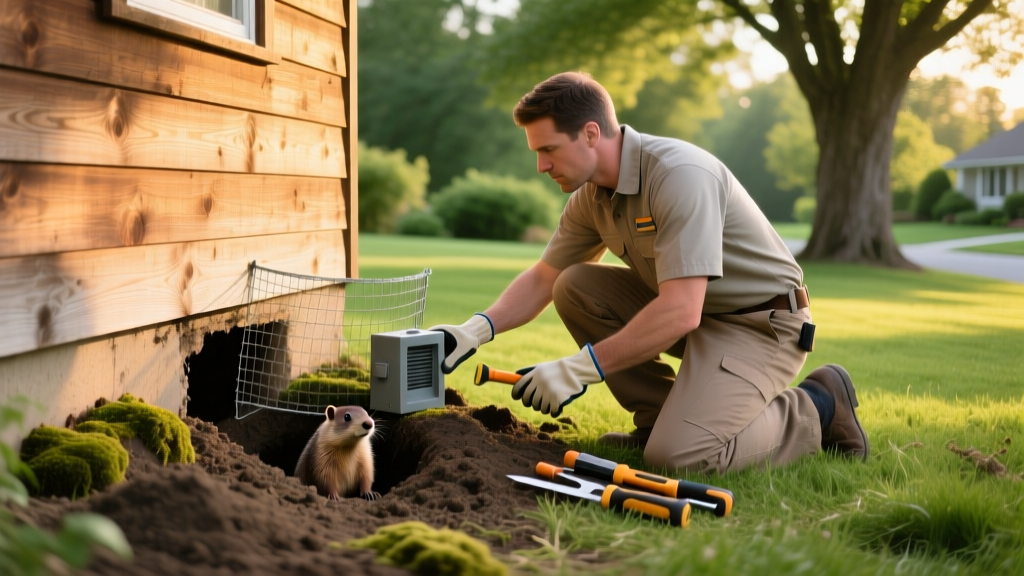
How to Get Rid of Groundhogs Under House: Safe Eviction & Exclusion
Assessing the Damage: Signs of Groundhog Activity
Groundhogs (Marmota monax), also known as woodchucks, are prolific excavators. A single adult can displace up to 35 cubic feet of soil while constructing a burrow system that reaches 5 feet deep and spans 25 feet horizontally. When a groundhog targets the crawlspace or foundation perimeter of your home, the structural risks are severe. Compromised foundation footings, torn vapor barriers, and damaged under-floor insulation are common consequences.
Before attempting any removal, confirm the culprit. Groundhog activity presents distinct indicators that separate them from smaller rodents like rats or voles:
- Excavation Mounds: Unlike the symmetrical, conical volcanoes left by moles, groundhog dig sites feature crescent-shaped soil mounds outside a 10-to-12-inch diameter entrance hole.
- Entry Points: Look for heavily scratched or chewed crawlspace vent louvers, gaps where the foundation meets wooden siding, or eroded soil beneath concrete porches.
- Interior Damage: If they breach the crawlspace, you will find shredded fiberglass batt insulation (used for nesting) and distinct, pungent ammonia odors from accumulated urine.
- Chewed Infrastructure: Groundhogs will gnaw on PVC plumbing lines, wooden joists, and low-voltage wiring to clear pathways or file their continuously growing incisors.
According to the Internet Center for Wildlife Damage Management, groundhogs prefer to dig at the intersection of two different materials—such as where a concrete foundation meets backfill soil—because the soil is looser and easier to tunnel through.
The 4-Step Eviction Protocol (Humane & Effective)
Never simply seal a groundhog hole. Trapping an animal inside your crawlspace leads to a decaying carcasm, severe odor issues, and secondary pest infestations from carrion beetles and flies. Furthermore, a trapped groundhog will frantically dig an alternate exit, potentially undermining your foundation further. Follow this systematic eviction process:
- Verify Occupancy (The Paper Test): Loosely stuff crumpled newspaper or sprinkle a fine layer of flour across the suspected entrance hole. Monitor for 48 to 72 hours. If the paper remains undisturbed and no tracks appear in the flour, the burrow is currently empty. (Note: This test is invalid during winter hibernation or spring birthing seasons).
- Install a One-Way Exclusion Door: Purchase a commercial one-way wildlife door (such as the Wildlife Control Supplies 12x12-inch exclusion door, typically $85-$110) or construct one using 14-gauge hardware cloth. Secure the door directly over the primary exit hole using masonry screws or heavy-duty landscape stakes, ensuring no gaps exist around the perimeter.
- Wait and Monitor: The one-way door allows the groundhog to exit to forage but prevents reentry. Leave the door in place for a minimum of 5 to 7 days. Continue checking for new excavation attempts around the edges of the door.
- Execute Permanent Trench Exclusion: Once you are certain the animal has vacated, remove the door and immediately install an L-footer trench barrier (detailed below) before backfilling the hole.
WARNING: Spring Breeding Season Restrictions
Groundhogs mate in March and April, with litters of 4-6 pups born in April and May. Evicting a mother during this window will trap flightless, dependent babies inside your crawlspace. If you suspect a nursing mother, you must wait until June when the pups are mobile enough to follow her out, or hire a licensed professional to perform a family reunification extraction.
Groundhogs mate in March and April, with litters of 4-6 pups born in April and May. Evicting a mother during this window will trap flightless, dependent babies inside your crawlspace. If you suspect a nursing mother, you must wait until June when the pups are mobile enough to follow her out, or hire a licensed professional to perform a family reunification extraction.
Deterrents vs. Exclusion: What Actually Works?
Homeowners frequently waste time and money on repellent products that fail to address the biological drive of a groundhog seeking shelter. The Penn State Extension emphasizes that physical exclusion is the only permanent solution for foundation burrowing. Below is a comparison of common market solutions:
| Method | Mechanism | Effectiveness | Cost | Verdict |
|---|---|---|---|---|
| Mothballs / Ammonia | Olfactory irritant | Very Low | $10 - $20 | Illegal outdoors; highly toxic to pets and soil. |
| Castor Oil Sprays | Taste/digestive irritant | Low (Temporary) | $25 - $40 | Washes away in rain; only protects surface lawns, not foundations. |
| Ultrasonic Spikes | High-frequency sound | None | $30 - $60 | Sound waves cannot penetrate soil or concrete; completely ineffective underground. |
| L-Footer Trenching | Physical subterranean barrier | Very High | $150 - $300 (DIY) | The gold standard. Stops digging by redirecting the animal away from the foundation. |
Constructing the L-Footer Exclusion Trench
The L-footer is a trenching technique designed specifically to defeat the burrowing mechanics of groundhogs and other digging mammals. When a groundhog encounters a vertical barrier, its instinct is to dig straight down to bypass it. The L-footer exploits this instinct by placing a horizontal barrier directly in their downward path.
Materials Required
- 14-gauge, 1/2-inch by 1/2-inch galvanized welded wire hardware cloth (Do not use chicken wire; groundhogs will easily crush and tear through it).
- Masonry screws and galvanized washers (if attaching to a concrete foundation).
- Heavy-duty landscape staples (U-pins).
- Trenching shovel and tamper.
Installation Steps
- Dig the Trench: Excavate a trench along the affected foundation wall that is 12 inches deep and 6 inches wide.
- Attach the Vertical Barrier: Secure the top edge of the hardware cloth to the foundation wall, extending it from the surface down into the trench. Ensure the mesh overlaps any existing crawlspace vents.
- Create the 'L' Bend: At the bottom of the trench, bend the remaining 12 inches of hardware cloth at a strict 90-degree angle, pointing outward, away from the house.
- Backfill and Tamp: Cover the horizontal wire shelf with the excavated soil and tamp it down firmly. When a groundhog attempts to dig down along your foundation, they will hit the wire shelf and be unable to proceed.
Crawlspace Sanitation and Vent Repair
Once the groundhog is evicted and the trench is sealed, the crawlspace requires immediate remediation. The Humane Society of the United States notes that wild mammals carry ectoparasites that will abandon the host and seek new targets once the animal is gone.
- Parasite Treatment: Apply a permethrin-based crawlspace spray or a natural diatomaceous earth dusting to eliminate abandoned flea, tick, and mite populations.
- Feces and Urine Removal: Wear an N95 respirator and heavy rubber gloves. Scoop out contaminated soil and insulation. Treat the remaining ground with an enzymatic cleaner designed for wildlife waste to break down uric acid crystals and eliminate the territorial scent markers that attract other rodents.
- Vent Upgrades: Replace damaged plastic crawlspace louvers with 16-gauge steel vent covers featuring 1/4-inch mesh. Secure them with tamper-proof exterior wood screws or masonry anchors.
Cost Breakdown: DIY vs. Professional Wildlife Removal
Deciding whether to handle the eviction yourself depends on your physical ability to trench and your tolerance for crawlspace work.
DIY Eviction and Exclusion
Total Estimated Cost: $180 - $350
Breakdown: A 50-foot roll of 14-gauge hardware cloth costs approximately $75-$95. A commercial one-way exclusion door runs about $90. Masonry screws, landscape staples, and enzymatic cleaners make up the remaining $50-$100. This route requires 1-2 full weekends of heavy labor.
Professional Wildlife Control
Total Estimated Cost: $450 - $1,200+
Breakdown: Licensed wildlife operators typically charge a $150-$250 inspection and trapping fee, plus $100-$150 per animal extracted. However, the bulk of the cost comes from the permanent exclusion trenching and crawlspace repair, which professionals price by the linear foot (usually $15-$25 per linear foot of L-footer installed). Always request proof of state wildlife control licensing and liability insurance before hiring.
Frequently Asked Questions
Can I use smoke bombs or exhaust fumes to drive them out?
No. Pumping carbon monoxide or smoke into a burrow connected to your crawlspace is extremely dangerous. Gases can easily seep through foundation cracks, plumbing penetrations, and subflooring into your living areas, posing a lethal threat to your household. Furthermore, smoke bombs are largely ineffective against deep, multi-chambered groundhog burrows.
Will a groundhog hibernate under my house?
Yes. In USDA Hardiness Zones 3 through 7, groundhogs enter true hibernation from late October through February or March. During this time, their heart rate drops from 80 beats per minute to just 5 beats per minute. You cannot evict a hibernating groundhog using one-way doors, as they will not leave the burrow. You must wait until spring or carefully excavate the hibernation chamber with professional assistance.
Do groundhogs carry rabies?
While any mammal can theoretically contract rabies, groundhogs are rarely vectors for the disease due to their solitary nature and subterranean lifestyle, which limits contact with primary carriers like raccoons, skunks, and foxes. However, they can carry tularemia and powassan virus (via ticks), making protective gear mandatory during crawlspace cleanup.

