
Pest Control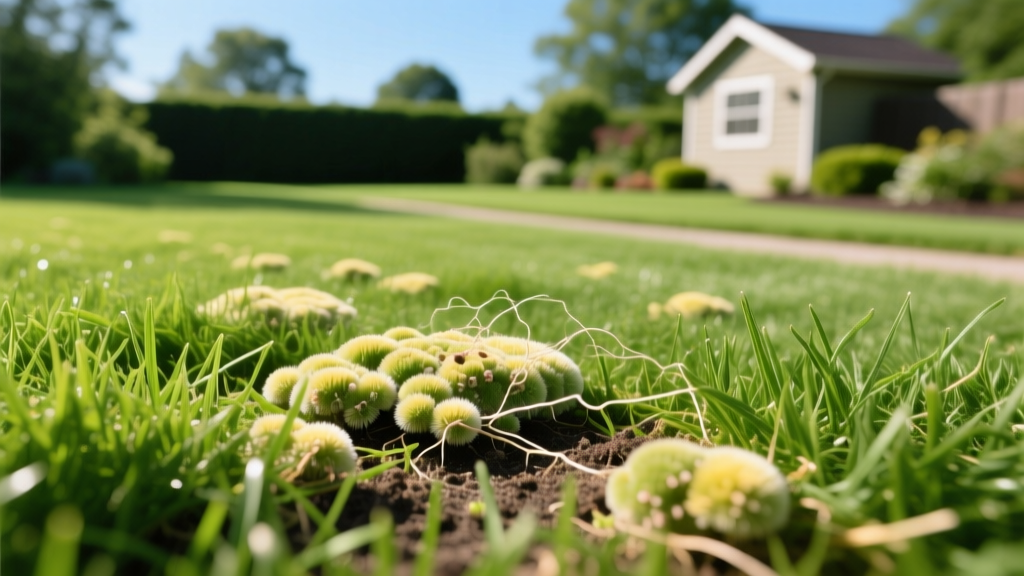
Rescue Guide: Best Fungicides for Dollar Spot Diagnosis & Cure
The 48-Hour Rescue Window: Confirming Dollar Spot
When your turf develops bleached, silver-dollar-sized patches, the clock starts ticking. Dollar spot, caused by the pathogen Clarireedia jacksonii (formerly known as Sclerotinia homoeocarpa), can escalate from a few isolated spots to severe canopy thinning in under a week if left untreated. Before reaching for a chemical, you must confirm the diagnosis to avoid wasting expensive products on the wrong disease.
Rapid Symptom Checklist
- Lesion Shape: Look for hourglass-shaped, bleached bands across the leaf blade with distinct reddish-brown margins.
- Patch Size: Initial spots are exactly the size of a silver dollar (1 to 2 inches), eventually coalescing into larger blighted areas.
- Mycelium Presence: The ultimate confirmation. Inspect the turf at dawn when dew is heavy. You will see white, cobweb-like fungal threads (mycelium) spanning across the leaves. This mycelium disappears as the sun dries the canopy.
Selecting the Right Fungicides for Dollar Spot: The FRAC Matrix
Choosing the correct chemistry is critical. As of 2026, turfgrass pathologists are documenting increased resistance to single-site fungicides, particularly within the QoI (FRAC 11) class. For a true curative rescue application, you need systemic active ingredients that can halt active infections inside the plant tissue, ideally tank-mixed with a multi-site contact fungicide to protect the canopy and manage resistance.
| Active Ingredient | Brand Example | FRAC Code | Curative Rate (per 1k sq ft) | Est. Cost per Application |
|---|---|---|---|---|
| Fluxapyroxad | Xzemplar | 7 (SDHI) | 0.36 fl oz | $14.50 |
| Azoxystrobin | Heritage | 11 (QoI) | 0.4 oz | $8.20 |
| Propiconazole | Banner MAXX | 3 (DMI) | 2.0 fl oz | $3.10 |
| Fluazinam + Chlorothalonil | Interface | 29 + M05 | 3.0 fl oz | $6.50 |
Expert Recommendation: For a severe, active outbreak, a tank mix of Fluxapyroxad (FRAC 7) and Chlorothalonil (FRAC M05) provides the fastest curative knockdown while simultaneously protecting uninfected leaf tissue. According to Penn State Extension, rotating FRAC groups every 14 to 21 days is non-negotiable to prevent the pathogen from developing genetic resistance.
Step-by-Step Curative Application Protocol
Applying the right product incorrectly will yield the same poor results as applying the wrong product. Follow this exact protocol for a curative rescue treatment:
- Calculate Water Volume: Use a minimum of 2.0 gallons of water per 1,000 square feet. Dollar spot is a foliar and crown disease; you need sufficient carrier volume to thoroughly coat the leaf blades and penetrate the thatch layer.
- Select the Right Nozzle: Use Air Induction (AI) nozzles, such as the TTI 11004. These produce coarse droplets that penetrate the dense canopy better than fine mist nozzles, which tend to drift or evaporate before reaching the lower crown where the infection originates.
- Mix and Agitate: Add the systemic fungicide first, then the contact fungicide, then a non-ionic surfactant (NIS) at 0.25% v/v. The surfactant is critical for breaking the surface tension of the waxy grass cuticle, allowing the chemistry to penetrate the leaf rapidly.
- Irrigation Strategy: Unlike soil-borne diseases, dollar spot fungicides do not require heavy watering-in. A light syringe cycle (1/10th of an inch) immediately after application is sufficient to wash the product off the very tip of the blade and into the lower canopy without washing it past the root zone.
WARNING: The Mowing Mistake
Do not mow your lawn for at least 48 hours after a curative fungicide application. Mowing too soon physically removes the chemical from the leaf surface before it has fully absorbed into the plant tissue, effectively cutting your treatment efficacy in half.
Do not mow your lawn for at least 48 hours after a curative fungicide application. Mowing too soon physically removes the chemical from the leaf surface before it has fully absorbed into the plant tissue, effectively cutting your treatment efficacy in half.
Cultural Rescue Fixes to Accelerate Recovery
Fungicides stop the pathogen, but cultural practices force the turf to recover. Clarireedia jacksonii thrives in low-nitrogen, moisture-heavy environments. You must alter the microclimate immediately.
Nitrogen Spoon-Feeding
Dollar spot is notorious for attacking nitrogen-deficient turf. Apply a quick-release nitrogen source, such as ammonium sulfate or urea, at a rate of 0.1 to 0.2 lbs of Nitrogen per 1,000 sq ft immediately following your fungicide application. This forces a flush of new growth, allowing the grass to outpace the disease and fill in the bleached patches within 10 to 14 days.
Dew and Guttation Management
The pathogen requires 12 to 15 hours of continuous leaf wetness to infect. If you are experiencing a multi-day outbreak, physically remove morning dew. Dragging a dew whip, a bamboo pole, or a rubber mat across the lawn at 6:00 AM disrupts the guttation fluid and mycelium, severely limiting the fungus's ability to spread. Research from UC Davis Turfgrass Disease Management highlights that mechanical dew removal can reduce dollar spot severity by up to 50% even without chemical intervention.
Troubleshooting: Why Your Fungicide Failed
If you applied a fungicide and the disease continued to spread, diagnose the failure using this framework:
- Misidentification: Are the patches larger than 3 inches? Is the mycelium brownish rather than stark white? You likely have Brown Patch (Rhizoctonia solani), not dollar spot. The chemistry required for Brown Patch overlaps, but the environmental triggers and cultural fixes differ vastly.
- Under-Dosing: Curative applications require the absolute maximum label rate. If you applied a preventative rate (e.g., 0.18 fl oz of Xzemplar) to an active infection, the pathogen will survive and develop resistance. Always use the highest curative rate listed on the manufacturer's label.
- UV Degradation: If you used a pure contact fungicide like Daconil (Chlorothalonil) without a systemic partner, and the turf was exposed to intense UV and heavy mowing, the protective barrier was likely degraded within 7 days. Always tank-mix contacts with systemics for curative scenarios.
By combining precise symptom diagnosis, FRAC-aware chemistry selection, and aggressive cultural recovery, you can halt dollar spot in its tracks and restore your lawn's canopy health within two weeks.

