
Pest Control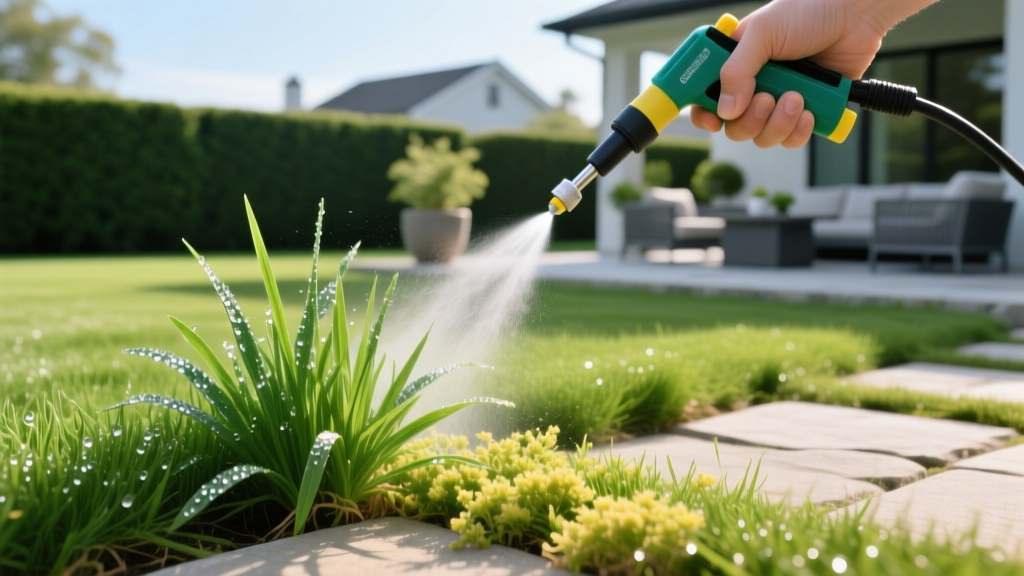
Revolver Weed Killer Spot-Treatment Guide for Poa Annua
The Mechanism of Action: Why Foramsulfuron Dominates
Revolver weed killer (active ingredient: foramsulfuron 19%) is an acetolactate synthase (ALS) inhibitor. When applied to susceptible cool-season grasses like Poa annua (annual bluegrass), Poa trivialis, and tall fescue, it halts the synthesis of branched-chain amino acids (valine, leucine, and isoleucine). This metabolic disruption causes rapid chlorosis (yellowing) and necrosis, typically killing the target weed within 14 to 21 days. Because warm-season turfgrasses like Bermudagrass and Zoysiagrass metabolize foramsulfuron rapidly via cytochrome P450 enzymes, they remain entirely unharmed. This selective metabolic breakdown makes Revolver the gold standard for post-emergent spot treatments in high-value warm-season lawns.
Revolver 0.19 SC Quick Specs:
• Formulation: Suspension Concentrate (SC)
• Target Weeds: Poa annua, Poa trivialis, tall fescue, perennial ryegrass, goosegrass (suppression)
• Safe Turf: Bermudagrass, Zoysiagrass
• Restricted Turf: St. Augustinegrass, Centipedegrass, Seashore Paspalum, all cool-season grasses
• Formulation: Suspension Concentrate (SC)
• Target Weeds: Poa annua, Poa trivialis, tall fescue, perennial ryegrass, goosegrass (suppression)
• Safe Turf: Bermudagrass, Zoysiagrass
• Restricted Turf: St. Augustinegrass, Centipedegrass, Seashore Paspalum, all cool-season grasses
Calibration and Micro-Dosing for Spot Treatment
The primary challenge with Revolver for residential or prosumer use is the application rate. The commercial label dictates 44 to 88 mL per acre. Translated to a 1,000-square-foot area, this equates to roughly 1.0 to 2.0 mL of product. Standard pump sprayers and measuring cups cannot accurately dose 2.0 mL. To achieve precise spot-treatment without wasting product or risking turf phytotoxicity from overlapping passes, you must use a 10 mL oral syringe (available at any pharmacy) for measurement.
| Target Area | Revolver Volume | Carrier Water | NIS Surfactant (0.25% v/v) |
|---|---|---|---|
| 1,000 sq ft | 2.0 mL | 1.0 Gallon | 2.5 mL (approx. 1/2 tsp) |
| 500 sq ft | 1.0 mL | 0.5 Gallon | 1.25 mL |
| 250 sq ft | 0.5 mL | 1.0 Quart | 0.6 mL |
While the Revolver label does not strictly mandate a non-ionic surfactant (NIS) for Poa annua control, adding a high-quality NIS (such as Dyne-Amic or R-11) at 0.25% v/v significantly improves foliar absorption, especially on the waxy cuticle of mature Poa annua leaves during late-fall spot treatments. According to NC State Extension TurfFiles, surfactant inclusion can accelerate visual control by 3 to 5 days.
Step-by-Step Execution Protocol
- Equipment Selection: Use a 1-gallon or 2-gallon pump sprayer equipped with a flat-fan nozzle (e.g., TeeJet XR11002VS). Avoid cone nozzles, which produce uneven distribution and increase the risk of localized overdose.
- Pressure Regulation: Maintain a spray pressure between 25 and 35 PSI. Pumping the sprayer 15 to 20 times typically achieves this. Higher pressures create fine drift particles that can land on non-target landscape beds.
- Mixing Order (W-A-L-E-S): Fill the tank halfway with water. Add the Revolver suspension concentrate (shaking the bottle vigorously first, as SC formulations settle). Agitate the tank. Add the NIS surfactant last, then top off with the remaining water to minimize foaming.
- Application Technique: Walk at a steady pace of 3 miles per hour. Hold the wand 18 to 24 inches above the turf canopy. Apply in a single, continuous sweeping motion directly over the Poa annua clumps. Do not wave the wand back and forth over the same area.
- Post-Application: Delay mowing for 48 hours to allow maximum foliar uptake. Avoid irrigation for 24 hours to prevent washing the herbicide off the leaf surface.
Environmental Triggers and Timing
Timing is the most critical variable in ALS-inhibitor efficacy. Revolver is most effective when Poa annua is actively growing and not under environmental stress. The optimal soil temperature window for fall spot-treatment is between 55°F and 65°F (typically October through November in transition zones). In spring, apply when soil temperatures are consistently above 50°F but before the weed begins producing seed heads. Applying Revolver during summer drought conditions or winter dormancy will result in severe stunting rather than complete mortality, as the weed's metabolic rate is too low to translocate the herbicide to the root zone. Texas A&M AggieTurf emphasizes that applications made during active tillering (fall) yield the highest long-term control rates.
⚠️ Phytotoxicity Warning: Never use Revolver on St. Augustinegrass or Centipedegrass. Foramsulfuron causes severe, irreversible chlorosis and necrosis in these species. If you are managing a mixed-stand lawn where St. Augustine has invaded Bermudagrass, do not use Revolver, as it will indiscriminately damage the St. Augustine patches.
Troubleshooting: Why Your Spot Treatment Failed
- Symptom: Poa annua turns bright yellow but recovers after 3 weeks.
Diagnosis: ALS-resistant biotype or application during drought stress. Poa annua has documented resistance to ALS inhibitors in several states. If resistance is suspected, rotate to a different mode of action, such as glufosinate (Finale) for non-selective spot treatment, or pronamide (Kerb) for pre-emergent control. - Symptom: Bermudagrass shows localized stunting and yellowing in the spray path.
Diagnosis: Overlapping spray passes or excessive pressure causing soil drenching. While Bermudagrass metabolizes foramsulfuron, applying 3x to 4x the labeled rate via overlapping passes will temporarily overwhelm its metabolic pathways. Stick to single passes. - Symptom: Weed control is excellent, but goosegrass remains unaffected.
Diagnosis: Revolver only suppresses goosegrass; it does not control it. For goosegrass spot-treatment in Bermudagrass, use a targeted application of MSMA (where legally permitted) or fluazifop (Ornamec) with strict adherence to label rates to avoid Bermudagrass injury.
Cost-Benefit Analysis: Revolver vs. Alternatives
As of 2026, a 14.1 oz bottle of Revolver 0.19 SC retails for approximately $285. While this represents a high upfront capital expenditure, the bottle treats up to 10 acres at the low Poa annua rate. For a prosumer managing a 10,000 sq ft lawn, a single bottle represents a multi-decade supply, making the cost-per-thousand-square-feet roughly $0.07. Compare this to retail-ready, pre-diluted herbicides which often cost $0.50 to $1.00 per 1,000 sq ft.
| Herbicide | Active Ingredient | Cost per 1,000 sq ft | Best Use Case |
|---|---|---|---|
| Revolver | Foramsulfuron | $0.07 | Poa annua & Poa trivialis in Bermuda/Zoysia |
| Certainty | Sulfosulfuron | $0.12 | Sedges and broadleaves in warm-season turf |
| Monument | Trifloxysulfuron | $0.15 | Nutsedge and Poa annua suppression |
| Retail Quinclorac | Quinclorac | $0.85 | Crabgrass and broadleaves (Poor Poa control) |
For comprehensive turf management, integrating Revolver spot-treatments with a robust pre-emergent program (such as prodiamine or dithiopyr applied in late summer) will reduce the total volume of post-emergent herbicide required, preserving the longevity of the foramsulfuron chemistry and delaying ALS resistance. For further reading on integrated weed management strategies, consult the Penn State Extension turfgrass management archives.

