
Pest Control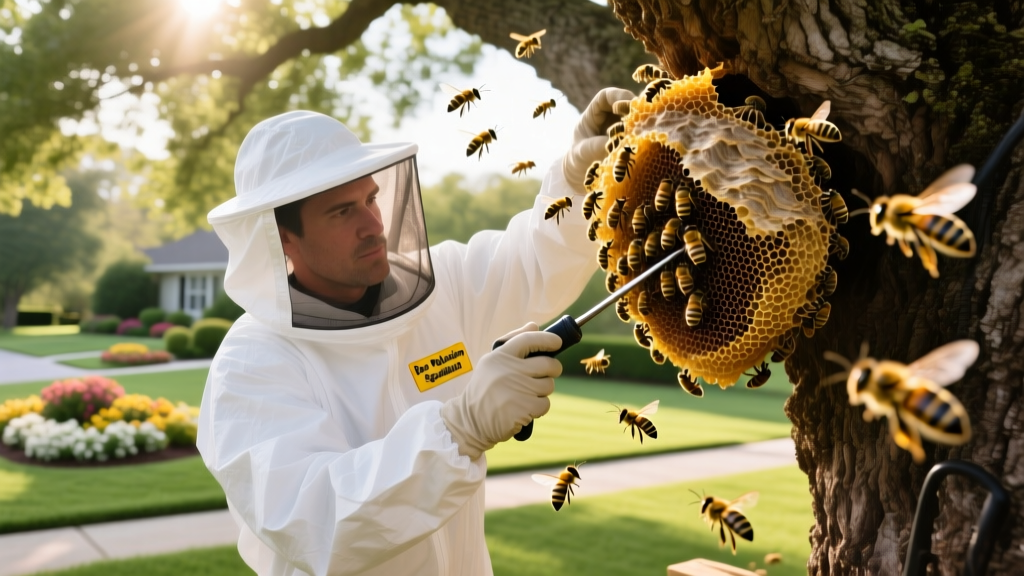
Safe Bee Nest Removal: Relocation and Eradication Protocols
The Golden Rule: Identify Before You Act
Effective yard defense begins with accurate species identification. Approximately 70% of homeowner complaints regarding 'ground bees' or 'aggressive bees' are actually misidentified yellowjackets (wasps). True bees are generally docile pollinators that require vastly different management strategies than stinging wasps. Eradicating a native bee colony disrupts local pollination networks and, in many jurisdictions, violates state agricultural protections. Before initiating any bee nest removal protocol, you must classify the insect, locate the nest architecture, and determine the legal and ecological parameters for intervention.
Quick Identification Tip: Bees are typically hairy or fuzzy with robust bodies and carry pollen on their hind legs. Wasps (like yellowjackets and hornets) have sleek, hairless bodies, distinct narrow waists, and exhibit aggressive, darting flight patterns.
Species Identification & Action Matrix
| Species | Nest Location | Aggression Level | Required Action |
|---|---|---|---|
| Honeybees (Apis mellifera) | Hollow trees, eaves, structural voids | Low (unless defending hive) | Live relocation by apiarist |
| Bumblebees (Bombus spp.) | Abandoned rodent burrows, grass clumps | Very Low | Tolerate; colony dies in autumn |
| Carpenter Bees (Xylocopa virginica) | Untreated wood, fascia boards, fences | Low (males lack stingers) | Targeted dust application & exclusion |
| Yellowjackets (Vespula spp.) | Ground voids, wall cavities, shrubs | Extremely High | Chemical eradication at dusk |
Honeybee Nest Removal: Relocation Over Eradication
Honeybees are critical agricultural assets. The Environmental Protection Agency (EPA) and state departments of agriculture heavily discourage and often legally prohibit the chemical eradication of honeybee colonies. When a honeybee swarm settles in your yard or an established hive takes up residence in a structural void, live removal is the only viable option.
Swarm Removal vs. Hive Cut-Outs
A swarm is a temporary cluster of bees resting on a branch or fence while scout bees search for a permanent home. Swarms are highly docile because they have no brood or honey stores to defend. Local beekeeping associations often deploy volunteer 'swarm catchers' who will remove these clusters for free or a nominal trip fee ($50–$100).
An established hive inside a tree hollow or wall cavity requires a 'cut-out.' This is a surgical procedure where a professional opens the cavity, vacuums the bees, extracts the honeycomb, and relocates the colony to a Langstroth hive box.
Critical Failure Mode: If a beekeeper removes the bees but leaves the honeycomb inside a wall void, the honey will melt in summer heat, destroying your drywall and attracting roaches, ants, and rodents. Always mandate complete comb extraction in your service contract.
Carpenter Bee Defense: Protecting Yard Structures
Carpenter bees do not eat wood; they excavate it to create brood galleries. The eastern carpenter bee (Xylocopa virginica) targets untreated, weathered softwoods like cedar, pine, and redwood commonly found in yard fences, pergolas, and deck railings.
The Nighttime Dusting Protocol
Spraying liquid insecticides into carpenter bee holes is largely ineffective because the galleries extend up to 10 inches deep and branch into multiple chambers. According to Penn State Extension, insecticidal dusts are the gold standard because they cling to the bees' hairy bodies and are carried deep into the gallery, eventually reaching the larvae.
- Wait for Dusk: Approach the nest at night when all foragers have returned and temperatures drop below 55°F, rendering the bees lethargic.
- Apply Residual Dust: Use a hand duster to apply a product containing Deltamethrin (e.g., Tempo 1% Dust) or Cyfluthrin directly into the 1/2-inch entry holes. Do not plug the hole immediately; leave it open for 48 hours so returning bees contact the dust.
- Seal and Exclude: After 48 hours, plug the hole with a wooden dowel coated in carpenter's glue, then seal the surface with exterior-grade polyurethane or paint. Carpenter bees avoid painted or varnished wood.
Ground Nest 'Bees' (Yellowjackets): The Aggressive Imposters
If the nest is in the ground and the insects are aggressively defending a perimeter of up to 15 feet, you are dealing with yellowjackets, not bees. Ground-nesting yellowjackets utilize abandoned vole or mouse burrows. Eradication requires extreme caution, as disturbing a ground nest can trigger a mass-envenomation event involving hundreds of stingers.
Jet-Stream Eradication Steps
For DIY eradication of ground nests, the UC Statewide IPM Program recommends using a rapid-knockdown aerosol formulated with d-tetramethrin and piperonyl butoxide (e.g., Spectracide Wasp Stop or Raid Wasp & Hornet Killer). These products shoot a concentrated stream up to 22 feet.
- Preparation: Wear thick clothing, gloves, and a veil. Plan your escape route before approaching.
- Application: Approach the nest entrance at night with a red-filtered flashlight (yellowjackets cannot see red light well). Saturate the hole entrance for 5 to 10 seconds until the void is flooded.
- Follow-up: Leave the area immediately. Return the next evening to apply a second treatment, as foragers that were away during the first application may return and attempt to rebuild.
- Closure: Once activity ceases for 48 hours, fill the burrow with soil and compact it to prevent future queens from utilizing the same void.
Cost Breakdown: DIY vs. Professional Bee Nest Removal
Budgeting for pest intervention requires weighing the cost of materials against the physical risk of anaphylaxis and structural damage. Below is the 2026 pricing matrix for common yard stinging insect scenarios.
| Scenario | DIY Material Cost | Professional Service Cost | Risk & Recommendation |
|---|---|---|---|
| Honeybee Swarm (Tree Branch) | $0 (Do not DIY) | $0 - $150 (Swarm Catcher) | Low risk. Always call a local apiarist. |
| Honeybee Hive (Structural Void) | $0 (Do not DIY) | $350 - $800+ (Cut-out) | High structural risk. Requires licensed bee removal specialist and contractor for repairs. |
| Carpenter Bee (Fence/Deck) | $15 - $30 (Dust & Putty) | $150 - $250 (Per visit) | Moderate risk. DIY is highly effective if done at night. |
| Yellowjacket (Ground Nest) | $10 - $20 (Aerosol) | $200 - $450 (Exterminator) | High physical risk. DIY only if no allergy history; otherwise, hire a pro. |
Post-Removal Yard Defense & Exclusion
Removing an active nest leaves behind chemical markers, pheromones, and physical voids that attract future queens. To secure your yard against re-infestation, implement these exclusion tactics:
Structural Exclusion
Inspect all fascia boards, soffits, and rooflines for gaps larger than 1/4 inch. Seal these with copper mesh and exterior silicone caulk. Yellowjackets and honeybees frequently exploit the gaps where plumbing or electrical lines enter the exterior walls. Ensure chimney caps and ridge vents are fitted with 1/8-inch hardware cloth.
Landscaping & Habitat Modification
Ground-nesting insects prefer dry, sparse soil. Maintaining a thick, irrigated turf canopy makes the soil less hospitable for burrowing wasps and solitary bees. For carpenter bees, apply a fresh coat of exterior paint or polyurethane sealant to all exposed wood structures in early spring (March-April) before the first generation of queens emerges to seek nesting sites. Avoid leaving stacks of untreated firewood or lumber near the home's perimeter, as these serve as primary staging areas for wood-boring insects.

