
Pest Control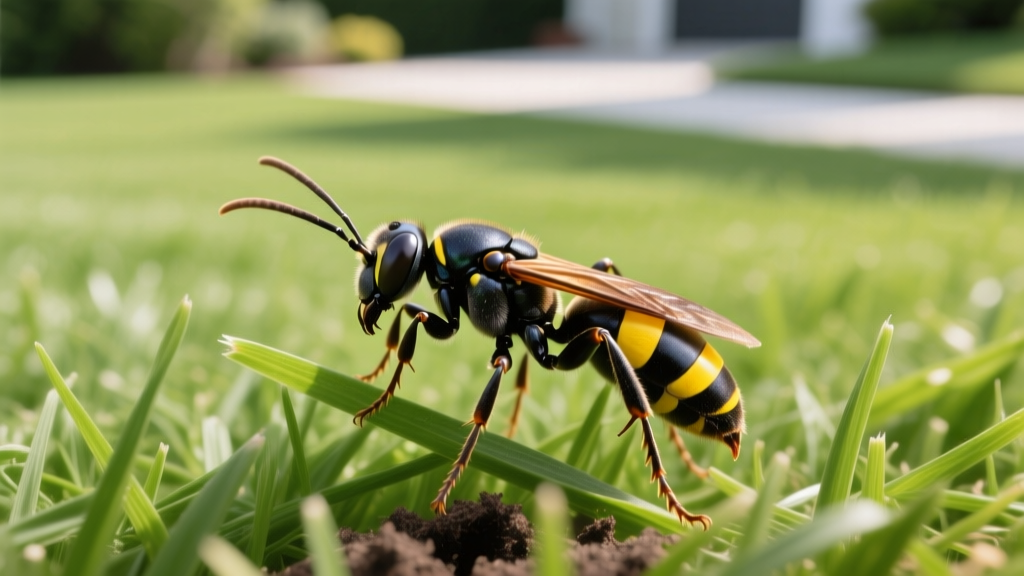
Scoliid Wasps in the Lawn: Identify, Manage, and Protect Your Yard
The Low-Flying Panic: Why Scoliid Wasps Are in Your Yard
When dozens of large, dark wasps begin zigzagging just inches above your turf in late summer, the instinctive reaction for most homeowners is to reach for a broad-spectrum insecticide. However, identifying the insect correctly is the most critical step in yard defense. The insects you are seeing are likely scoliid wasps (specifically Scolia dubia in the eastern and southern United States), and their presence is not an invasion—it is an active biological pest control operation happening in real time.
Scoliid wasps are solitary parasitoids. Unlike aggressive colonial wasps such as yellowjackets or hornets, they do not build paper nests, they do not defend a hive, and they have no reason to attack humans. The males, which make up the vast majority of the low-flying swarm you see, do not even possess stingers. They fly in erratic, low-level patterns solely to locate females and mate. The females are larger, possess a stinger, but are exceptionally docile, using their venom exclusively to paralyze subterranean white grubs.
According to entomological research highlighted by the Environmental Protection Agency's guidelines on beneficial insects, preserving parasitoid wasp populations is a cornerstone of integrated pest management (IPM). If you see scoliid wasps, your lawn is actively hosting a population of scarab beetle grubs, and the wasps are there to harvest them.
Identification Matrix: Scoliid Wasps vs. Aggressive Lookalikes
Misidentifying a scoliid wasp as a yellowjacket or a cicada killer can lead to unnecessary chemical applications and the destruction of beneficial biological controls. Use this comparison matrix to accurately identify the insect flying over your lawn.
| Feature | Scoliid Wasp (Scolia dubia) | Yellowjacket (Vespula spp.) | Cicada Killer (Sphecius speciosus) |
|---|---|---|---|
| Size | 0.75 to 1.0 inches | 0.5 to 0.75 inches | 1.5 to 2.0 inches |
| Coloration | Blue-black body, two distinct yellow spots/bands on abdomen | Bright yellow and black alternating bands | Black with yellow abdominal bands, reddish-orange wings |
| Flight Pattern | Low, erratic zigzagging just above grass blades | Direct, purposeful flight to and from ground nests | High, heavy, loud flight; often carrying large prey |
| Nesting | Solitary; no visible nest or hive | Colonial; visible ground holes with high traffic | Solitary; large U-shaped burrows in bare soil |
| Aggression Level | Extremely low; males cannot sting | High; will swarm and sting repeatedly if disturbed | Low; females rarely sting unless physically crushed |
The Real Culprit: White Grubs and Lawn Damage
The presence of scoliid wasps is a secondary symptom; the primary issue is a subterranean grub infestation. Female wasps use their highly sensitive antennae to detect the exact location of scarab beetle larvae (such as Japanese beetles, June bugs, and masked chafers) buried in the soil profile. The female digs down, stings the grub to paralyze it, and lays a single egg on its body. When the wasp larva hatches, it consumes the grub, eventually pupating in the soil to emerge as an adult the following summer.
While the wasps are beneficial, the grubs they are hunting can cause severe structural damage to turfgrass roots, leading to brown, dead patches that roll back like loose carpet. The decision to intervene depends entirely on the grub population density, not the presence of the wasps.
The 1-Square-Foot Grub Test
Before applying any grub-control chemicals, you must establish your baseline infestation rate. Follow this standardized diagnostic procedure:
- Select Test Zones: Choose three distinct areas in your lawn—one near a brown patch, one in a transitional zone, and one in healthy green turf.
- Cut the Sod: Using a sharp flat spade, cut a 12-inch by 12-inch square into the soil to a depth of 3 inches.
- Peel and Inspect: Roll back the turf square like a carpet. Examine the exposed soil and the root zone for C-shaped, white grubs with brown head capsules.
- Count and Calculate: Tally the grubs found in that single square foot. Replace the turf and tamp it down gently.
- Determine the Threshold: Turfgrass can typically tolerate 5 to 7 grubs per square foot without visible damage. If your count exceeds 8 to 10 grubs per square foot, chemical intervention is required to save the lawn.
Management Strategy: To Treat or Not to Treat?
The IPM Decision Framework: If your grub count is under the 8-per-square-foot threshold, the scoliid wasps are successfully managing the population. Do not apply insecticides, as you will kill the beneficial wasps and disrupt the natural biological control cycle. If the count exceeds the threshold, the wasps are overwhelmed, and targeted chemical intervention is necessary.
Option A: Let the Wasps Work (Biological Control)
If your lawn falls below the economic damage threshold, your only required action is patience. The adult wasp flight period typically lasts 3 to 5 weeks in late summer to early fall. During this time, avoid mowing the lawn during peak flight hours (mid-morning to early afternoon) to prevent accidentally striking the low-flying insects. Maintain standard irrigation practices to keep the turf resilient against minor root pruning caused by the grubs. For more on leveraging natural predators, consult resources from Penn State Extension's lawn pest management programs, which heavily advocate for preserving parasitoid populations whenever possible.
Option B: Chemical Grub Intervention (When Damage is Severe)
When grub populations exceed 10 per square foot, the biological control provided by scoliid wasps is insufficient to prevent turf death. You must target the grubs directly. Note that treating the grubs will naturally cause the scoliid wasp population to decline in subsequent years, as their food source and breeding hosts are eliminated.
- Preventive Control (Early Summer): Products containing Chlorantraniliprole (e.g., Scotts GrubEx1) or Imidacloprid (e.g., Bayer Advanced 24 Hour Grub Killer) should be applied between late May and early July. These active ingredients have a long residual life in the soil and target young, early-instar grubs as they hatch. They have minimal impact on adult wasps flying above ground.
- Curative Control (Late Summer/Fall): If you missed the preventive window and are seeing active damage and high grub counts in August or September, you need a fast-acting contact killer. Products containing Trichlorfon (e.g., Dylox) or Carbaryl will kill large, mature grubs within 24 to 48 hours. Apply these products heavily watered into the soil profile, as the grubs will be feeding deep near the root zone.
Cost Expectation: A standard 15-pound bag of Chlorantraniliprole granules covers approximately 5,000 square feet and costs between $35 and $45. Curative Trichlorfon treatments are generally more expensive per square foot, averaging $50 to $60 for the same coverage area.
Frequently Asked Questions About Scoliid Wasps
Will scoliid wasps sting my pets or children playing in the yard?
The risk is virtually zero. Male scoliid wasps lack stingers entirely. Females possess stingers but are solitary and lack the defensive hive-protecting instinct of social wasps. A female will only sting if she is physically crushed or trapped against the skin. Normal lawn activities, including pets running through the grass, will not provoke them.
Can I use a wasp trap to get rid of them?
Commercial wasp traps baited with heptyl butyrate or sugar-water are designed for yellowjackets and are entirely ineffective against scoliid wasps. Scoliid wasps do not forage for human food or sweet liquids; adult females feed on nectar from deep-throated flowers, and males feed on plant exudates. Trapping is a waste of time and resources.
Do scoliid wasps kill the grass directly?
No. The females do dig small, pencil-sized holes into the soil to reach grubs, which can leave minor mounds of dirt on the surface. However, this aeration effect is harmless to the turf. The brown, dying patches in your lawn are caused exclusively by the root-feeding grubs, not the wasps hunting them.

