
Pest Control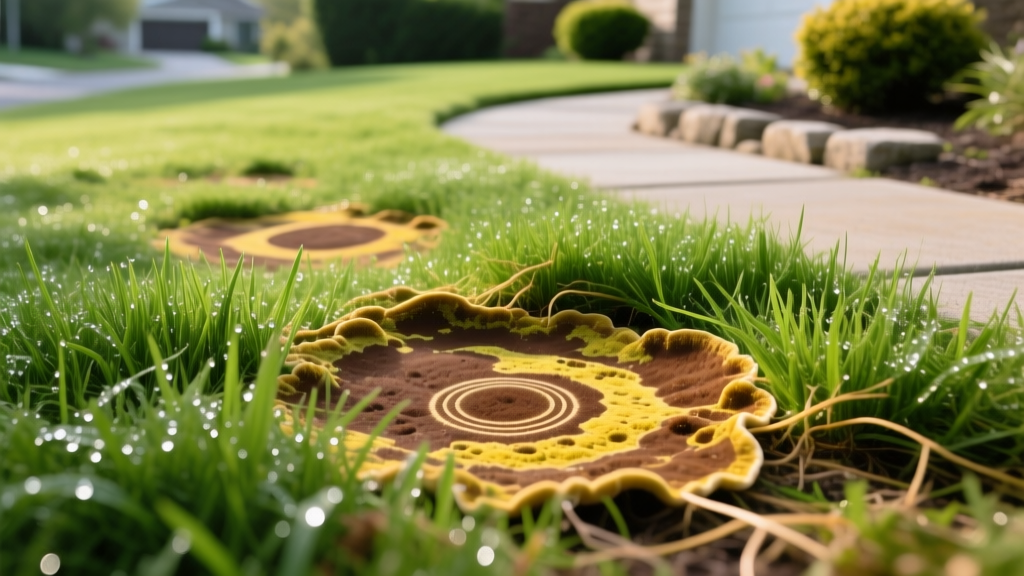
Diagnosing Lawn Fungus: Scotts DiseaseEx Lawn Fungicide Rescue Guide
The 48-Hour Fungal Collapse: Why Speed Matters
When high humidity and nighttime temperatures above 65°F collide, turfgrass pathogens can decimate a healthy lawn in under 48 hours. Homeowners often mistake early fungal lesions for drought stress or dog urine burn, delaying treatment until the mycelium has colonized the plant crown. At this stage, preventative measures are useless; you need a curative systemic intervention.
Scotts DiseaseEx lawn fungicide relies on a 0.31% concentration of Azoxystrobin, a strobilurin-class active ingredient. Unlike contact fungicides that wash off the leaf blade, Azoxystrobin is absorbed by the plant tissue and translocates upward through the xylem, halting fungal respiration at the cellular level. However, deploying it correctly during an active outbreak requires precise diagnostic skills and strict adherence to curative application rates.
Symptom Diagnosis Matrix: Is It Actually Fungus?
Applying a broad-spectrum fungicide to abiotic stress (like compaction or nitrogen burn) wastes money and accelerates chemical resistance. Before opening a bag of DiseaseEx, cross-reference your lawn's symptoms against this diagnostic matrix.
| Disease | Visual Symptom (Macro) | Close-Up Clue (Micro) | Optimal Infection Temp |
|---|---|---|---|
| Brown Patch | Circular patches (1-5 ft) with dark smoke rings at the margins in early morning. | Lesions on leaf blades with tan centers and dark brown borders. | 75°F - 85°F (Night > 65°F) |
| Dollar Spot | Small, silver-dollar-sized bleached spots that merge into larger blighted areas. | Hourglass-shaped lesions spanning the width of the leaf blade. | 60°F - 85°F (High Humidity) |
| Lawn Rust | Yellowing turf canopy; shoes/pants get coated in orange dust when walking. | Pustules on leaf surfaces that rupture to release orange spores. | 65°F - 85°F (Prolonged Dew) |
| Fairy Ring | Dark green stimulated growth rings, sometimes with dead interior zones or mushrooms. | Hydrophobic (water-repellent) soil in the root zone beneath the ring. | 70°F - 90°F (Summer Stress) |
Source: For comprehensive visual identification, refer to the Penn State Extension Brown Patch Guide and the NC State Turfgrass Pathology Database.
Curative vs. Preventative: Adjusting Your Application Rates
The most common failure mode with Scotts DiseaseEx lawn fungicide is using the preventative rate on an active infection. The product label dictates two distinct application tiers based on the severity of the outbreak.
⚠️ CRITICAL RESCUE DOSING WARNING:
If you already see active mycelium or expanding brown patches, you must use the curative rate. Applying the lower preventative dose to an active infection will fail to halt the pathogen and will expose the surviving fungal population to sub-lethal chemical doses, rapidly breeding Azoxystrobin-resistant strains.
If you already see active mycelium or expanding brown patches, you must use the curative rate. Applying the lower preventative dose to an active infection will fail to halt the pathogen and will expose the surviving fungal population to sub-lethal chemical doses, rapidly breeding Azoxystrobin-resistant strains.
Exact Application Rates & 2026 Pricing Context
- Preventative Rate: 2 lbs per 1,000 sq ft. (A standard 10 lb bag covers 5,000 sq ft). Cost: ~$0.06 per sq ft.
- Curative Rescue Rate: 4 lbs per 1,000 sq ft. (A 10 lb bag covers only 2,500 sq ft). Cost: ~$0.12 per sq ft.
As of early 2026, a 10 lb bag of Scotts DiseaseEx retails between $28.00 and $32.00. Budget accordingly for curative treatments, as your coverage area is effectively halved during a rescue operation.
The 14-Day Rescue Protocol
Follow this exact sequence to halt an active outbreak and protect new growth.
- Mow and Bag: Mow the lawn at your standard height, but use a bagger to physically remove as many infected leaf clippings and fungal spores as possible. Do not mulch infected clippings back into the canopy.
- Calibrate the Spreader: Set your Scotts Rotary Spreader to the setting indicated on the bag for 4 lbs/1,000 sq ft (typically around setting 5.5, but verify against the specific bag's calibration chart). Walk at a steady pace of 3 feet per second.
- Apply in Grid Pattern: Spread the granules in a north-south direction, then repeat in an east-west direction to ensure uniform coverage and avoid striping.
- Water-In Immediately: Azoxystrobin granules must be washed off the leaf blade and into the thatch layer where the fungus attacks the crown. Apply exactly 0.1 to 0.25 inches of irrigation immediately after spreading. Use a rain gauge or empty tuna cans to measure the output. Do not overwater, as excessive saturation will push the active ingredient past the root zone and promote further fungal growth.
- Restrict Access: Keep pets and children off the lawn until the grass is completely dry (usually 2-4 hours).
- Day 14 Follow-Up: Assess the lawn. The existing brown spots will not turn green immediately (the tissue is dead), but the margins should stop expanding. If the disease is still advancing, a second application is required, but do not use DiseaseEx again (see Resistance Management below).
Resistance Management: The FRAC Rotation Rule
Azoxystrobin belongs to Fungicide Resistance Action Committee (FRAC) Group 11 (Quinone outside Inhibitors). According to the EPA's Azoxystrobin pesticide fact sheet, Group 11 fungicides carry a high risk of resistance development because they target a single, specific site in the fungal mitochondria.
If your lawn requires a second rescue application 14 to 21 days later, you must rotate to a different chemical class. Purchase a fungicide containing Propiconazole or Myclobutanil (both are FRAC Group 3 - Demethylation Inhibitors). Alternating between Group 11 and Group 3 chemistries disrupts the pathogen's ability to mutate and survive your treatments.
Common Edge Cases & Application Failures
1. The "Wash-Off" Failure
If heavy rain is forecast within 6 hours of application, delay the treatment. While granular formulations are less susceptible to immediate wash-off than liquid sprays, a torrential downpour before the granules dissolve and move into the thatch will dilute the active ingredient below effective thresholds.
2. Misdiagnosing Abiotic Stress
If your brown patches are concentrated near sidewalks, driveways, or south-facing slopes, the issue is likely heat stress and localized drought, not fungus. Azoxystrobin will not cure a lawn suffering from hydrophobic soil or inadequate irrigation. Perform a "screwdriver test"—if you cannot easily push a 6-inch screwdriver into the brown soil, you have a moisture/compaction issue, not a fungal one.
3. Thatch Barrier Interference
If your lawn has more than 0.5 inches of thatch, the granular fungicide will get trapped in the organic layer and never reach the soil-dwelling pathogens causing diseases like Fairy Ring or Summer Patch. Core aerate the lawn before applying the fungicide to create direct channels to the root zone.

