
Pest Control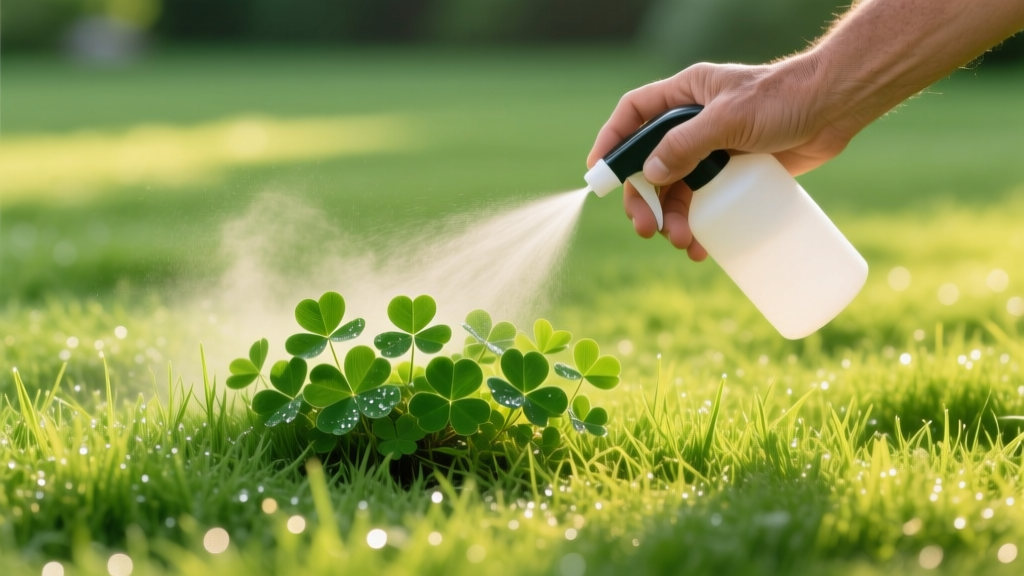
Best Clover Weed Killer Options for Targeted Lawn Spot Treatments
White clover (Trifolium repens) and red clover (Trifolium pratense) are perennial broadleaf weeds that exploit nitrogen-deficient turfgrass. Because clover possesses a symbiotic relationship with Rhizobium bacteria to fix atmospheric nitrogen, it easily outcompetes starving grass in under-fertilized lawns. Furthermore, its creeping stolons and waxy leaf cuticles make it highly resistant to generic, off-the-shelf weed sprays. Selecting the right clover weed killer requires understanding plant physiology, active ingredient chemistry, and precise application mechanics.
The Biological Challenge: Why Clover Resists Standard Herbicides
Clover leaves feature a dense network of trichomes (microscopic hairs) and a thick, waxy cuticle. When sprayed with standard aqueous herbicide solutions, the liquid beads up and rolls off the leaf surface before the active ingredients can penetrate the plant tissue. Additionally, clover spreads via above-ground stolons that root at the nodes. If your chosen herbicide lacks systemic translocation properties, it will only burn the top growth while the rooted nodes regenerate new shoots within 14 to 21 days.
According to turfgrass specialists at Penn State Extension, effective eradication requires a systemic, selective broadleaf herbicide paired with a high-quality surfactant to break the leaf's surface tension.
Clover Species Identification Matrix
Before mixing your clover weed killer, identify the specific species. Misidentification can lead to improper dosage or accidental eradication of intentionally seeded eco-lawn components.
| Species | Visual Markers | Growth Habit | Herbicide Susceptibility |
|---|---|---|---|
| White Clover | 3-lobed leaves with white 'V' chevron; white/pink spherical flowers | Creeping stolons, roots at nodes | Moderate (Requires systemic 2,4-D/Dicamba mixes) |
| Red Clover | Larger, hairy leaves; prominent reddish-purple spherical flowers | Upright, short-lived perennial, deep taproot | Low (Requires Triclopyr or higher application rates) |
| Microclover | Tiny leaves, fewer flowers, dense low canopy | Creeping, often intentionally seeded | High (Easily killed by standard broadleaf herbicides) |
Active Ingredients That Actually Work
Single-ingredient herbicides rarely provide complete clover control. The most effective clover weed killers utilize a three- or four-way active ingredient blend to attack the plant's metabolic processes simultaneously.
- 2,4-D (Choline or Amine): A synthetic auxin that causes uncontrolled, fatal cellular growth in broadleaf plants. Amine formulations are safer for warm-season grasses like Bermuda and Zoysia during high heat.
- Dicamba: Works synergistically with 2,4-D. It is highly mobile in the soil, which helps it reach the stolon nodes, but care must be taken near the drip lines of desirable trees and shrubs.
- MCPP-p (Mecoprop): Excellent for controlling mature, tough-stemmed clover and works well in cooler spring temperatures when 2,4-D efficacy drops.
- Triclopyr: The heavy hitter for stubborn red clover and woody-stemmed broadleaves. Often required if standard 2,4-D blends fail after two applications.
- Carfentrazone-ethyl: A PPO-inhibitor that provides rapid 'burn-down' of leaf tissue within 24 hours, allowing the slower systemic ingredients (2,4-D/Dicamba) more time to translocate to the roots before the plant shuts down.
Step-by-Step Spot Treatment Protocol
Spot-treating isolated clover patches saves money and minimizes chemical introduction to your soil. Follow this exact protocol for optimal results.
Step 1: Environmental Timing
Apply herbicides when soil temperatures are between 65°F and 80°F. Clover must be actively growing to pull the systemic chemicals down to the roots. Avoid applications if rainfall is expected within 24 hours or if daytime air temperatures exceed 85°F, which increases the risk of vapor drift damaging nearby ornamentals.
Step 2: The Surfactant Mandate
Never spray clover without a non-ionic surfactant (NIS). The University of California IPM program notes that surfactants reduce water's surface tension, allowing the herbicide to spread evenly across the waxy clover leaf rather than beading up.
Mixing Ratio: Add 0.5 teaspoons (approx. 2.5 ml) of NIS per gallon of mixed herbicide.
Step 3: Equipment and Mixing
Use a 1-gallon or 2-gallon pump sprayer equipped with a flat-fan nozzle (e.g., TeeJet 110-02) rather than a cone nozzle. Calibrate your sprayer to deliver a medium droplet size at 20 to 30 PSI. This minimizes fine mist drift. Spray the clover until the leaves are uniformly wet, but stop before the liquid begins to run off onto the soil.
⚠️ Drift Warning: Never use a hose-end sprayer for clover weed killers. The high volume and coarse droplets inevitably lead to soil saturation and root uptake by surrounding desirable turf and ornamentals.
Top Commercial Formulations for Spot Treatments
Based on current turfgrass management standards, these formulations offer the highest efficacy for residential spot treatments.
1. PBI Gordon SpeedZone Broadleaf Herbicide (Concentrate)
Active Ingredients: 2,4-D, MCPP-p, Dicamba, Carfentrazone-ethyl.
Average Cost: $50 - $55 per 20 oz bottle.
Mix Rate: 1.4 to 1.8 fl oz per 1,000 sq ft (approx. 0.5 fl oz per gallon for spot spraying).
Why it works: The addition of Carfentrazone provides visible leaf necrosis within 48 hours, while the systemic trio kills the stolon nodes over the next two weeks. It is safe for most cool-season grasses and Bermudagrass.
2. PBI Gordon Trimec 992 (Concentrate)
Active Ingredients: 2,4-D, MCPP-p, Dicamba.
Average Cost: $35 - $40 per 32 oz bottle.
Mix Rate: 1.5 fl oz per gallon of water per 1,000 sq ft.
Why it works: A highly reliable, economical three-way herbicide. It lacks the rapid burn-down of SpeedZone but is exceptionally effective on white clover when applied during optimal spring or fall temperatures. Requires a surfactant.
3. Ortho WeedClear Lawn Weed Killer (Ready-to-Use)
Active Ingredients: 2,4-D, Quinclorac, Dicamba.
Average Cost: $12 - $15 per 32 oz RTU wand bottle.
Mix Rate: Pre-mixed.
Why it works: Best for homeowners with only 5 to 10 isolated clover patches. The built-in wand provides targeted application. Note that Quinclorac is primarily a crabgrass killer, making this a versatile dual-purpose product, though it is less effective on mature red clover than Triclopyr-based concentrates.
Post-Eradication Turf Recovery
Killing the clover is only half the battle. Clover is a symptom of low soil nitrogen. If you do not correct the nutrient deficiency, new clover seeds (which can remain viable in the soil seedbank for up to 5 years) will germinate in the bare spots left behind.
According to Michigan State University Extension, turfgrass requires significantly more nitrogen than clover to thrive. Fourteen days after your final herbicide application, apply a slow-release nitrogen fertilizer. Look for a product containing methylene urea or sulfur-coated urea (SCU) and apply at a rate of 0.5 to 0.8 lbs of actual Nitrogen per 1,000 square feet. This will force the surrounding grass to lateral growth, quickly filling the voids and shading out any remaining clover seedlings.
Frequently Asked Questions
Will vinegar or boiling water kill clover?
Horticultural vinegar (20% acetic acid) and boiling water are non-selective contact burn-downs. They will destroy the top foliage of the clover but will not translocate to the roots. Furthermore, they will instantly kill any surrounding grass, leaving a bare patch that is highly susceptible to immediate clover regrowth from the surviving root system.
How many applications are required to kill mature clover?
For heavily established patches of white or red clover, expect to make two applications spaced 21 to 28 days apart. The first application weakens the root system and burns the primary foliage; the second application targets the secondary regrowth from the stolons.
Is it safe to use clover weed killers near vegetable gardens?
No. Systemic broadleaf herbicides like 2,4-D and Dicamba can easily drift or leach into adjacent soil. Tomatoes, peppers, and grapes are exceptionally sensitive to auxin-type herbicides and will suffer severe cupping, twisting, and yield loss even from microscopic vapor drift. Maintain a minimum 15-foot buffer zone or use physical hand-pulling near garden beds.

