
Pest Control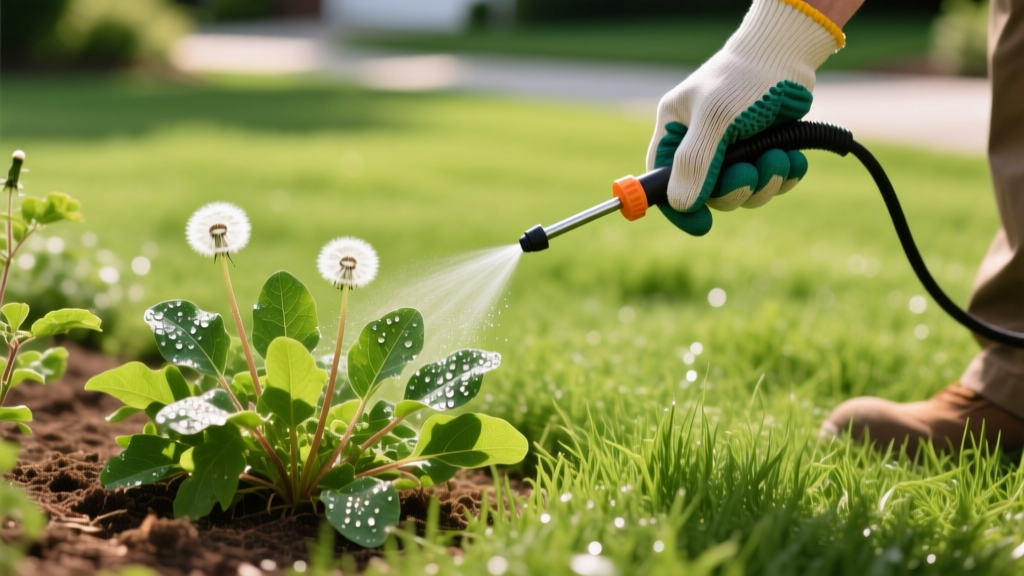
Selective Herbicide for Broadleaf Weeds: Spot-Treatment Guide
The Science of Selective Broadleaf Control
Spot-treating isolated weed outbreaks preserves turfgrass health and minimizes chemical load on your soil. When selecting a selective herbicide for broadleaf weeds, you are leveraging synthetic auxins—chemical compounds that mimic natural plant growth hormones. Monocots (grasses) possess a protected apical meristem and distinct vascular structure that allows them to rapidly metabolize these compounds. Dicots (broadleaf weeds), however, absorb the auxin mimics into their unprotected meristematic tissues, triggering uncontrolled, unsustainable cellular division that ultimately causes the plant to twist, necrotize, and die.
According to the University of Missouri Extension, the efficacy of these synthetic auxins relies heavily on application timing, carrier volume, and the specific physiological stage of the target weed. Broadcast spraying entire lawns for a few isolated dandelions is an outdated practice; precision spot-treatment is the modern standard for integrated pest management.
Active Ingredient Matrix: Choosing the Right Chemistry
No single active ingredient controls all broadleaf species. Professional-grade formulations typically combine two to four active ingredients to broaden the spectrum of control and prevent weed resistance. Below is a comparison of the primary chemistries used in selective broadleaf herbicides.
| Active Ingredient | Target Weeds | Turf Safety | Approx. Cost (Per Gallon) | Rainfast Period |
|---|---|---|---|---|
| 2,4-D (Amine) | Dandelion, Plantain, Thistle | Safe on most cool/warm-season grasses | $35 - $50 (in mixes) | 6 - 8 hours |
| Dicamba | Clover, Chickweed, Knotweed | Safe on most turf; avoid near tree roots | $40 - $60 (in mixes) | 4 - 6 hours |
| MCPP-p | Clover, Ground Ivy, Spurge | Excellent safety profile | $50 - $70 (in mixes) | 6 hours |
| Triclopyr | Violet, Wild Strawberry, Oxalis | Safe on cool-season; injures Bermuda/St. Augustine | $80 - $110 (standalone) | 8 hours |
| Carfentrazone | Spurge, Purslane, Clover (burn-down) | Safe on all major turf species | $120+ (in premium mixes) | 2 - 4 hours |
Note: For residential spot-treatments, a 3-way or 4-way mixture like Trimec 992 (2,4-D + MCPP + Dicamba) or SpeedZone (adds Carfentrazone for rapid visual burn-down) provides the highest probability of success across multiple weed species.
Species-Specific Spot-Treatment Protocols
Broadleaf weeds exhibit distinct growth habits that dictate how you should apply your selective herbicide. A uniform spray approach fails when dealing with diverse morphologies.
Dandelion (Taraxacum officinale)
Dandelions survive via a deep, brittle taproot that can extend 10 to 15 inches into the soil. If the crown and upper taproot are not killed, the weed will regenerate within weeks. Protocol: Mix a 3-way selective herbicide at the maximum label rate (typically 1.5 fl oz per gallon of water per 1,000 sq ft). Spray the basal rosette until the leaves are uniformly wet but not dripping. The systemic herbicide will translocate down into the taproot over 10 to 14 days. Do not mow for 48 hours before or after application to maximize leaf surface area.
White Clover (Trifolium repens)
Clover spreads laterally via stolons (above-ground runners) that root at the nodes. Spot-treating only the visible leaves leaves the stolon network intact. Protocol: Use a mixture containing MCPP-p and Dicamba, which are highly effective on legumes. Spray the central crown and trace the stolon outward by 6 inches, lightly misting any connected nodes. Adding a high-quality non-ionic surfactant is mandatory here, as clover leaves possess a waxy cuticle that repels water-based sprays.
Broadleaf Plantain (Plantago major)
Plantain forms a dense, low-growing rosette with thick, ribbed leaves that shed liquid easily. It thrives in compacted soil where turfgrass struggles. Protocol: Increase your carrier volume. Instead of a fine mist, use a slightly coarser spray pattern to physically penetrate the overlapping leaf layers and reach the crown at the soil line. A product containing Carfentrazone will provide visible necrosis within 24 hours, confirming adequate coverage.
Crucial Chemistry Note: The Surfactant Multiplier
The University of California Statewide IPM Program emphasizes that herbicide efficacy drops by up to 40% on waxy broadleaf weeds without a surfactant. Always add a non-ionic surfactant (NIS) at a rate of 0.25% v/v (roughly 1 teaspoon per gallon of mixed solution). This reduces the surface tension of the water droplet, forcing the chemical to spread across the leaf surface and penetrate the stomata rather than beading up and rolling into the soil.
Calibration and Application Mechanics
The most common failure mode in spot-treatment is not the chemical itself, but poor equipment calibration. Over-application causes turf phytotoxicity (chemical burn), while under-application results in weed survival and resistance.
- Nozzle Selection: Swap the standard cone nozzle on your pump sprayer for a flat fan nozzle (e.g., TeeJet 8002EVS). Flat fan nozzles produce uniform droplet sizes that ensure even coverage without excessive runoff.
- Pressure Control: Maintain tank pressure between 20 and 30 PSI. Pressures above 40 PSI create fine driftable droplets that can land on nearby ornamental shrubs and cause severe damage.
- Carrier Volume: Calibrate your walking speed and spray pattern to deliver exactly 1.5 to 2.0 gallons of mixed solution per 1,000 square feet of target area. For spot treatments, this means spraying a 3-foot diameter circle for roughly 2 to 3 seconds.
- Dye Markers: Add a few drops of turf-marking dye (brilliant blue) to your tank. This provides immediate visual feedback on your coverage overlap and prevents accidental double-spraying of the same weed cluster.
Environmental Guardrails and Volatility Risks
Selective broadleaf herbicides are highly sensitive to environmental conditions at the exact moment of application. Ignoring these thresholds is the primary cause of collateral damage to non-target landscape plants.
Temperature Thresholds: Never apply 2,4-D or Dicamba when ambient temperatures exceed 85°F (29°C), or when temperatures are forecasted to exceed 85°F within 24 hours of application. Under high heat, these chemicals undergo vapor drift—converting from a liquid into a gas that floats across your property and curls the leaves of your tomatoes, roses, and hydrangeas.
Wind Limits: The Environmental Protection Agency (EPA) strictly advises against pesticide application during windy conditions. For spot-treatments, abort the operation if sustained winds exceed 5 to 8 mph. Even a light breeze can carry atomized droplets into neighboring garden beds.
Irrigation Timing: Do not irrigate the lawn for at least 24 hours post-application. Watering too soon washes the systemic herbicide off the leaf tissue and into the soil profile before it has time to translocate into the weed's root system. Conversely, ensure the weeds are not drought-stressed before spraying; a dehydrated weed shuts down its vascular system to conserve water, which halts the internal movement of the herbicide.
Summary Checklist for Spot-Treatment Success
- Identify the specific weed species to select the correct active ingredient matrix.
- Mix at the precise label rate using a non-ionic surfactant (0.25% v/v).
- Use a flat fan nozzle at 20-30 PSI to target the basal rosette and crown.
- Apply only when temperatures are below 85°F and winds are under 5 mph.
- Withhold mowing and irrigation for 48 hours to allow full root translocation.

