
Pest Control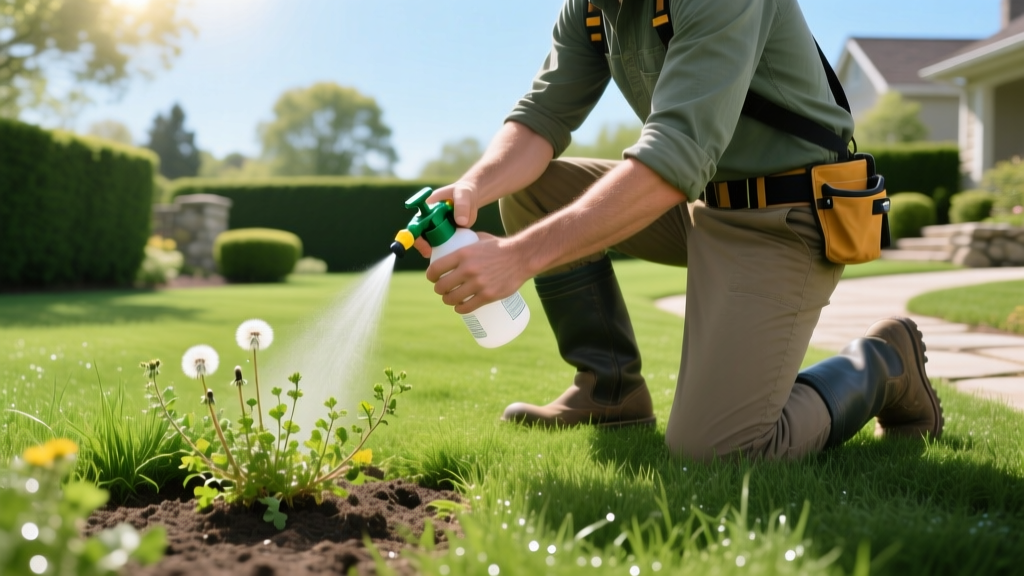
Mastering Selective Herbicide for Weeds: A Spot-Treatment Guide
The Science of Selectivity: Why Spot-Treating Works
Applying a non-selective herbicide like glyphosate to a lawn results in total turf destruction. Selective herbicides, however, exploit biochemical differences between monocots (grasses) and dicots (broadleaf weeds), or target specific enzymatic pathways unique to certain weed families. By utilizing a selective herbicide for weeds, you can eradicate invasive species like dandelion, crabgrass, or nutsedge while leaving your surrounding turfgrass entirely unharmed.
Spot-treatment amplifies the benefits of selective chemistry. Instead of broadcasting chemicals across 5,000 square feet of healthy grass to kill 50 square feet of weeds, spot-treating reduces chemical load, lowers costs, and minimizes environmental impact. According to NCSU TurfFiles, targeted application reduces total active ingredient usage by up to 80% compared to broadcast applications in lawns with scattered weed pressure.
The Weed-to-Herbicide Matching Matrix
Selecting the correct selective herbicide for weeds requires matching the active ingredient to the specific weed species and your turfgrass type. The following matrix outlines professional-grade active ingredients, their target weeds, and current market pricing for residential-scale purchases.
| Target Weed | Active Ingredient | Product Example | Est. Cost | Optimal Growth Stage |
|---|---|---|---|---|
| Broadleaf (Dandelion, Clover) | Carfentrazone + 2,4-D + MCPP + Dicamba | SpeedZone Broadleaf Herbicide | $65 / pint | Young, actively growing |
| Crabgrass (Smooth & Hairy) | Quinclorac | Drive XLR8 | $75 / half-gallon | 1 to 3-tiller stage |
| Yellow & Purple Nutsedge | Halosulfuron-methyl | SedgeHammer Plus | $28 / 5-pack (13.5g) | 3 to 5-leaf stage |
| Poa Annua & Bentgrass | Mesotrione | Tenacity | $62 / 8 oz | Pre-emergent or young post |
| Wild Violet & Ground Ivy | Triclopyr + Fluroxypyr | Trimec Southern | $55 / gallon | Fall application preferred |
Precision Spot-Treatment Protocol
Achieving a clean kill without damaging surrounding turf requires strict adherence to mixing and application protocols. Herbicide failure is rarely due to the chemical itself; it is almost always a result of improper water conditioning, missing surfactants, or poor calibration.
Step 1: Water Conditioning and Surfactants
Municipal water and well water often contain high levels of calcium, magnesium, and iron. These hard water cations bind to weak-acid herbicides (like 2,4-D and glyphosate), rendering them inactive before they even reach the leaf surface. To prevent this, add Ammonium Sulfate (AMS) at a rate of 1.5 to 2.5 pounds per 100 gallons of water (roughly 1 tablespoon per 2 gallons) before adding the herbicide.
Next, select the correct surfactant. For most selective herbicides like Drive XLR8 or SedgeHammer, a Non-Ionic Surfactant (NIS) at 0.25% v/v (1/2 oz per gallon) is required to break the leaf's waxy cuticle. For Mesotrione (Tenacity), a Methylated Seed Oil (MSO) is mandatory to facilitate cuticular penetration.
Step 2: Calibration and Mixing
For spot-treating, a 1-gallon or 2-gallon hand-pump sprayer is superior to a hose-end sprayer, which lacks precision. Calibrate your sprayer to deliver exactly 1 gallon per 1,000 square feet. When mixing, always follow the W-A-L-E-S protocol: Wettable powders first, Agitate, Liquid flowables, Emulsifiable concentrates, and Surfactants/Solutions last. This prevents chemical clumping and nozzle clogging.
Add a blue spray indicator dye (1/4 oz per gallon). This provides immediate visual confirmation of your coverage, ensuring you do not double-spray and accidentally exceed the maximum label rate, which can cause severe phytotoxicity to your turf.
Step 3: Application Timing and Weather Constraints
Systemic selective herbicides require active plant growth to translocate from the leaf tissue down to the root crown. Do not apply during drought stress, as weeds close their stomata to conserve water, halting herbicide uptake. Water the lawn deeply 24 hours prior to application.
Warning: Temperature Inversions and Volatility
Auxin-mimic herbicides (2,4-D, Dicamba, Triclopyr) are highly volatile when temperatures exceed 85°F. Applying these chemicals on hot days can cause vapor drift, damaging non-target broadleaf plants, shrubs, and even your turfgrass. Restrict spot-treatments to early morning hours when temperatures are between 65°F and 80°F and wind speeds are below 5 mph.
Turfgrass Safety Limits and Phytotoxicity Risks
While selective herbicides are designed to spare grass, 'selective' does not mean 'universally safe.' The margin of safety varies drastically depending on your specific turfgrass species. As noted by University of Minnesota Extension, misidentifying your grass type is the leading cause of chemical turf damage.
- Cool-Season Grasses (Tall Fescue, Kentucky Bluegrass, Ryegrass): Highly tolerant of most selective herbicides. 2,4-D, Quinclorac, and Mesotrione can generally be applied at full label rates without causing more than temporary, mild chlorosis (yellowing).
- Warm-Season Grasses (Bermudagrass, Zoysia): Moderate tolerance. Quinclorac can cause severe stunting and yellowing in Bermudagrass if applied during peak summer heat. Mesotrione (Tenacity) will bleach Bermudagrass white and should only be used on dormant turf or as a very precise, shielded spot-treatment.
- St. Augustinegrass & Centipedegrass: Highly sensitive. Standard 2,4-D formulations will severely burn St. Augustine. You must use products specifically labeled for sensitive southern turfs, such as those relying on Atrazine or low-dose Penoxsulam, and avoid Dicamba entirely.
Troubleshooting: Why Did the Weed Survive?
If your spot-treatment resulted in the weed wilting but ultimately recovering, analyze the following failure modes:
- Incorrect Growth Stage: Quinclorac is highly effective on crabgrass in the 1-tiller stage, but its efficacy drops precipitously once the plant transitions to the 4-tiller stage or matures. Mature weeds require multiple applications spaced 14 days apart.
- Mowing Interference: Systemic herbicides need leaf surface area to enter the plant. Mowing immediately before or after application removes the chemical or reduces the absorption zone. Wait 48 hours after spraying before mowing.
- Hard Water Antagonism: If you skipped the AMS water conditioner, the calcium in your tap water likely neutralized the herbicide. The weed may show initial burn from the surfactant but will recover fully within a week.
- Waxy Cuticle Barrier: Weeds like wild violet and ground ivy have thick, waxy leaves. If you used a standard crop oil instead of a high-quality MSO, or omitted the surfactant entirely, the droplets simply beaded up and rolled off the leaf surface.
Mastering the use of a selective herbicide for weeds transforms lawn care from a reactive, chemical-heavy chore into a precise, strategic operation. By matching the active ingredient to the weed species, conditioning your water, and respecting turfgrass safety limits, you can maintain a pristine lawn with minimal environmental footprint.

