
Pest Control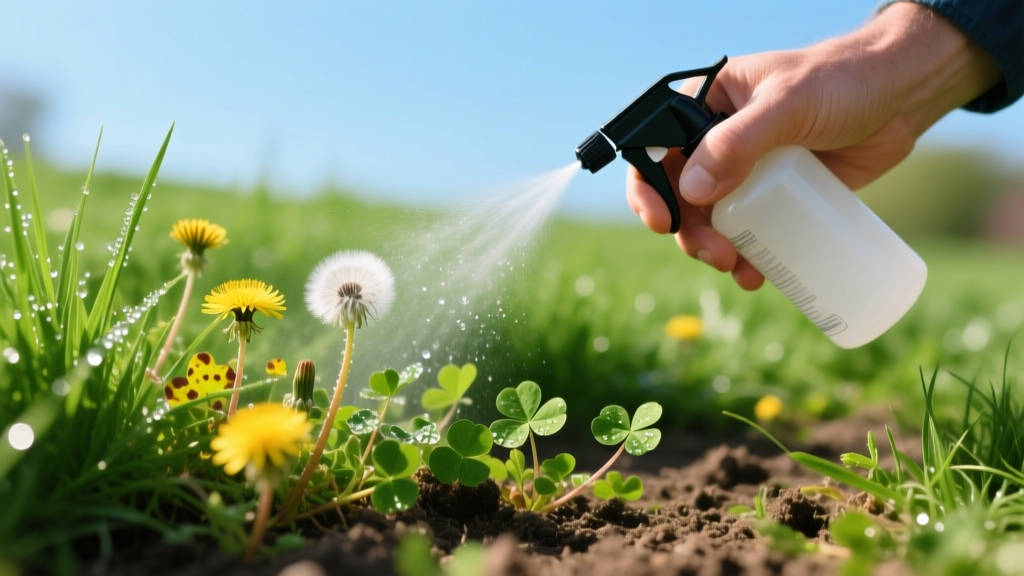
Best Selective Herbicide for Lawn Weeds: Spot-Treatment Guide
Spot-treating weeds requires precision, patience, and the right chemistry. Applying a broadcast spray across an entire yard wastes product, increases environmental runoff, and unnecessarily stresses your turfgrass. Instead, utilizing a targeted selective herbicide for lawn weeds allows you to eradicate specific invasive species while leaving your desirable turf completely unharmed. This guide breaks down the biochemistry of selective weed control, provides a product comparison matrix, and details an exact application protocol for professional-grade results.
The Biochemistry of Selective Weed Control
Selective herbicides exploit physiological differences between monocots (grasses) and dicots (broadleaf weeds), or between different grass species. Understanding the Mode of Action (MOA) is critical for preventing herbicide resistance and avoiding turf phytotoxicity.
Group 4: Synthetic Auxins (Broadleaf Control)
Active ingredients like 2,4-D, Dicamba, MCPP, and Fluroxypyr mimic the natural plant hormone auxin. When absorbed by broadleaf weeds (dandelions, clover, plantain), these chemicals trigger uncontrolled, unsustainable cell division, causing the plant to literally grow itself to death. Monocot turfgrasses possess enzymes that rapidly metabolize and detoxify these synthetic auxins, rendering them immune to the fatal growth surge.
Group 1: ACCase Inhibitors (Grassy Weed Control)
When your lawn is invaded by grassy weeds like crabgrass, dallisgrass, or annual bluegrass, synthetic auxins are useless. Instead, you need Acetyl-CoA carboxylase (ACCase) inhibitors such as Fluazifop or Sethoxydim. These disrupt lipid biosynthesis, halting cell membrane formation in target grassy weeds. According to the University of Minnesota Extension, timing is critical here; ACCase inhibitors are most effective when grassy weeds are young and actively growing, typically in late spring.
Selective Herbicide Comparison Matrix
Choosing the correct formulation depends entirely on your turf species and the specific weed profile. Below is a breakdown of top-tier selective herbicides for spot-treatment scenarios.
| Product / Formulation | Active Ingredients | Target Weeds | Safe Turf Types | Est. Price (2026) |
|---|---|---|---|---|
| Southern Ag Amine 2,4-D | 2,4-D (34.4%) | Dandelion, Plantain, Thistle | Bermuda, Zoysia, Fescue, Bluegrass | $20 - $25 / 32oz |
| PBI/Gordon's Trimec 992 | 2,4-D, MCPP, Dicamba | Broadleaf complex (Clover, Chickweed) | Cool-season turfs, Bermuda, Zoysia | $40 - $50 / 1gal |
| Hi-Yield Grass Killer | Fluazifop-P-butyl (13%) | Crabgrass, Bermudagrass (in Zoysia) | Centipede, Zoysia, Fine Fescue | $25 - $35 / 16oz |
| Ortho WeedClear for Lawns | 2,4-D, Quinclorac, Dicamba | Broadleaves + Crabgrass | Most Northern & Southern lawns (check label) | $15 - $20 / 32oz |
⚠️ Turf Sensitivity Warning: St. Augustine and Centipede grasses are highly sensitive to 2,4-D. Applying standard 2,4-D formulations to these warm-season turfs will cause severe yellowing and stunting. For St. Augustine, always select an Atrazine-based selective herbicide or a specifically labeled reduced-rate 2,4-D formulation.
The Surfactant Multiplier: Why It Matters
The most common reason DIY spot-treatments fail is the omission of a surfactant. Many broadleaf weeds, such as plantain and wild violet, have waxy cuticles that cause water-based herbicide droplets to bead up and roll off onto the soil, where they are rendered ineffective.
Adding a Non-Ionic Surfactant (NIS) reduces the surface tension of the spray solution, allowing the herbicide to spread evenly across the leaf surface and penetrate the stomata. Products like Hi-Yield Spreader Sticker or Southern Ag Surfactant cost roughly $12 for a pint, which is enough to treat over 10,000 square feet of weeds. The standard mixing rate for spot-treatment is 0.25% v/v, which translates to exactly 1/2 teaspoon of surfactant per gallon of mixed herbicide solution.
Step-by-Step Spot-Treatment Protocol
Follow this exact sequence to maximize weed mortality and protect your surrounding turfgrass.
- Calibrate for Spot Spraying: Unlike broadcast applications measured in gallons per acre, spot-treating requires a localized mix. Mix 1.5 to 2.0 fluid ounces of concentrated selective herbicide per 1 gallon of water. This 1-gallon batch will cover approximately 500 to 800 square feet of targeted weed patches.
- Integrate the Surfactant: Add your 1/2 teaspoon of NIS to the tank after the herbicide and water are mixed. Agitate the tank gently to avoid creating excessive foam.
- Verify Weather Thresholds: Check your local forecast. The ideal temperature window for systemic herbicide translocation is between 65°F and 85°F. Wind speeds must be under 5 mph to prevent drift onto ornamental flower beds.
- Apply to the Point of Runoff: Use a 1-gallon or 2-gallon hand-pump sprayer with the nozzle adjusted to a coarse, flat-fan pattern. Spray the weed leaves until they are visibly wet, but stop before the liquid drips onto the soil. The Environmental Protection Agency (EPA) emphasizes that soil drenching with foliar-absorbed herbicides wastes chemical and increases groundwater contamination risks.
- Enforce the Rainfast Window: Ensure no rainfall is expected for at least 4 to 6 hours post-application. If it rains within 2 hours, the application is compromised and must be repeated.
Critical Failure Modes and Edge Cases
Even with the right selective herbicide for lawn weeds, environmental and mechanical factors can derail your results. Watch out for these specific failure modes:
1. Volatilization and Vapor Drift
When ambient temperatures exceed 85°F, ester-based herbicides (and some amine formulations) can vaporize into a gas. This vapor can drift across your yard and severely damage non-target plants, including your turf, vegetable gardens, and ornamental shrubs. Rule of thumb: Never spray when temperatures are above 85°F or when a heatwave is forecasted within 48 hours.
2. Mowing Stress Interference
Systemic herbicides rely on the weed's active vascular system to pull the chemical down into the root crown. If you mow the lawn immediately before or after spraying, you sever the phloem tissue and remove the leaf surface area required for absorption. Wait 48 hours before mowing and 48 hours after mowing to apply your spot-treatment.
Expert Insight: If you are battling mature, deep-rooted perennial weeds like wild violet or ground ivy (creeping charlie), a single application of a selective herbicide will only burn back the top growth. You must schedule a secondary follow-up application exactly 21 to 28 days after the first treatment to kill the regenerating root system.
Post-Application Turf Recovery
After the weeds begin to curl, yellow, and necrose (typically visible within 7 to 14 days), you will be left with small bare spots in your lawn. Do not apply pre-emergent herbicides to these bare spots, as this will prevent your turfgrass from spreading laterally to fill the gaps. Instead, apply a light dusting of starter fertilizer (high in phosphorus, such as a 10-18-10 NPK ratio) to the bare soil to encourage your surrounding Bermuda, Zoysia, or Fescue to send out stolons and rhizomes to reclaim the space. Proper spot-treatment not only kills the invader but sets the stage for a denser, more resilient turf canopy.

