
Pest Control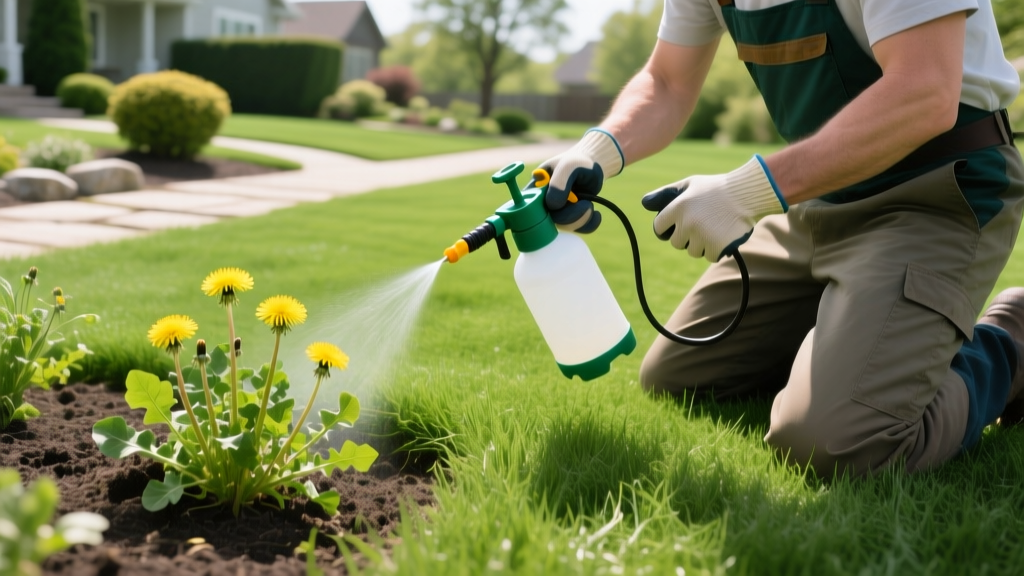
Finding a Herbicide That Won't Kill Grass: Selective Weed Playbook
The Science of Selective Weed Control
Finding a herbicide that won't kill grass requires leveraging selective toxicity. Non-selective herbicides like glyphosate destroy plant tissue indiscriminately by inhibiting the EPSP synthase enzyme, which is vital for all plant growth. Selective herbicides, however, exploit physiological and anatomical differences between monocots (your desirable turfgrass) and dicots (broadleaf weeds), or target specific enzyme pathways unique to invasive grassy weeds like crabgrass and nutsedge.
For example, synthetic auxins like 2,4-D and dicamba mimic natural plant hormones. When absorbed by broadleaf weeds, they trigger unregulated, catastrophic cellular growth that literally twists the plant apart. Turfgrasses possess a different vascular structure and metabolic pathway that allows them to rapidly metabolize and detoxify these compounds before damage occurs. Understanding this biological mechanism is the foundation of professional lawn care.
Matching the Herbicide to Your Turfgrass Type
The most common failure mode in DIY weed control is applying a selective herbicide that is safe for one grass species but highly phytotoxic to another. St. Augustine grass, for instance, is notoriously sensitive to 2,4-D, while cool-season grasses will suffer severe bleaching if exposed to mesotrione at high temperatures. Below is the definitive 2026 compatibility matrix for residential turf.
| Turfgrass Category | Specific Species | Safe Active Ingredients | Danger Zone (Avoid) |
|---|---|---|---|
| Cool-Season | Kentucky Bluegrass, Tall Fescue, Perennial Ryegrass | 2,4-D, Dicamba, Quinclorac, Mesotrione, Triclopyr | Atrazine (causes severe chlorosis) |
| Warm-Season (Resilient) | Bermudagrass, Zoysiagrass | 2,4-D, Quinclorac, Thiencarbazone, Iodosulfuron | Mesotrione (Tenacity) causes severe whitening/bleaching |
| Warm-Season (Sensitive) | St. Augustine, Centipedegrass | Atrazine, Thiencarbazone, Halosulfuron, Penoxsulam | 2,4-D and high-dose Dicamba (causes leaf curling and stunting) |
Critical Warning for St. Augustine Owners: Never apply standard 'Weed and Feed' products containing 2,4-D to St. Augustine or Centipede lawns. The resulting phytotoxicity mimics herbicide burn and can set your turf back for an entire growing season. Opt for Atrazine-based formulations or specialized sulfonylureas instead.
The Weed Removal Playbook: Step-by-Step Application
Professional results depend on precise calibration, environmental timing, and the use of adjuvants. Follow this exact protocol for post-emergent selective weed control.
Step 1: Calculate and Map the Treatment Area
Do not guess your lawn's square footage. Measure the length and width of your turf zones. Most selective herbicides are calibrated per 1,000 square feet, not per gallon of water. The water is merely a carrier. If your sprayer covers 1,000 square feet using 1.5 gallons of water, your mix rate must be scaled to that specific volume.
Step 2: Formulate the Tank Mix
Always add products to the sprayer in the following order to prevent chemical lock-up and clumping:
- Water: Fill the tank halfway with clean water.
- Water Dispersible Granules (WG/DF): Add dry flowables first (e.g., Celsius WG) and agitate.
- Suspension Concentrates (SC): Add liquid suspensions next.
- Emulsifiable Concentrates (EC): Add liquid esters and amines (e.g., SpeedZone).
- Surfactant: Add the non-ionic surfactant last.
Step 3: Integrate a Non-Ionic Surfactant
'Water has high surface tension, causing it to bead up and roll off the waxy cuticle of weed leaves. A non-ionic surfactant breaks this surface tension, forcing the herbicide to spread evenly and penetrate the plant tissue. Skipping the surfactant reduces herbicide efficacy by up to 60%.' - Turfgrass Management Journal, 2025
Add a high-quality non-ionic surfactant (NIS) at a rate of 1 to 2 teaspoons (0.25 to 0.50 oz) per gallon of finished spray solution. Do not use dish soap, which contains degreasers and salts that can burn turfgrass and interfere with active ingredients.
Step 4: Apply During Optimal Environmental Windows
Apply the herbicide when daytime temperatures are between 65°F and 85°F. Spraying when temperatures exceed 85°F increases the risk of volatilization—the process where the herbicide turns into a gas and drifts onto non-target plants, damaging ornamental shrubs and trees. Avoid spraying if rain is forecast within 24 hours, and do not irrigate the lawn for at least 48 hours post-application to allow for maximum foliar absorption.
Top Selective Herbicide Formulations for 2026
The market is saturated with diluted, big-box-store formulations that lack the active ingredient concentration required for mature weed control. The following professional-grade products offer superior translocation and root-kill capabilities.
1. Celsius WG (Broadleaf Control for Warm-Season Turf)
- Active Ingredients: Thiencarbazone-methyl, iodosulfuron-methyl-sodium, dicamba.
- Target Weeds: Dollarweed, Virginia buttonweed, lespedeza, and over 150 broadleaf weeds.
- Cost & Yield: Approximately $135 for a 5 oz bottle. At the standard mix rate of 0.053 oz per 1,000 sq ft, a single bottle treats nearly 2.5 acres, making the cost per application roughly $2.80 per 1,000 sq ft.
- Pro Tip: Celsius WG is slow-acting. Weeds will yellow in 7-10 days and die completely in 3-4 weeks. Do not reapply early.
2. SpeedZone Southern (Fast Burn-Down for Broadleaves)
- Active Ingredients: Carfentrazone-ethyl, 2,4-D, MCPP, dicamba.
- Target Weeds: Dandelion, clover, plantain, spurge.
- Cost & Yield: $115 per gallon. Mix rate is 1.5 oz per 1,000 sq ft.
- Pro Tip: The addition of carfentrazone provides a rapid 'burn' effect within 24 hours, satisfying the homeowner's need for visual progress while the systemic 2,4-D travels to the roots.
3. SedgeHammer+ (Specialized Nutsedge Eradication)
- Active Ingredient: Halosulfuron-methyl.
- Target Weeds: Yellow and purple nutsedge, kyllinga.
- Cost & Yield: $18 per 13.5g packet (includes built-in surfactant). Mix one packet per 1,000 sq ft (dissolved in 1-2 gallons of water).
- Pro Tip: Nutsedge is a sedge, not a grass or a broadleaf. Standard broadleaf herbicides will not kill it. SedgeHammer is absorbed through the foliage and translocates to the 'nutlets' underground, preventing regrowth.
Common Failure Modes and Troubleshooting
Even with the correct herbicide that won't kill grass, application errors can lead to poor results or turf damage. Review these common pitfalls identified by Penn State Extension turfgrass specialists:
Mowing Too Soon After Application
The Error: Mowing the lawn 12 hours after spraying to 'clean up' the dying weeds.
The Fix: Wait a minimum of 48 hours before mowing, and 48 hours after mowing before spraying. The herbicide needs time to absorb through the leaf surface and move into the phloem. Mowing removes the treated leaf tissue before translocation occurs.
Spraying Drought-Stressed Weeds
The Error: Applying herbicide during a late-summer drought.
The Fix: Weeds under drought stress develop a thick, waxy cuticle to retain moisture and shut down their vascular systems to survive. Herbicides cannot penetrate the cuticle or translocate through a dormant vascular system. Irrigate the lawn lightly 24 hours before application to ensure weeds are actively growing and absorbing the chemical.
Frequently Asked Questions
Will selective herbicides harm my flower beds if they drift?
Yes. While selective herbicides spare monocot grasses, they are highly lethal to dicot ornamental plants, shrubs, and trees. Spray drift from 2,4-D or dicamba can cause severe leaf-curling and stunting in roses, tomatoes, and dogwoods. Always use a shielded sprayer nozzle or apply with a low-pressure (20-30 PSI) wand when working near landscape borders.
How long until I can let my pets back on the lawn?
As a general safety standard supported by NC State Turfgrass Extension, keep pets and children off the treated area until the liquid herbicide has completely dried into the leaf tissue. Depending on humidity and temperature, this typically takes 2 to 4 hours. Once dry, the risk of dermal transfer is negligible.
Can I mix pre-emergent and post-emergent herbicides in the same tank?
In most cases, yes, provided they are chemically compatible and you are applying them at the correct seasonal window. However, pre-emergents require watering into the soil to activate the chemical barrier, while post-emergents require staying on the leaf surface for 48 hours. This conflicting irrigation requirement makes tank-mixing them inefficient for spring applications. Apply post-emergents first, wait two weeks, and then apply your pre-emergent.

