
Pest Control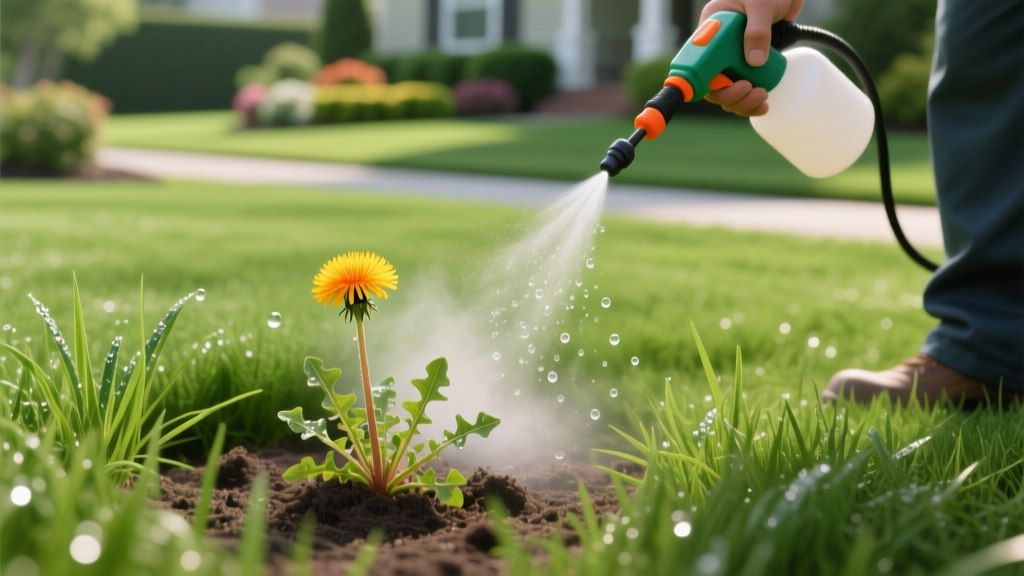
Targeted Spot Treatment: Using Selective Herbicides for Weeds
The Mechanics of Selective Spot Treatment
Broadcast spraying an entire lawn to eliminate a few isolated weed clusters is an inefficient use of chemicals and money. Spot-treating with selective herbicides for weeds allows you to target specific invasive species while leaving the surrounding desirable turfgrass completely unharmed. The success of this method relies entirely on matching the exact active ingredient to the weed's biological classification (broadleaf, grassy, or sedge) and applying it with precision equipment.
Selective herbicides exploit physiological differences between monocots (grasses) and dicots (broadleaves), or target specific enzyme pathways absent in your turf species. For example, synthetic auxins like 2,4-D cause uncontrolled, lethal growth in broadleaf weeds but are rapidly metabolized by most turfgrasses. However, misidentifying the weed or using the wrong adjuvant can result in severe turf phytotoxicity or total herbicide failure.
Weed Identification and Active Ingredient Matrix
Before mixing any chemical, you must accurately identify the weed. A common mistake is applying a broadleaf herbicide to a grassy weed, which will only act as an expensive fertilizer. Use the decision matrix below to select the correct active ingredient for your specific spot-treatment scenario.
| Weed Category | Common Species | Primary Active Ingredients | Required Adjuvant | Expected Timeline to Kill |
|---|---|---|---|---|
| Broadleaf | Dandelion, White Clover, Plantain | 2,4-D, Dicamba, MCPP, Carfentrazone | None (usually formulated in) | 7 to 14 days |
| Grassy | Crabgrass, Dallisgrass, Goosegrass | Quinclorac, Fenoxaprop-p-ethyl | Methylated Seed Oil (MSO) | 14 to 21 days |
| Sedge | Yellow Nutsedge, Purple Nutsedge, Kyllinga | Halosulfuron-methyl, Sulfentrazone | Non-Ionic Surfactant (NIS) | 10 to 21 days |
Top Commercial-Grade Selective Herbicides for Spot Spraying
While big-box stores sell diluted, ready-to-use (RTU) selective herbicides, professional-grade concentrates offer vastly superior efficacy and cost-efficiency for spot treatments. Here are the industry standards for targeted applications:
1. Broadleaf Control: SpeedZone Southern (Ester Formulation)
SpeedZone Southern combines 2,4-D, MCPP, dicamba, and carfentrazone. The carfentrazone provides a rapid 'burn-down' effect, often showing visible wilting within 24 hours, while the systemic auxins kill the root system. Because it is an ester formulation, it penetrates the waxy cuticle of leaves rapidly, making it highly effective in cool spring or fall weather. Cost: Approximately $48 per pint. Mix Rate: 1.5 oz per gallon of water to treat 1,000 sq ft.
Warning: Temperature Volatility
Ester formulations of 2,4-D and dicamba are highly volatile when ambient temperatures exceed 85°F (29°C). The chemical can vaporize, drift through the air, and severely damage or kill nearby desirable ornamental shrubs, flowers, and trees. If you are spot-treating in mid-summer, switch to an amine formulation like Trimec Classic to prevent volatility drift.
Ester formulations of 2,4-D and dicamba are highly volatile when ambient temperatures exceed 85°F (29°C). The chemical can vaporize, drift through the air, and severely damage or kill nearby desirable ornamental shrubs, flowers, and trees. If you are spot-treating in mid-summer, switch to an amine formulation like Trimec Classic to prevent volatility drift.
2. Sedge Control: SedgeHammer (Halosulfuron-methyl)
Nutsedge is technically a sedge, not a grass, and is immune to standard grassy weed killers. SedgeHammer halts cell division in the meristematic tissue of the sedge. It is notoriously slow-acting; the weed will stop growing immediately, but yellowing (chlorosis) may not appear for 10 to 14 days. Do not reapply simply because it 'isn't working yet.' Cost: ~$25 per 13.5g packet. Mix Rate: 1 packet per 1,000 sq ft, diluted in 1 to 2 gallons of water.
3. Grassy Weed Control: Drive XLR8 (Quinclorac)
Quinclorac is the undisputed king of post-emergent crabgrass control. It also provides excellent suppression of broadleaf weeds like clover and dandelion, making it a versatile spot-treatment option. However, mature crabgrass (tillered with 3+ leaves) requires a second application 14 to 21 days after the first. Cost: ~$60 per 18 oz bottle. Mix Rate: 1.45 oz per gallon.
Step-by-Step Spot Application Protocol
Precision is the difference between a successful spot treatment and a dead patch of desirable turf. Follow this exact protocol for mixing and application.
- Calibrate Your Sprayer: Do not use the adjustable cone nozzle that comes with standard 1-gallon pump sprayers; it produces uneven droplet sizes and excessive drift. Swap it for a red or yellow flat-fan nozzle (110-degree spray angle) or a specialized spot-treatment shield.
- Condition the Water: If your local water is 'hard' (high in calcium and magnesium), the cations will bind to weak-acid herbicides like 2,4-D and quinclorac, rendering them useless. Add Ammonium Sulfate (AMS) at a rate of 1.5 lbs per 100 gallons (or roughly 1 tablespoon per gallon) before adding the herbicide to precipitate the hard water minerals.
- The WAALE Mixing Order: Fill the tank halfway with water. Add the Wettable powder or Aqueous solution (herbicide). Agitate. Add the Liquid Emulsion or surfactant (NIS/MSO). Fill the rest of the water.
- Targeted Application: Pump the sprayer to 40 PSI. Hold the wand 18 inches above the weed canopy. Spray the weed until the leaves are glistening but not dripping. Dripping leads to soil accumulation, which can harm turf roots via soil-residual activity.
Common Spot-Treatment Failure Modes
If your targeted weeds are surviving your selective herbicide applications, you are likely falling victim to one of these three agronomic failure modes:
- Wrong Growth Stage: Applying quinclorac to crabgrass when it is in the transition stage between 2 and 4 tillers often results in poor control. The plant's vascular system is shifting, making systemic translocation of the herbicide difficult. Wait until the weed is fully mature, or treat it when it is very young (pre-tiller).
- Mowing Too Soon: Selective herbicides require time to translocate from the leaf tissue down to the root crown. Mowing your lawn within 48 hours of a spot treatment physically removes the chemical before it has reached the meristematic growing points. Always wait a minimum of 2 to 3 days post-application before mowing.
- Surfactant Mismatch: Using a Non-Ionic Surfactant (NIS) when the label specifically calls for a Methylated Seed Oil (MSO) or Crop Oil Concentrate (COC). MSO is required to dissolve the thick, waxy cuticle of mature grassy weeds like crabgrass. NIS simply reduces water surface tension and will not penetrate a waxy grassy cuticle effectively.
Turf Recovery and Post-Treatment Monitoring
Once the targeted weed begins to undergo senescence (browning and dying back), it will leave a physical void in the turf canopy. For cool-season grasses like Tall Fescue or Kentucky Bluegrass, overseed the spot immediately after the weed has completely died, provided the herbicide's reseeding interval has passed (check the specific product label, as some auxins require a 3-to-4-week waiting period before seeding). For warm-season grasses like Bermuda or Zoysia, apply a light dose of nitrogen (0.5 lbs per 1,000 sq ft) to stimulate lateral stolon growth and allow the surrounding turf to naturally fill the void.
For comprehensive, region-specific data on weed life cycles and localized herbicide efficacy trials, consult the extension programs at Purdue University Turfgrass Science and NC State Turfgrass Science. These university databases provide annually updated trial results that reflect the latest herbicide resistance patterns in local weed populations.

