
Pest Control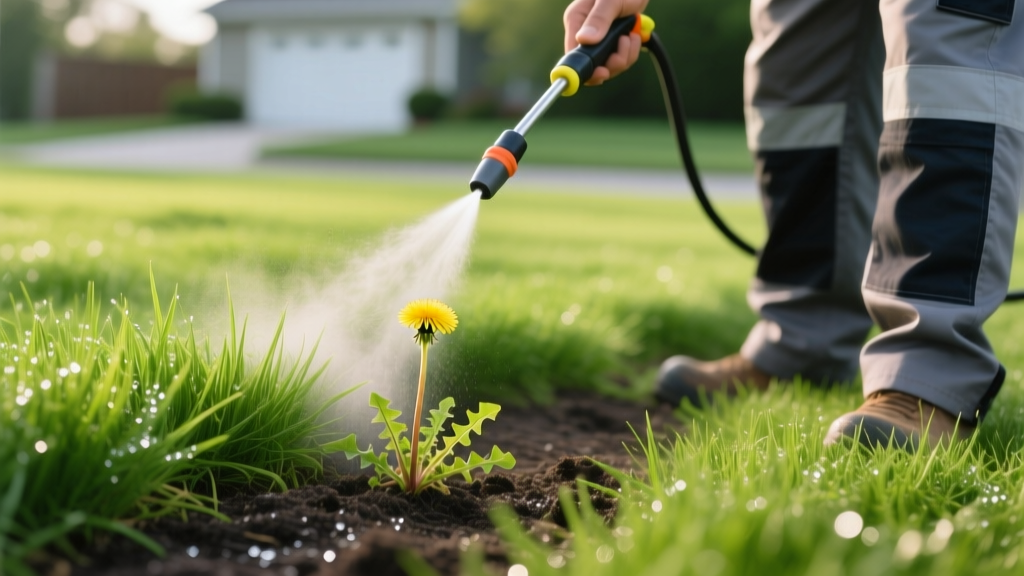
How to Use a Selective Post Emergent Weed Killer for Spot Treatment
The Science of Selective Post Emergent Weed Control
A selective post emergent weed killer is formulated to target specific biological pathways present in weeds but absent in your desired turfgrass. Unlike non-selective herbicides such as glyphosate, which will destroy any green plant tissue they contact, selective herbicides exploit differences in plant metabolism, growth hormones, and enzyme structures. For example, broadleaf weeds (dicots) process synthetic auxins like 2,4-D and Dicamba as lethal growth signals, causing their cells to divide uncontrollably until the plant starves. Turfgrasses (monocots) naturally metabolize and break down these same chemicals before they cause harm.
When executing a weed species spot-treatment strategy, understanding this chemical selectivity is critical. Broadcasting a blanket application over your entire lawn wastes product, increases environmental runoff, and unnecessarily stresses your turf. Spot-treating with the correct selective chemistry saves money and preserves lawn health, but it requires precise identification of the weed species and the corresponding active ingredient.
Weed Species and Active Ingredient Match Matrix
The most common failure mode in DIY lawn care is applying a broadleaf herbicide to a grassy weed, or vice versa. Below is a precise matrix matching common lawn invaders with the correct selective post emergent weed killer chemistry, top-tier residential products, and estimated 2026 pricing.
| Weed Category | Target Species | Active Ingredient | Recommended Product | Est. Cost (2026) | Turf Safety Profile |
|---|---|---|---|---|---|
| Broadleaf | Dandelion, Clover, Plantain | 2,4-D + Dicamba + MCPP | SpeedZone Southern (Ester) | $65 / gallon | Bermuda, Zoysia, Fescue, KBG |
| Grassy Weed | Crabgrass, Dallisgrass, Foxtail | Quinclorac | Drive XLR8 | $95 / gallon | Bermuda, Fescue, KBG (Avoid St. Aug) |
| Sedge | Yellow Nutsedge, Purple Nutsedge | Halosulfuron-methyl | SedgeHammer | $35 / 1.33 oz bottle | All warm and cool-season turfgrasses |
| Grassy Weed | Dallisgrass, Bermuda (in Fescue) | Fluazifop-P-butyl | Ornamec Over-The-Top | $120 / gallon | Tall Fescue, Kentucky Bluegrass only |
| Broadleaf/Grassy | Crabgrass, Chickweed, Clover | Mesotrione | Tenacity | $85 / 8 oz bottle | KBG, Fescue, Bermuda (causes whitening) |
Pro-Tip on Formulations: Pay attention to whether a product is an ester or amine formulation. Ester formulations (like SpeedZone Southern) penetrate the waxy leaf cuticle of weeds much faster, making them ideal for cool-weather spot treatments (below 75°F). However, esters are prone to volatility (turning into a gas and drifting) in high heat. If you are spot-treating in mid-summer when temperatures exceed 85°F, switch to an amine formulation (like SpeedZone EW) to prevent chemical drift from damaging nearby ornamental shrubs or sensitive turf.
Step-by-Step Spot Treatment Protocol
Proper calibration and mixing are non-negotiable for selective post emergent weed killers. Over-mixing will not kill the weed faster; it will only cause soil residual issues or phytotoxicity (chemical burn) to the surrounding desirable grass.
1. Equipment Setup and Calibration
Use a dedicated 1-gallon or 2-gallon pump sprayer. Never use a sprayer that has previously held non-selective herbicides like glyphosate, as microscopic residue in the tank and wand will kill your turf. To calibrate your sprayer for spot treatment:
- Mark off a 20 x 50 foot area on your driveway (1,000 square feet).
- Fill your sprayer with exactly 1 gallon of plain water.
- Spray the area at your normal walking pace and pump pressure.
- If you run out of water before finishing the 1,000 sq ft, you are walking too fast or spraying too fine. Adjust your nozzle to a coarse fan pattern and slow down.
2. Mixing the Solution
Most selective herbicides require a surfactant to break the surface tension of the water, allowing the chemical to spread and stick to the weed's leaves rather than beading up and rolling off into the soil.
- Broadleaf Weeds: Add a Non-Ionic Surfactant (NIS) at a rate of 0.25% v/v. This equates to roughly 1/2 teaspoon per gallon of mixed solution.
- Grassy Weeds & Sedges: Products containing Quinclorac or Halosulfuron often require a Methylated Seed Oil (MSO) or Crop Oil Concentrate (COC) at 1% v/v (approx. 2.5 tablespoons per gallon) to effectively penetrate the thick cuticles of grassy weeds.
- Marker Dye: Add 3-4 drops of blue turf marker dye to your tank. This allows you to see exactly which weeds you have already sprayed, preventing accidental double-application.
3. Application Technique
Adjust your sprayer wand to a coarse fan nozzle. A fine mist increases the risk of wind drift onto desirable plants. Hold the wand 12 to 18 inches above the weed, spraying just enough to wet the leaves until they glisten, but not to the point of runoff. According to the University of Minnesota Extension, targeting the weed directly rather than broadcast spraying minimizes chemical exposure to the surrounding ecosystem.
Warning: The Mowing Window
Do not mow your lawn for 48 hours before or 48 hours after applying a selective post emergent weed killer. Mowing before reduces the leaf surface area available to absorb the chemical. Mowing after physically removes the herbicide before it has had time to translocate from the leaves down into the weed's root system.
Do not mow your lawn for 48 hours before or 48 hours after applying a selective post emergent weed killer. Mowing before reduces the leaf surface area available to absorb the chemical. Mowing after physically removes the herbicide before it has had time to translocate from the leaves down into the weed's root system.
Troubleshooting Common Failure Modes
If your spot treatment failed to kill the target weed, review these common edge cases and environmental variables:
Rainfastness Violations
Every selective herbicide has a specific 'rainfast' window—the time it takes for the chemical to fully absorb into the leaf tissue. 2,4-D and Dicamba typically require 4 to 6 hours of dry weather. Quinclorac and Halosulfuron require a full 24 hours. If it rains 3 hours after you spray Drive XLR8 on crabgrass, the application is effectively washed away.
Weed Maturity and Drought Stress
Selective post emergent weed killers rely on the plant's internal vascular system to move the poison to the roots. If the weed is mature, has gone to seed, or is experiencing severe drought stress, its vascular system shuts down to conserve water. The herbicide will sit in the leaves, causing localized burning but failing to kill the root. Always irrigate the lawn deeply 24 hours before spot-treating to ensure weeds are actively growing and translocating nutrients (and herbicides) to their roots.
Temperature Inversions
Never spray ester-based herbicides during a temperature inversion (typically early morning or late evening when the air is perfectly still and a layer of warm air traps cool air near the ground). Inversions trap herbicide vapors near the soil surface, which can then drift laterally and cause severe damage to sensitive ornamental trees and shrubs hundreds of feet away.
Frequently Asked Questions
Can I mix multiple selective herbicides in one tank?
Yes, this is known as 'tank mixing' and is common for lawns with complex weed profiles. For example, mixing a broadleaf killer (SpeedZone) with a sedge killer (SedgeHammer) is safe and effective. However, always perform a small 'jar test' first to ensure the chemicals do not react and form a clumpy gel, and never exceed the maximum application rates listed on the individual labels. The NC State Extension recommends strictly adhering to label instructions to prevent turf phytotoxicity.
How long does it take to see results?
Visible results vary by active ingredient. Fast-acting auxin herbicides like 2,4-D will cause broadleaf weeds to curl and twist (epinasty) within 24 to 48 hours, with total browning in 10-14 days. Slower translocators like Quinclorac or Halosulfuron may take 7 to 14 days just to show initial yellowing, with complete necrosis taking up to 3 weeks.
Are selective herbicides safe for pets?
According to the Environmental Protection Agency (EPA), when used according to label directions, selective herbicides pose minimal risk. The standard safety protocol is to keep pets and children off the treated area until the liquid spray has completely dried into the leaf tissue, which typically takes 2 to 4 hours depending on humidity and sunlight.

