
Pest Control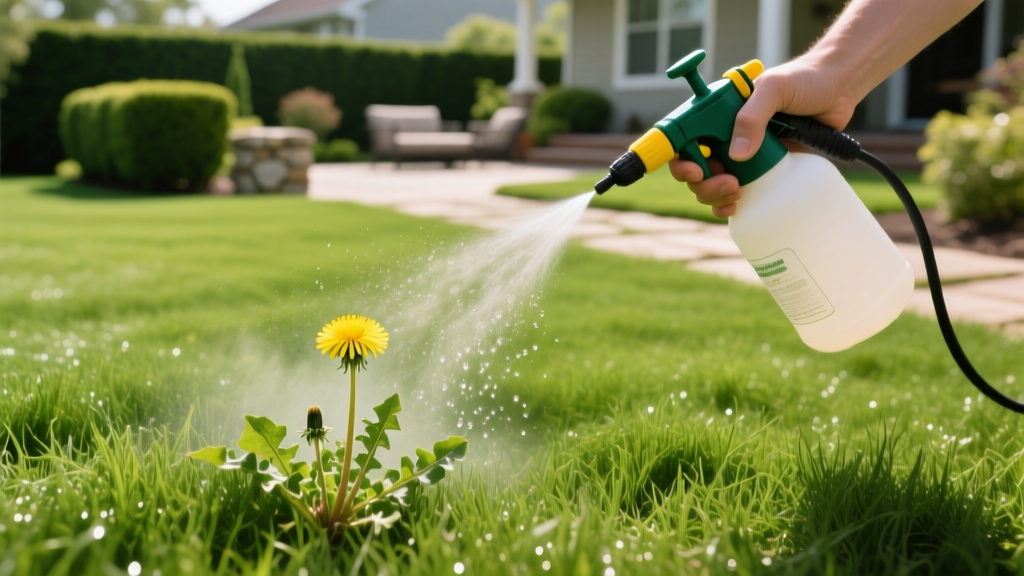
Selective Weed Killer for Lawns: Spot-Treatment Guide
The Biochemistry of Selective Herbicides
Applying a selective weed killer for lawns requires understanding how specific active ingredients exploit physiological differences between monocotyledonous turfgrasses and dicotyledonous broadleaf weeds, or between different grass species. Selective herbicides do not merely 'burn' foliage; they disrupt specific enzymatic pathways. For instance, synthetic auxins like 2,4-D and Dicamba mimic natural plant growth hormones, causing uncontrolled, lethal cellular division in broadleaf weeds while cool-season grasses rapidly metabolize the chemical into non-toxic compounds. Conversely, HPPD inhibitors like Mesotrione block carotenoid biosynthesis, leading to fatal bleaching in target weeds like crabgrass and dandelions, while Kentucky Bluegrass and Fescue utilize alternative metabolic pathways to neutralize the compound.
Quick Decision Matrix: Match the Weed to the Chemistry
- Broadleaf (Dandelion, Clover, Plantain): 2,4-D + Dicamba + MCPP (Trimec formulations)
- Grassy (Crabgrass, Foxtail): Quinclorac (Drive XLR8)
- Sedge (Yellow/Purple Nutsedge): Halosulfuron-methyl (SedgeHammer)
- Difficult Broadleaf/Grassy (Creeping Charlie, Poa Annua): Mesotrione (Tenacity)
Active Ingredient Breakdown by Weed Species
Blanket spraying an entire lawn is rarely necessary and often damages soil microbiology. Spot-treating isolated weed clusters with targeted chemistry is more cost-effective and environmentally sound. Below is a deep dive into the active ingredients required for specific weed categories.
Broadleaf Weeds: The Three-Way Advantage
Single-active-ingredient herbicides often fail against mature broadleaf weeds due to natural resistance mechanisms. A three-way herbicide combining 2,4-D (ester or amine), Dicamba, and MCPP-p attacks the weed through multiple metabolic pathways simultaneously. The ester formulation of 2,4-D penetrates the waxy cuticle of mature dandelions and plantain much faster than amine formulations, making it the superior choice for late-season spot treatments when temperatures drop below 60°F. Expect to pay approximately $45 to $60 per gallon for commercial-grade three-way concentrates like Trimec Classic or SpeedZone.
Grassy Weeds: Targeting Crabgrass Without Killing Turf
Grassy weeds are notoriously difficult to selectively remove because they share the same monocot physiology as your lawn. Quinclorac is the industry standard for post-emergent crabgrass control. It disrupts cellulose biosynthesis and induces auxin-like toxicity in crabgrass. However, Quinclorac carries severe phytotoxicity risks for St. Augustinegrass and Centipedegrass. If you maintain a warm-season lawn of these types, you must pivot to Atrazine or carefully timed pre-emergents, as post-emergent selective options for grassy weeds in St. Augustine are virtually non-existent without causing severe turf bleaching.
Sedges: The False Grasses
Nutsedge is a sedge, not a grass, rendering Quinclorac and 2,4-D entirely ineffective. Sedges require Halosulfuron-methyl, a sulfonylurea herbicide that inhibits the ALS (acetolactate synthase) enzyme, starving the weed of essential branched-chain amino acids. Because nutsedge propagates via underground tubers (nutlets), contact herbicides will only burn the top growth. Halosulfuron is systemic, translocating down into the tubers to prevent regrowth. A box of water-soluble packets (like SedgeHammer+) typically costs around $35 and treats up to 2 acres, making it highly economical for spot treatments.
Product Comparison and Turfgrass Safety Matrix
Selecting the wrong selective weed killer for lawns can result in total turf loss. Use this matrix to verify active ingredient safety against your specific grass species before mixing.
| Active Ingredient | Target Weeds | Safe on Cool-Season Turf? | Safe on Warm-Season Turf? | Est. Price (Concentrate) |
|---|---|---|---|---|
| 2,4-D + Dicamba + MCPP | Dandelion, Clover, Thistle | Yes (Excellent) | Bermuda/Zoysia only (St. Aug sensitive) | $45 - $60 / Gal |
| Quinclorac | Crabgrass, Foxtail, Bindweed | Yes (Excellent) | Bermuda/Zoysia only (Toxic to St. Aug) | $90 - $110 / Half-Gal |
| Mesotrione | Crabgrass, Creeping Charlie, Poa Annua | Yes (Excellent) | Centipede/St. Aug (Causes temporary whitening) | $60 - $75 / 4 oz |
| Halosulfuron-methyl | Yellow/Purple Nutsedge, Kyllinga | Yes (Excellent) | Yes (Excellent across all types) | $35 / 5 packets |
Precision Spot-Treatment Application Protocol
According to the University of Minnesota Turfgrass Science program, the most common cause of herbicide failure in residential lawns is improper calibration and poor droplet coverage, not chemical inefficacy. Follow this exact protocol for spot-treating isolated weed patches.
Calibration and Mixing Math
Herbicide labels dictate application rates per 1,000 square feet, not per gallon of water. Water is merely the carrier. To spot-treat a 500 square foot zone heavily infested with clover:
- Determine Herbicide Volume: If the Trimec label prescribes 1.5 fl oz per 1,000 sq ft, you need exactly 0.75 fl oz of concentrate for your 500 sq ft area.
- Determine Carrier Volume: For dense broadleaf canopies, you need 1.5 to 2.0 gallons of water per 1,000 sq ft to achieve thorough leaf wetting without runoff. Therefore, mix your 0.75 oz of herbicide into 1 gallon of water.
- Add Surfactant: Most selective herbicides require a Non-Ionic Surfactant (NIS) at a 0.25% to 0.5% v/v rate to break the surface tension of the water droplet and penetrate the weed's waxy cuticle. For 1 gallon of water (128 oz), a 0.5% rate requires 0.64 oz (approximately 1.25 tablespoons) of NIS.
- Agitate: Shake the 2-gallon pump sprayer vigorously for 30 seconds before walking the target area.
CRITICAL WARNING: Temperature and Volatility Limits
Never apply ester-based selective weed killers (like SpeedZone or 2,4-D LV4) when ambient temperatures exceed 85°F. At high temperatures, ester formulations volatilize—turning from liquid into a gas. This vapor drifts unpredictably and will severely curl, stunt, or kill nearby ornamental shrubs, tomato plants, and desirable broadleaf trees. Always spot-treat in the early morning when temperatures are between 65°F and 80°F and wind speeds are below 5 mph.
Troubleshooting Application Failures
If your targeted weeds are twisting and curling but failing to die after 14 days, you are likely encountering one of three edge cases documented by NC State Extension turfgrass specialists:
- Hard Water Tie-Up: Municipal or well water with high calcium and magnesium levels (hard water) contains positively charged cations. These cations bind to the negatively charged molecules of weak-acid herbicides like 2,4-D and Glyphosate, neutralizing them before they enter the plant. Fix: Add Ammonium Sulfate (AMS) at a rate of 1 to 2 pounds per 100 gallons of water (or 1 tablespoon per gallon) to condition the water and buffer the pH.
- Drought Stress Shutdown: Weeds under severe drought stress develop thicker, more impenetrable waxy cuticles and slow their internal translocation processes to conserve water. Systemic herbicides will get stuck in the top leaves and fail to reach the roots. Fix: Irrigate the lawn deeply 24 hours before application to ensure the weeds are actively growing and translocating nutrients downward.
- Mowing Too Soon: Cutting the grass immediately after spot-treatment removes the herbicide-treated foliage before the chemical has time to translocate to the root system. Fix: Wait a minimum of 48 hours after application before mowing, and do not irrigate for at least 24 hours to allow maximum foliar absorption.
For comprehensive safety data, disposal protocols, and environmental impact statements regarding residential herbicide use, always consult the EPA Safe Pest Control guidelines before purchasing commercial-grade concentrates. Properly executed spot-treatments utilizing the correct selective weed killer for lawns will preserve your turf's root density while systematically eradicating invasive species.

