
Pest Control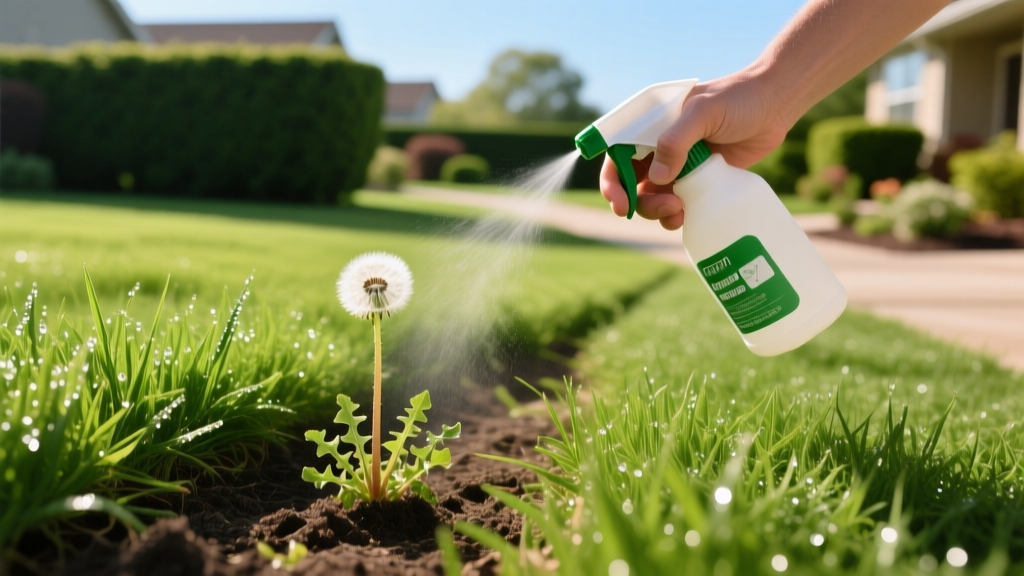
Selective Weed Killer Safe for Grass: Spot-Treatment Guide
Blanket spraying an entire lawn with herbicides is an inefficient use of chemicals, money, and time. When dealing with isolated weed outbreaks, spot-treatment is the superior strategy. However, the primary challenge homeowners face is finding a selective weed killer safe for grass that eradicates the target weed without causing phytotoxicity to the surrounding turf. Selective herbicides exploit physiological differences between monocots (grasses) and dicots (broadleaf weeds), or target specific enzymatic pathways unique to certain weed families.
This guide details the exact active ingredients, mixing ratios, adjuvant requirements, and application parameters necessary for effective spot-treatment in residential lawns.
The Science of Selective Herbicide Toxicity
Selective herbicides do not 'know' the difference between a dandelion and a Kentucky bluegrass blade. Instead, they rely on biochemical vulnerabilities. Broadleaf herbicides like 2,4-D and Dicamba are synthetic auxins (growth regulators). When absorbed by a broadleaf plant, they trigger unregulated, exponential cellular growth that ultimately ruptures the plant's vascular tissue. Grasses possess enzymes that rapidly metabolize and detoxify these synthetic auxins before they can cause lethal damage.
⚠️ CRITICAL GRASS-TYPE WARNING: Not all grasses metabolize auxins equally. Cool-season grasses (Fescue, Bluegrass, Ryegrass) are highly tolerant of 2,4-D. Warm-season grasses like St. Augustinegrass and Centipedegrass are highly sensitive to 2,4-D and will suffer severe stunting or death. For these sensitive warm-season turfgrasses, you must use alternative active ingredients like Atrazine or specific Penoxsulam formulations.
Active Ingredient Matrix for Spot-Treatment
Selecting the correct chemical depends entirely on the weed species and your turf type. Below is a breakdown of the industry-standard active ingredients used by lawn care professionals for targeted spot-treatments.
| Active Ingredient | Target Weeds | Safe Grass Types | Avg. Cost (2026) |
|---|---|---|---|
| 2,4-D + Dicamba + MCPP | Dandelion, Clover, Plantain, Thistle | Cool-season, Bermudagrass, Zoysia | $45 / gallon |
| Quinclorac | Crabgrass, Foxtail, Barnyardgrass | Cool-season, Bermudagrass, Zoysia | $85 / pint |
| Halosulfuron-methyl | Yellow & Purple Nutsedge | Almost all turfgrasses | $16 / 0.25oz packet |
| Sulfentrazone | Nutsedge, Morning Glory, Spurge | Cool-season, Bermudagrass, Zoysia | $60 / 8oz bottle |
Species-Specific Spot-Treatment Protocols
Simply spraying the weed is not enough. The carrier volume, adjuvant selection, and environmental conditions dictate whether the herbicide reaches the root system or merely burns the top growth.
Protocol 1: Deep-Rooted Broadleaf Weeds (Dandelion, Thistle)
Dandelions possess a deep taproot that stores carbohydrates. If you only kill the leaves, the root will push up new growth within 14 days. You need a systemic translocating herbicide.
- Product Formulation: A 3-way ester or amine blend (e.g., Trimec Classic or SpeedZone).
- Mix Rate: 1.5 fl oz of concentrate per 1 gallon of water per 1,000 sq ft.
- Adjuvant Requirement: Add a Non-Ionic Surfactant (NIS) at 0.25% v/v (roughly 1 teaspoon per gallon). This breaks the surface tension of the water, allowing the spray to spread across the waxy cuticle of the dandelion leaf rather than beading up and rolling off.
- Application Technique: Use a flat-fan nozzle. Spray until the leaves are wet, but not to the point of runoff. Dripping herbicide onto the soil is wasted chemical, as 2,4-D has minimal soil activity for post-emergent control.
Protocol 2: Grassy Weeds (Crabgrass)
Crabgrass is a monocot, just like your lawn. Killing it requires a highly specific selective herbicide like Quinclorac, which disrupts cellulose biosynthesis in susceptible grassy weeds.
- Product Formulation: Quinclorac 75% WP or liquid equivalent (e.g., Drive XLR8).
- Mix Rate: 0.36 fl oz per 1 gallon of water per 1,000 sq ft.
- Adjuvant Requirement: NIS is insufficient here. You must use a Methylated Seed Oil (MSO) at 1% v/v (1.3 fl oz per gallon). MSO penetrates the thick, silica-rich cuticle of grassy weeds, driving the Quinclorac into the plant tissue.
- Timing Constraint: Quinclorac is most effective on crabgrass when it is young (1-3 tillers). Mature crabgrass with seed heads requires two applications spaced 21 days apart.
Protocol 3: Sedges (Yellow and Purple Nutsedge)
Nutsedge is not a grass or a broadleaf; it is a sedge. It reproduces via underground tubers (nutlets). Pulling them by hand snaps the stem, leaving the tubers to generate new plants. According to the University of California Integrated Pest Management program, chemical control must target the tuber production cycle.
- Product Formulation: Halosulfuron-methyl (e.g., SedgeHammer) or Sulfentrazone.
- Mix Rate: 1/3 oz (approx. 2 teaspoons) of SedgeHammer per 1 gallon of water per 1,000 sq ft.
- Adjuvant Requirement: SedgeHammer typically includes a built-in surfactant in the water-soluble packet, but if using a liquid sulfentrazone, add NIS at 0.25% v/v.
- Patience Factor: Halosulfuron is notoriously slow. The nutsedge will stop growing immediately, but it will take 14 to 21 days for the leaves to turn yellow and necrotic. Do not reapply during this window.
Application Calibration & Common Failure Modes
Even with the correct selective weed killer safe for grass, applications frequently fail due to water chemistry and environmental mismanagement. Avoid these critical errors:
1. The Hard Water Antagonism Problem
Weak-acid herbicides (2,4-D, Dicamba, Glyphosate) react with the calcium and magnesium ions found in hard water. This process, called 'tie-up' or antagonism, causes the herbicide molecules to bind to the minerals and precipitate out of the solution. The result is a clogged sprayer filter and a severely weakened herbicide that fails to kill the weed.
💡 PRO TIP: Water Conditioning
If your municipal water or well water is hard (above 150 ppm calcium carbonate), add Ammonium Sulfate (AMS) to your sprayer before adding the herbicide. Use a rate of 1 to 2 pounds of AMS per 100 gallons of water (roughly 1 tablespoon per 2 gallons). The sulfate ions bind to the calcium, leaving the herbicide molecules free to be absorbed by the weed.
If your municipal water or well water is hard (above 150 ppm calcium carbonate), add Ammonium Sulfate (AMS) to your sprayer before adding the herbicide. Use a rate of 1 to 2 pounds of AMS per 100 gallons of water (roughly 1 tablespoon per 2 gallons). The sulfate ions bind to the calcium, leaving the herbicide molecules free to be absorbed by the weed.
2. Temperature and Volatilization Limits
Ester formulations of 2,4-D are highly prone to volatilization (turning into a gas) when ambient temperatures exceed 85°F (29°C). This vapor can drift into neighboring garden beds, causing severe twisting and cupping of sensitive ornamentals like tomatoes and roses. Always spot-treat with amine formulations during the summer, or restrict ester applications to early morning when temperatures are below 80°F.
3. Mowing Restrictions
Never mow 2 days before or 2 days after a spot-treatment. Before application, the weed needs maximum leaf surface area to intercept the spray. After application, the systemic herbicide requires 48 hours to translocate from the leaves down into the root system. Mowing too soon physically removes the treated tissue before the chemical can complete its journey.
Frequently Asked Questions
How long does it take for the weed killer to become rainfast?
Rainfast periods vary by active ingredient and adjuvant use. Quinclorac with MSO becomes rainfast in approximately 2 hours. 2,4-D and Dicamba blends with a quality NIS typically require 4 to 6 hours to become rainfast. Halosulfuron-methyl requires a minimum of 4 hours. If a heavy rainstorm occurs before the rainfast window closes, the application must be repeated at a 50% reduced rate.
Can I mix fertilizer with my spot-treatment herbicide?
It is highly discouraged for spot-treatments. Liquid fertilizers (especially those high in nitrogen) stimulate rapid, succulent weed growth, which can outpace the herbicide's ability to translocate. Furthermore, the high salt index of liquid fertilizers can cause the herbicide to bind or degrade in the tank. Apply your lawn fertilizer 7 to 10 days after the herbicide has begun showing visible effects on the weeds.
What is the safest herbicide for newly seeded lawns?
Newly germinated grass lacks the enzymatic pathways to detoxify selective herbicides. According to turfgrass specialists at Penn State Extension, you must wait until the new turf has been mowed at least three times before applying any post-emergent broadleaf or grassy weed killer. For weeds emerging during the seedling stage, rely on careful hand-pulling or spot-treat with a non-selective herbicide using a shielded applicator to protect the new grass.

