
Pest Control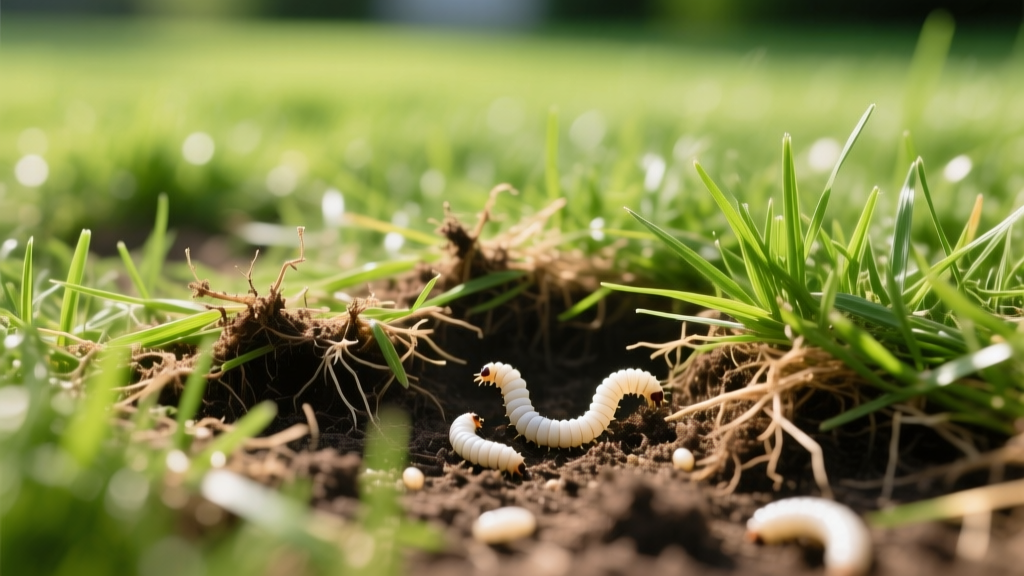
7 Early Signs of Grubs on Lawn and How to Stop the Damage
Understanding the Subsurface Threat
White grubs are the larval stage of scarab beetles, including Japanese beetles, European chafers, and June bugs. These C-shaped, cream-colored pests live just beneath the soil surface, severing grass roots at the soil line and cutting off the turf's ability to absorb water and nutrients. Because the damage occurs underground, many homeowners mistake grub infestations for drought stress or fungal diseases until the turf is completely destroyed. Recognizing the early signs of grubs on lawn ecosystems is the only way to intervene before secondary pests and severe root loss compound the problem.
The 7 Telltale Signs of Grubs on Lawn
Do not wait for your lawn to turn entirely brown. Monitor your yard for these specific indicators from early summer through late fall:
- Spongy Turf Texture: When you walk across the lawn, the ground feels unusually soft, spongy, or loose underfoot, indicating the root structure has been detached from the soil.
- Irregular Brown Patches: Unlike the perfect circles of brown patch fungus, grub damage appears as irregular, sprawling brown or yellow patches that expand rapidly in late summer and early fall.
- The Carpet Roll Effect: The most definitive sign. Damaged turf can be rolled back like a loose carpet or sod because the roots anchoring it to the soil have been entirely consumed.
- Wilting Despite Irrigation: Grass blades fold, turn bluish-gray, and wilt even when the soil is adequately moist, a direct result of the severed root system failing to transport water.
- Increased Avian Activity: Flocks of starlings, crows, or robins repeatedly pecking at the same area of your lawn are actively foraging for exposed larvae.
- Presence of Adult Beetles: A heavy flight of Japanese beetles or June bugs around your landscape lights or ornamental trees in early summer guarantees egg-laying in your turf within 10 to 14 days.
- Frass and Soil Mounding: Close inspection of the soil surface near the transition zone of brown and green grass may reveal tiny, granular soil mounds (frass) pushed up by feeding larvae.
The Diagnostic Framework: The 12-Inch Peel-Back Test
Visual signs alone are not enough to justify chemical treatment. You must quantify the population density. According to Penn State Extension, the economic threshold for treatment is generally 5 to 10 grubs per square foot, depending on turf health and soil moisture.
🛠️ Step-by-Step Diagnostic Procedure:
- Locate the transition zone where healthy green grass meets the damaged brown area.
- Use a sharp spade or a specialized sod cutter to slice a 12-inch by 12-inch square, cutting exactly 3 inches deep into the soil profile.
- Peel the turf back like a hinge. Inspect the exposed soil and the underside of the sod.
- Count the number of C-shaped grubs. Multiply this number by 1 to get the per-square-foot density (since 12x12 inches equals 1 square foot).
- If the count exceeds 8 grubs per square foot on a stressed lawn, or 10 on a healthy lawn, immediate curative action is required.
Grub Species Identification Matrix
Identifying the specific scarab species dictates your long-term biological control strategy. Examine the raster pattern (the arrangement of tiny hairs and spines on the grub's posterior end).
| Species | Raster Pattern | Peak Damage Window | Primary Adult Indicator |
|---|---|---|---|
| Japanese Beetle | V-shaped, distinct zipper | August - September | Metallic green/copper beetles on roses |
| European Chafer | No distinct pattern, Y-shaped anal slit | September - November | Tan/brown beetles swarming at dusk |
| Masked Chafer | Transverse row of spines | August - October | Small golden-brown beetles |
Secondary Pest Indicators: When Animals Attack
Insect and rodent yard defense requires understanding the food chain. Grubs are a high-protein food source that attracts destructive secondary foragers. If you notice the following, a grub infestation is highly probable:
- Skunks and Raccoons: These nocturnal foragers use their claws to peel back large, crescent-shaped flaps of sod to access grubs. This secondary damage is often worse than the grub damage itself.
- Moles: While moles primarily hunt earthworms, a heavy grub population will cause them to push up extensive, raised tunnel networks just beneath the turf surface, drying out the roots.
- Crows and Starlings: Look for hundreds of small, conical holes punched into the soil, roughly the size of a pencil eraser, left by birds probing for larvae.
Treatment Decision Framework: Preventative vs. Curative
Selecting the right chemical intervention depends entirely on the time of year and the size of the grubs. As of 2026, modern active ingredients are highly targeted, but mis-timing the application is the most common cause of treatment failure.
Preventative Control (The Long Game)
Active Ingredient: Chlorantraniliprole (e.g., Scotts GrubEx1).
Application Window: April through early June.
How it Works: This chemistry requires 60 to 90 days to fully translocate into the root zone. It targets newly hatched, first-instar grubs in late summer. It will not kill large, mature grubs actively feeding in the fall.
Cost Analysis: Approximately $30 for a 5,000 sq. ft. bag ($6.00 per 1,000 sq. ft.).
Pro-Tip: You must water the product in with 0.5 inches of irrigation immediately after spreading to move it past the thatch layer.
Curative Control (The Emergency Rescue)
Active Ingredient: Trichlorfon (e.g., Bayer Advanced 24 Hour Grub Killer Plus / Dylox).
Application Window: Late August through September (when grubs are small and near the surface) or early spring (as they wake up).
How it Works: A fast-acting contact and stomach poison that kills actively feeding grubs within 24 hours. It degrades rapidly in the soil (half-life of roughly 10 days), meaning it offers zero residual protection for the following year.
Cost Analysis: Approximately $35 for a 5,000 sq. ft. bag ($7.00 per 1,000 sq. ft.).
Warning: Trichlorfon is highly sensitive to UV light and high pH soils. It must be watered in immediately and heavily (0.5 to 1 inch of water) to survive the descent into the root zone.
🛑 Common Failure Mode: Applying a preventative product like Chlorantraniliprole in September to kill grubs that are already the size of jellybeans. The chemical is too slow-acting and weak at this stage to penetrate the exoskeleton of mature third-instar grubs. You must switch to a Dylox-based curative treatment in the fall.
Organic and Biological Controls
For homeowners managing sensitive ecosystems, near waterways, or maintaining organic lawn certifications, biological controls offer a sustainable alternative. UMass Amherst Extension highlights two primary biological agents, though their efficacy varies wildly based on application precision.
Beneficial Nematodes (Heterorhabditis bacteriophora)
These microscopic, unsegmented worms actively seek out grubs in the soil, enter their bodies, and release bacteria that kill the host within 48 hours. You must purchase the Heterorhabditis bacteriophora (Hb) species, as other nematodes do not effectively penetrate grub exoskeletons.
- Cost: ~$45 for 50 million nematodes (covers roughly 2,500 sq. ft., equating to $18 per 1,000 sq. ft.).
- Application Rules: Apply at dusk to avoid UV degradation. The soil temperature must be above 60°F. You must irrigate before application to provide a moist travel medium, and keep the soil consistently moist for 10 days post-application.
Milky Spore (Paenibacillus popilliae)
Milky spore is a bacterium that causes a fatal disease in Japanese beetle grubs. However, it is highly misunderstood by consumers.
- Limitation 1: It only works on Japanese beetle grubs. It will not control European chafers or June bugs.
- Limitation 2: It takes 2 to 5 years of repeated applications and specific soil temperatures to build up enough spore count in the soil to provide meaningful control.
- Verdict: Use milky spore only as a long-term, multi-year supplement in regions heavily dominated by Japanese beetles, never as an immediate rescue treatment.
Frequently Asked Questions
Can I treat for grubs and plant grass seed at the same time?
Yes, but you must choose your chemistry carefully. Preventative products containing Chlorantraniliprole (GrubEx) are safe to use during fall or spring overseeding and will not harm germinating grass seed. However, curative products containing Trichlorfon (Dylox) can sometimes stunt young seedling root development. If doing a major fall renovation, apply the seed and starter fertilizer first, wait for germination, and then apply the curative grub control if threshold counts demand it.
Why do I still see grubs in the spring after treating in the fall?
Grubs overwinter deep in the soil profile (often 6 to 12 inches down) to survive freezing temperatures. In early spring, they migrate back to the surface to feed for a few weeks before pupating into adult beetles. If you applied a curative treatment in the fall, the chemical degraded months ago. These spring grubs are usually mature, do minimal feeding damage, and are best left alone to pupate, while you prepare your preventative application for May.
Do mole traps solve a grub problem?
No. Trapping or baiting moles only addresses the secondary symptom. Moles are opportunistic and will simply continue to tunnel for earthworms even if the grubs are eradicated. To stop the turf destruction, you must eliminate the grub food source using the chemical or biological frameworks outlined above, then roll the lawn with a water-filled roller to collapse the abandoned tunnels and re-establish root-to-soil contact.

