
Pest Control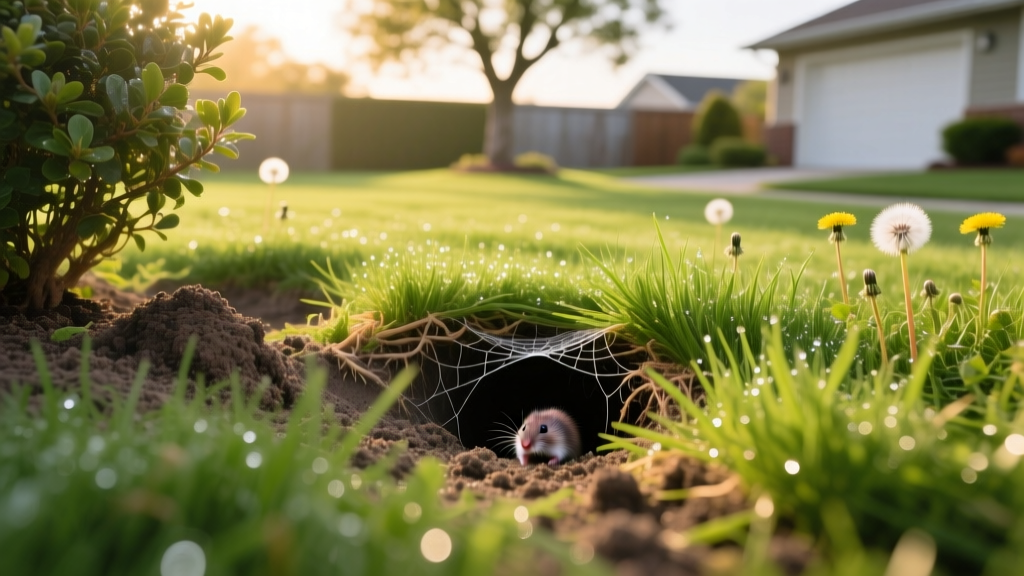
7 Clear Signs of Voles in Yard and How to Evict Them
Identifying the Enemy: Voles vs. Moles
Before deploying traps or repellents, you must accurately identify the pest. Homeowners frequently confuse voles (Microtus species) with moles, but their behaviors, diets, and the damage they inflict are entirely different. Voles are herbivorous rodents that feed on grass stems, roots, bulbs, and tree bark. Moles are insectivores that eat grubs and earthworms, rarely damaging plant roots directly. According to the University of Minnesota Extension, misidentifying these pests leads to wasted money on ineffective grub treatments when the real issue is a vole colony.
| Feature | Voles (Meadow & Pine) | Moles |
|---|---|---|
| Diet | Herbivores (grass, roots, bark, bulbs) | Insectivores (grubs, earthworms, beetles) |
| Surface Signs | 1.5 to 2-inch wide cleared runways | Volcano-shaped dirt mounds (molehills) |
| Burrow Openings | 1.5-inch diameter, no dirt mounds | Hidden under mounds, plugged with dirt |
| Plant Damage | Severe (girdling trees, eating roots) | Minimal (indirect root lifting) |
7 Telltale Signs of Voles in Yard
If your landscape is suffering, look for these specific indicators to confirm a vole infestation.
1. Surface Runways (1.5 to 2 Inches Wide)
Meadow voles (Microtus pennsylvanicus) create distinct, well-worn surface tunnels through the grass. These runways are typically 1.5 to 2 inches wide and are often visible after snowmelt or in overgrown turf. The grass within the runway is chewed down to the crown, creating a clear pathway.
2. Golf-Ball Sized Burrow Openings
Unlike gophers or moles, voles do not push dirt to the surface when excavating. Their burrow entrances are clean, round holes roughly 1.5 inches in diameter (the size of a golf ball), usually located near the base of trees, shrubs, or within dense ground cover.
3. Girdled Tree Bark
Voles gnaw on the cambium layer of young trees, especially in winter when other food is scarce. Look for irregular, non-uniform gnaw marks about 1/16-inch wide and 3/8-inch long at the base of the trunk. If the bark is completely removed around the circumference (girdling), the tree will likely die.
4. Spongy, Undulating Turf
Pine voles (Microtus pinetorum) prefer subterranean tunneling. If your lawn feels spongy underfoot or the turf sinks when you walk on it, pine voles are likely hollowing out the root zone beneath the surface, severing grass roots as they travel.
5. Clean, 45-Degree Clipped Grass Stems
Voles have sharp incisors that cut grass and plant stems at a precise 45-degree angle. If you inspect the edges of your runways or damaged garden beds, you will see cleanly clipped stems, unlike the ragged tearing caused by deer or rabbits.
6. Missing Bulbs and Root Voids
If your spring tulips, hostas, or crocuses fail to emerge, or if mature perennials suddenly wilt and pull out of the ground with no roots attached, voles have consumed the subterranean storage organs. They are notorious for hollowing out the center of tubers and bulbs.
7. Rice-Sized Droppings in Runways
Inspect the surface runways closely. Vole feces are small, cylindrical, and roughly the size of a grain of rice (about 1/8-inch long). Fresh droppings are greenish-brown, while older ones turn gray or white.
Expert Warning: Do not wait until spring to address vole damage. The UC Statewide IPM Program notes that voles remain active year-round and cause their most severe structural damage to trees and shrubs during winter months when snow cover hides them from predators.
Proven Deterrence and Eradication Strategies
Once you have confirmed the signs of voles in yard, implement a multi-tiered management plan. Relying on a single method rarely collapses an established colony.
Exclusion: The Hardware Cloth Standard
Protecting high-value trees and shrubs requires physical barriers. Chicken wire is useless; voles easily squeeze through 1-inch gaps.
- Material: 19-gauge, 1/4-inch x 1/4-inch galvanized hardware cloth.
- Installation: Cut a piece 24 inches wide. Wrap it around the tree trunk, leaving a 2-inch gap between the wire and the bark to allow for growth.
- Depth: Bury the bottom 6 inches of the cloth in the soil to prevent voles from tunneling underneath. The remaining 18 inches should extend above the anticipated snow line.
- Cost: Expect to pay $35 to $50 for a 36-inch x 50-foot roll, which is sufficient to protect dozens of young trees.
Repellents: Castor Oil and Capsaicin
For turf and garden beds, castor oil-based repellents alter the taste and smell of the root zone, driving voles away without killing them.
- Product Recommendation: Bonide Mole Max or similar castor oil granular formulations.
- Application Rate: Apply 1 lb per 1,000 square feet. Water it in heavily to push the active ingredient into the root zone where voles forage.
- Timing: Reapply every 3 to 4 weeks, or immediately after heavy rainfall. Cost averages $25 per 10 lb bag.
Lethal Control: Strategic Trapping
When populations are high, trapping is the most immediate solution. The Victor Out O'Sight Mole Trap (Model 0645) is highly effective for voles when placed directly inside their surface runways.
- Locate an active, straight section of a surface runway.
- Use a trowel to cut out a section of the runway exactly the size of the trap's jaws.
- Set the trap in the depression so the trigger pan sits flush with the runway floor.
- Bait the trigger with a small piece of apple or peanut butter mixed with oatmeal.
- Cover the trap with a dark bucket or cardboard box to block light and prevent pets from accessing it.
Seasonal Vole Behavior & Timing Your Defense
"Vole populations can explode exponentially under the insulation of a winter snowpack. By the time the snow melts and runways become visible, the colony has already multiplied and girdled your most vulnerable ornamentals."
— Landscape Pest Management Guidelines
To stay ahead of the breeding cycle, apply granular repellents in late autumn (November) before the ground freezes. Install hardware cloth on newly planted trees immediately upon planting, regardless of the season. Maintain a 3-foot mulch-free zone around tree trunks, as thick mulch layers provide ideal winter harbor for foraging voles.
Frequently Asked Questions
Do ultrasonic repellents work for voles?
No. Independent university trials consistently show that ultrasonic stakes and solar sonic spikes fail to deter voles. Voles quickly habituate to the noise, and soil density severely limits the transmission range of the sound waves.
Will getting a cat solve my vole problem?
While outdoor cats will hunt individual voles, they cannot eradicate an established subterranean colony. Voles reproduce rapidly—a single female can produce 5 to 10 litters per year. Cats may reduce surface foraging but will not stop root and bulb damage.
How deep do vole tunnels go?
Meadow voles mostly stay in the top 2 to 3 inches of soil or on the surface. Pine voles, however, can tunnel 12 to 18 inches deep to reach bulbs and taproots, making deep soil drenching with liquid castor oil necessary for pine vole deterrence.

