
Pest Control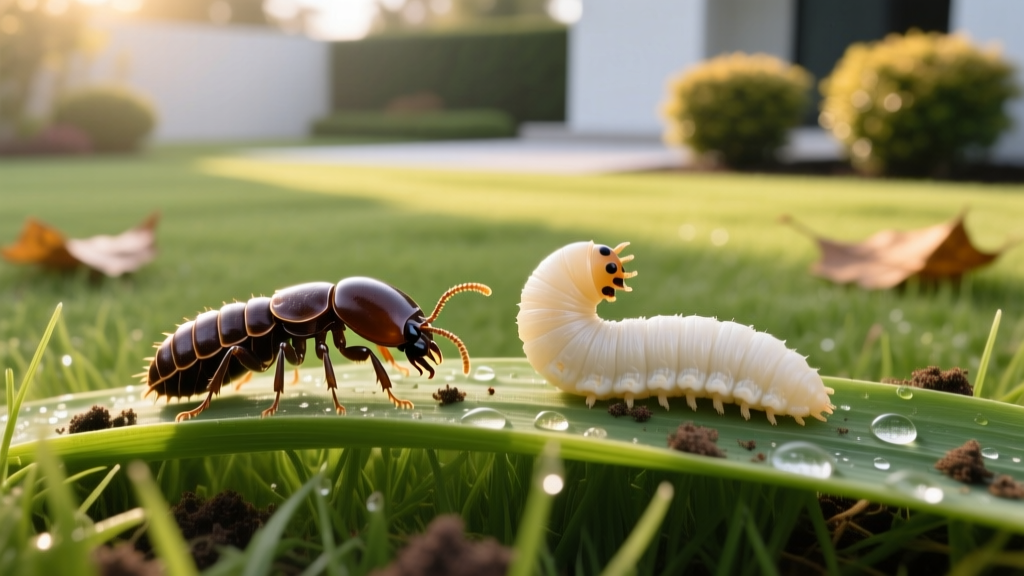
Termite vs Grub: Solving the Termite Grub Identification Mystery
The "Termite Grub" Confusion: What Are You Actually Looking At?
Homeowners searching for a "termite grub" are almost always experiencing a case of mistaken identity. When you dig into your lawn or inspect mulch near your foundation and find pale, segmented, soft-bodied insects, it is natural to assume they are a hybrid threat. In reality, subterranean termites and lawn grubs (the larval stage of scarab beetles) are entirely distinct pests with different biology, dietary preferences, and eradication protocols. Misidentifying them leads to wasted money on ineffective chemicals and continued property damage.
To solve the termite grub mystery, you must first look at the physical anatomy of the specimen and the specific type of damage occurring in your yard. According to Penn State Extension, white grubs are exclusively turfgrass root feeders, while termites are cellulose consumers that pose a direct threat to structural wood.
Visual Identification Matrix
Place the specimen on a dark surface and examine it closely. Use the following diagnostic matrix to confirm the pest's identity before purchasing any treatment.
| Diagnostic Feature | White Grub (Scarab Larva) | Subterranean Termite Worker |
|---|---|---|
| Body Shape | Distinct "C" shape when at rest; plump and wrinkled | Straight, elongated, and uniform in width |
| Coloration | Creamy white body with a distinct brown/orange head capsule | Translucent, creamy white, or pale yellow throughout |
| Antennae | Virtually non-visible or extremely short bristles | Straight, beaded, and clearly visible extending from the head |
| Legs | Three pairs of jointed legs clustered near the head | Three pairs of legs distributed evenly along the thorax |
| Average Size | 0.5 to 1.25 inches depending on instar stage | 0.125 to 0.375 inches (much smaller than mature grubs) |
The Damage Profile: Turf vs. Timber
The location and nature of the damage will confirm your visual identification. Termites and grubs occupy different ecological niches in your yard.
Lawn Grub Damage (Root Severing)
Grubs feed on the fibrous root systems of cool-season and warm-season turfgrasses. The primary symptom is turf that detaches easily from the soil, much like rolling back a carpet. You will notice irregular brown patches appearing in late summer or early fall. Secondary damage often occurs when foraging animals—such as raccoons, skunks, and crows—tear up the lawn to eat the protein-rich grubs. If you can pull up a 1-square-foot section of sod and count more than 5 to 10 grubs, treatment is required.
Termite Damage (Cellulose Hollowing)
Termites do not eat grass roots. If you find them in your yard, they are targeting wooden fence posts, deck supports, landscape timbers, or the cellulose in woodchip mulch. Termites consume wood from the inside out, leaving a thin veneer of timber or paint on the surface. Look for pencil-width mud tubes climbing from the soil up your foundation or wooden structures. As noted by UC Agriculture and Natural Resources, subterranean termites require constant contact with soil moisture to survive, which is why they build these protective earthen tunnels.
⚠️ The Mulch Edge Case: Homeowners frequently find termites swarming in their garden mulch and assume the mulch caused a termite infestation. While mulch provides an ideal moisture bridge for termites to reach your home's foundation, the termites are not eating the mulch as their primary food source if structural wood is available. Keep mulch at least 6 inches away from your home's siding and foundation to break the moisture bridge.
Chemical Treatment Protocols
Because these pests belong to entirely different biological orders (Coleoptera for grubs, Blattodea for termites), the active ingredients used to kill them are not interchangeable. Follow the specific protocol for your identified pest.
Protocol A: Eradicating Lawn Grubs
Grub control is dictated by timing. You must choose between preventative and curative applications based on the season.
- Preventative (May to Mid-July): Apply products containing Chlorantraniliprole (e.g., Scotts GrubEx) or Clothianidin. These chemicals take 60 to 90 days to fully translocate into the root zone but offer long-lasting residual control. Apply at a rate of 2.87 lbs per 1,000 square feet and water in with 0.5 inches of irrigation immediately.
- Curative (August to October): If you discover active grubs eating roots in late summer, preventative chemicals will not work fast enough. Use a contact insecticide containing Trichlorfon (e.g., Dylox). This kills grubs within 24 to 48 hours but degrades rapidly in alkaline soils (pH above 7.0). Apply at 3 lbs per 1,000 square feet.
Protocol B: Stopping Subterranean Termites
Termite treatment requires creating a continuous chemical barrier in the soil surrounding your foundation or targeting the colony via bait matrices.
- Liquid Trenching (Fipronil): Dig a trench 6 inches wide and 6 inches deep around the perimeter of the structure. Mix a non-repellent termiticide like Termidor SC (Fipronil 9.1%) at a rate of 0.8 fluid ounces per gallon of water. Apply 4 gallons of the finished solution per 10 linear feet of trench. The non-repellent nature of Fipronil allows termites to pass through the treated soil, pick up the chemical, and transfer it to the colony via trophallaxis (food sharing).
- Bait Stations (Hexaflumuron): For properties where trenching is impossible due to concrete patios or drainage issues, install in-ground bait stations (e.g., Sentricon or Trelona ATG) every 10 linear feet. These contain a chitin synthesis inhibitor that prevents termites from molting, eventually collapsing the colony. Expect to pay $15 to $25 per station for DIY setups, or $800 to $1,500 for professional installation and annual monitoring.
Biological Controls: Can Nematodes Kill Both?
Beneficial nematodes are microscopic, soil-dwelling worms that parasitize insects, but species specificity is critical. You cannot use a single nematode product for both the termite grub confusion.
| Nematode Species | Target Pest | Application Rate & Conditions |
|---|---|---|
| Heterorhabditis bacteriophora (Hb) | White Grubs | 1 billion per acre. Apply in late summer when soil temps are 60°F–85°F. Requires immediate watering. |
| Steinernema carpocapsae (Sc) | Termites (Limited efficacy) | Not recommended as a primary barrier. While Sc can infect termites in lab settings, termites detect and avoid nematode-infested soil in real-world conditions, breaking the barrier. |
For an organic lawn care approach, Hb nematodes are highly effective against grubs, costing roughly $40 to $60 per million infective juveniles. However, for termites, biological controls are unreliable for protecting structural assets; chemical barriers or bait matrices remain the industry standard for guaranteed defense.
Decision Framework: When to Call a Professional
DIY treatment is highly effective for lawn grubs, as broadcast spreaders and hose-end sprayers easily cover large turf areas. Termite remediation, however, carries significant financial risk if the chemical barrier is incomplete. A single untreated gap in a foundation trench allows termites to bypass the Fipronil barrier and enter your home.
If your home is built on a slab foundation with interior plumbing penetrations, or if you have a finished basement, DIY trenching is insufficient. In these scenarios, professional pest control operators use specialized rod-injection equipment to drill through concrete and inject termiticide directly beneath the slab, a service that typically costs between $1,200 and $2,500 but comes with a multi-year damage warranty.

