
Pest Control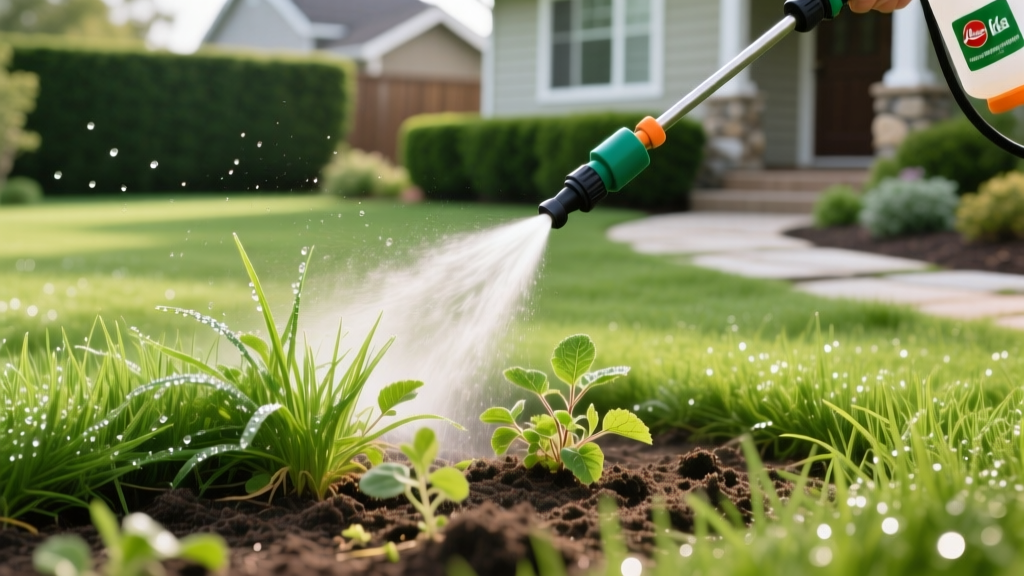
Grass Fertilizer With Weed Killer: Spot-Treatment Protocol
The Agronomic Reality of Combination Products
Combination products, universally recognized as grass fertilizer with weed killer, merge nitrogen-phosphorus-potassium (NPK) macronutrients with selective broadleaf herbicides. While broadcast application across an entire 10,000-square-foot lawn is the standard marketing push, it is often an agronomic mismatch. Most residential lawns experience localized weed pressure—specifically in compacted zones, shaded edges, or thin turf areas—rather than uniform infestation. Spot-treating with these combination products allows you to deliver targeted synthetic auxins (like 2,4-D, Dicamba, and MCPP) directly to weed clusters while simultaneously pushing nitrogen into the surrounding turf to close the canopy and prevent future germination.
According to Penn State Extension, targeted weed management reduces total herbicide load on the soil microbiome by up to 70% compared to blanket applications, preserving beneficial mycorrhizal fungi while still achieving visual eradication.
Why Spot-Treating Beats Broadcast Application
The decision to spot-treat rather than broadcast is driven by three critical factors: cost efficiency, environmental stewardship, and turf safety.
- Cost Efficiency: A standard 40lb bag of premium grass fertilizer with weed killer costs between $45 and $60 in 2026, covering roughly 10,000 square feet. If your weed coverage is less than 15% of your total lawn area, spot-treating reduces your product expenditure to under $10 per season.
- Canopy Closure: By applying the nitrogen component only to the areas surrounding the weed clusters, you stimulate lateral stolon and rhizome growth exactly where the turf is thin, naturally choking out future weed seedlings.
- Reduced Phytotoxicity Risk: High-nitrogen weed-and-feed products (e.g., 28-0-3 or 32-0-4) carry a high salt index. Broadcast applying these during late-summer heat stress can cause severe fertilizer burn. Spot-treating limits this risk to isolated zones.
⚠️ CRITICAL APPLICATION WARNING: The Moisture Rule
Granular herbicides in weed-and-feed products are not soil-active; they are strictly foliar-absorbed. The granules must physically stick to the waxy cuticle of the weed's leaves to be absorbed. If you apply grass fertilizer with weed killer to a bone-dry lawn, the granules will bounce off the dandelion leaves, fall to the soil, and become entirely ineffective. Always apply early in the morning when dew is present, or lightly irrigate the lawn 30 minutes before application.
Product Matrix: Choosing the Right Active Ingredients
Not all grass fertilizer with weed killer formulations are identical. The herbicide profile dictates which species will die, while the NPK ratio dictates the speed of turf recovery. Below is a breakdown of the top formulations available for spot-treatment protocols.
| Product Formulation | Active Herbicides | Target Weeds | NPK Ratio | Est. Price (40lb) |
|---|---|---|---|---|
| Scotts Turf Builder Weed & Feed | 2,4-D, Mecoprop-p, Dicamba | Dandelion, Clover, Chickweed | 28-0-3 | $48.00 |
| BioAdvanced All-in-One Lawn Care | 2,4-D, Dicamba, Quinclorac | Broadleaves + Crabgrass | 20-0-4 | $56.00 |
| Pennington UltraGreen Weed & Feed | 2,4-D, Mecoprop-p, Dicamba | Dandelion, Dollarweed, Plantain | 28-0-3 | $42.00 |
Note: If your localized spots contain crabgrass or grassy weeds like Poa annua, standard 3-way herbicide blends will fail. You must select a product containing Quinclorac, such as the BioAdvanced formulation, as noted in University of Minnesota Turf Science guidelines.
Step-by-Step Spot-Treatment Protocol
Executing a granular spot-treatment requires different mechanical calibration than a full-lawn broadcast. Follow this precise sequence to ensure foliar absorption and prevent turf burn.
- Calibrate the Handheld Spreader: Do not use a full-sized drop spreader for spot treatments. Use a handheld rotary spreader (e.g., Scotts Whirl). Set the dial to 50% of the manufacturer's recommended broadcast setting. Because you are covering a smaller area, you will naturally walk slower and overlap more, which compensates for the reduced flow rate.
- Prepare the Foliage: Check the weed leaves. If they are dry, run a sprinkler for exactly 10 minutes to create a micro-layer of surface moisture. Wait 15 minutes for the water to absorb into the soil, leaving the leaves damp but not dripping.
- Apply the Product: Walk at a steady pace of 3 feet per second. Keep the handheld spreader 12 inches above the turf canopy. Extend the application 2 feet beyond the visible edge of the weed cluster to treat the surrounding thin turf with nitrogen.
- Enforce the 48-Hour Dry Window: This is where most homeowners fail. Do not water the lawn for 48 hours after application. The EPA notes that 2,4-D requires up to 48 hours to fully translocate from the leaf tissue down into the weed's root system. Watering too soon washes the active ingredient into the soil, rendering it useless and potentially harming shallow-rooted desirable plants.
- Deep Irrigation on Day 3: After the 48-hour window, apply 0.5 inches of water. This dissolves the remaining nitrogen fertilizer granules on the soil surface, pushing the nutrients into the root zone to stimulate grass growth.
Troubleshooting Common Failure Modes
When a spot-treatment fails, it is almost always due to one of three agronomic errors:
- The Weed Turned Yellow but Survived: The herbicide dose was sufficient to cause epinasty (twisting and yellowing) but insufficient to kill the taproot. This happens when the granular product was applied to dry leaves, and only a fraction of the active ingredient stuck to the foliage. Fix: Reapply in 14 days, ensuring heavy morning dew.
- The Grass Burned in Brown Patches: Over-application of the nitrogen component. Handheld spreaders often dump product when you stop walking. Fix: Always engage the spreader trigger while in motion, and never stop walking while the product is flowing.
- The Weed Didn't React At All: You are likely dealing with a grassy weed (like crabgrass, nutsedge, or goosegrass) or a highly resistant broadleaf weed (like wild violet). Standard 2,4-D and Dicamba blends do not affect monocots (grassy weeds) and struggle against the thick waxy cuticles of wild violet. Fix: Switch to a liquid Quinclorac or Sulfentrazone spot-spray for these specific species; granular weed-and-feed is not formulated for them.
"The biggest misconception about grass fertilizer with weed killer is that it's a soil treatment. It is fundamentally a foliar herbicide paired with a soil fertilizer. Treating it like a pre-emergent or a soil drench will result in total product failure and wasted capital."
Environmental and Soil Health Considerations
Spot-treating inherently aligns with integrated pest management (IPM) principles by minimizing chemical runoff. When broadcast applications are heavily watered in, excess Dicamba and 2,4-D can leach into storm drains. By restricting application to isolated 5x5 foot zones and enforcing a 48-hour dry period, you allow soil microbes to begin breaking down any herbicide that eventually reaches the soil surface. Furthermore, limiting high-salt nitrogen applications to only the areas requiring canopy closure prevents the salinization of your broader lawn soil, maintaining optimal cation exchange capacity (CEC) for long-term turf health.

