
Pest Control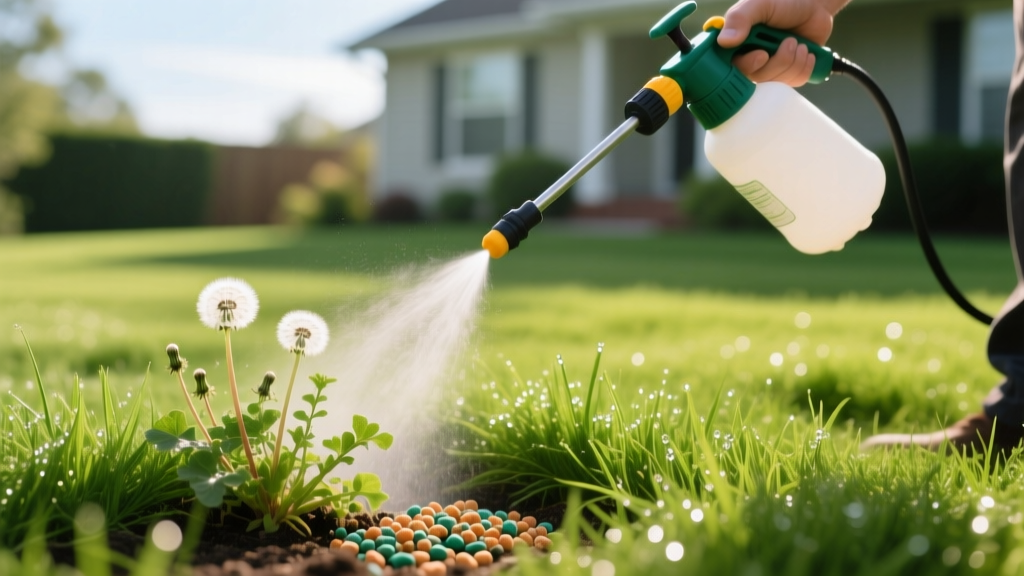
Weed Spot-Treatment: Using Grass Fertiliser and Weed Killer Safely
Broadcast applications of combination lawn products are an outdated approach that wastes chemicals, increases environmental runoff, and damages non-target ornamentals. Modern integrated pest management (IPM) relies on precision. When dealing with isolated infestations, deploying a targeted grass fertiliser and weed killer strategy ensures you deliver nutrients to the turf while eradicating specific weed species without overloading your soil with unnecessary herbicides.
This guide deconstructs the exact active ingredients, calibration metrics, and application protocols required to spot-treat the most stubborn lawn weeds in 2026, moving beyond generic advice into actionable, species-specific frameworks.
The Anatomy of a Spot-Treatment Strategy
A true spot-treatment isolates the weed cluster and applies the minimum effective dose of herbicide, paired with a localized nutrient boost to help the surrounding turfgrass outcompete the dying weed. Most commercial 'weed and feed' products are formulated for broadcast spreader applications. To adapt these for spot-treatment, or to select specialized liquid concentrates, you must understand the chemical synergy between the nutrient base (NPK) and the selective herbicide.
Expert Insight: Never apply granular combination products to dormant or heat-stressed turf. The herbicide component (often 2,4-D or Dicamba) requires active weed growth for foliar uptake, while the fertiliser component requires active turf root uptake. If soil temperatures are below 55°F or above 85°F, the treatment will fail and risk fertilizer burn.
Weed Species Identification & Active Ingredient Matrix
Different weed species possess distinct biological defenses. Using a broad-spectrum product on a sedge, for example, is a guaranteed failure. Use this decision matrix to match the weed species with the correct active ingredient and application method.
| Weed Species | Classification | Required Active Ingredient | Optimal Spot-Treatment Format | Estimated Cost per 1,000 sq ft |
|---|---|---|---|---|
| Dandelion (Taraxacum officinale) | Broadleaf | 2,4-D + Dicamba | Liquid concentrate (surfactant required) | $0.85 - $1.20 |
| White Clover (Trifolium repens) | Broadleaf | Quinclorac + 2,4-D | Liquid concentrate or targeted granular | $1.10 - $1.50 |
| Crabgrass (Digitaria) | Grassy (Annual) | Quinclorac (Post-emergent) | Liquid spray (must catch before 3-tiller stage) | $1.50 - $2.00 |
| Yellow Nutsedge (Cyperus esculentus) | Sedge | Sulfentrazone or Halosulfuron-methyl | Liquid spray (Standard combos will fail) | $3.50 - $5.00 |
Liquid vs. Granular: The Spot-Treatment Economics
When formulating your grass fertiliser and weed killer regimen for isolated patches, the physical state of the product dictates efficacy and cost.
Liquid Concentrates (The Precision Standard)
- Mechanism: Foliar absorption. The herbicide enters through the weed's stomata, while the liquid fertilizer (often urea-based nitrogen) provides an immediate green-up to surrounding grass.
- Pros: Pinpoint accuracy; zero granular bounce onto hardscapes; immediate visual tracking (if a dye is added).
- Cons: Requires pump sprayer calibration; susceptible to wind drift; requires 24 hours of rain-free drying time.
- Top 2026 Product Pick: Ortho WeedClear Lawn Weed Killer Plus Crabgrass Control (Approx. $22 for 32oz ready-to-spray, covering up to 5,000 sq ft of targeted spot treatments).
Granular Combos (The Broadcast Compromise)
- Mechanism: Granules must physically stick to the moist leaves of the weed for the herbicide to work, while the fertilizer pellets fall to the soil to be watered in.
- Pros: No mixing required; zero drift risk; longer soil residual for pre-emergent weed prevention.
- Cons: Highly inefficient for spot-treating. You end up applying heavy fertilizer loads to weed-free zones just to hit a few dandelions.
- Top 2026 Product Pick: Scotts Turf Builder Triple Action (Approx. $42 for a 12 lb bag covering 4,000 sq ft. Best reserved for perimeter border treatments rather than isolated spots).
Step-by-Step Calibration and Application Protocol
Improper calibration is the leading cause of turf damage during spot-treatments. Follow this exact protocol when mixing and applying liquid grass fertiliser and weed killer concentrates.
- Mow the Turf: Cut your lawn to its standard height (e.g., 3 inches for Tall Fescue). Do not scalp the lawn, as this stresses the turf and reduces its ability to absorb the fertilizer component.
- Wait 48 Hours: Allow the weeds to regenerate fresh leaf tissue. Fresh cuts absorb systemic herbicides 40% faster than mature, hardened leaves.
- Calibrate the Sprayer: Fill a 1-gallon pump sprayer with water and spray a 1,000 sq ft test area (e.g., a 20x50 ft driveway) to measure your output. Adjust your nozzle to deliver exactly 1.5 gallons per 1,000 sq ft.
- Mix the Solution: For a standard 2,4-D + Dicamba liquid concentrate, mix 2.0 fluid ounces of herbicide per gallon of water. Add 1 teaspoon of non-ionic surfactant per gallon to break the surface tension on waxy weed leaves (like plantain or clover).
- Apply with Precision: Use a fan-nozzle tip held exactly 18 inches above the turf canopy. Spray only until the weed leaves are visibly wet (glistening), but not to the point of runoff. Runoff wastes chemical and pushes it into the soil where it is ineffective for foliar-absorbing herbicides.
- The Fertilizer Follow-Up: If using a standalone liquid herbicide for the spot-treatment, follow up 7 days later with a localized application of liquid kelp and urea (20-0-0) to force the surrounding grass to fill the void left by the dying weed.
Critical Edge Cases: When Standard Combos Fail
Even the most carefully applied grass fertiliser and weed killer products will fail under specific biological and chemical conditions. Recognizing these edge cases separates professional turf managers from frustrated homeowners.
Edge Case 1: The Sedge Imposter
Yellow Nutsedge and Purple Nutsedge look like grass, but they are sedges. Standard broadleaf herbicides (2,4-D, Dicamba, MCPP) have zero effect on them. Furthermore, pulling them leaves the nutlets (tubers) in the soil, triggering a survival mechanism that sprouts three new plants. The Fix: You must abandon standard combo products and use a dedicated Sulfentrazone-based product like SedgeHammer ($18 for a 13.5g packet). Apply it strictly as a liquid spot-treatment; do not mix it with heavy nitrogen fertilizers, as rapid turf growth can outpace the herbicide's translocation into the sedge's tubers.
Edge Case 2: Soil pH Lockout
If your soil pH is above 7.5 (highly alkaline), the iron and micronutrients in many weed-and-feed products become chemically locked in the soil, unavailable to the turfgrass. Simultaneously, high pH can accelerate the breakdown of certain herbicides in the tank mix. The Fix: Test your soil before purchasing combination products. If pH is high, apply elemental sulfur (at a rate of 1 lb per 1,000 sq ft) in the fall to lower the pH, and rely on liquid foliar fertilizers for spot-treatments in the spring.
Expert Troubleshooting FAQ
Can I mix a liquid pre-emergent with my post-emergent spot-treatment?
No. Pre-emergents (like Prodiamine) must be watered into the soil to create a chemical barrier at the root zone. Post-emergent spot-treatments must remain on the leaf surface for 24-48 hours to translocate to the weed's roots. Watering in a pre-emergent will wash the post-emergent off the weed leaves, rendering the spot-treatment useless.
Why did my granular weed and feed kill the weed but burn the surrounding grass?
Granular products require moisture (dew or light irrigation) to stick to the weed leaves. However, if the granules are applied heavily to dry soil and then watered in deeply, the sudden release of synthetic nitrogen (often 20% to 30% in these combos) can cause osmotic shock to the turfgrass roots, resulting in 'fertilizer burn.' Always apply granular combos to moist turf and water in lightly—just enough to activate the granule, not enough to create puddles.
Is it safe to use spot-treatments near the drip line of mature trees?
Exercise extreme caution. Tree roots extend well beyond the canopy drip line. Herbicides like Dicamba are highly mobile in the soil and can be absorbed by the shallow feeder roots of sensitive trees (like maples, oaks, and dogwoods), causing leaf cupping and canopy dieback. Within the drip line, avoid soil-active herbicides and rely solely on careful, shielded applications of glyphosate or manual extraction for weed control.
For more detailed research on turfgrass chemistry and weed biology, consult resources from the NC State Turfgrass Program and the University of Minnesota Extension. Always adhere to local environmental guidelines and read the full product label as mandated by the EPA before applying any chemical treatments to your lawn.

