
Pest Control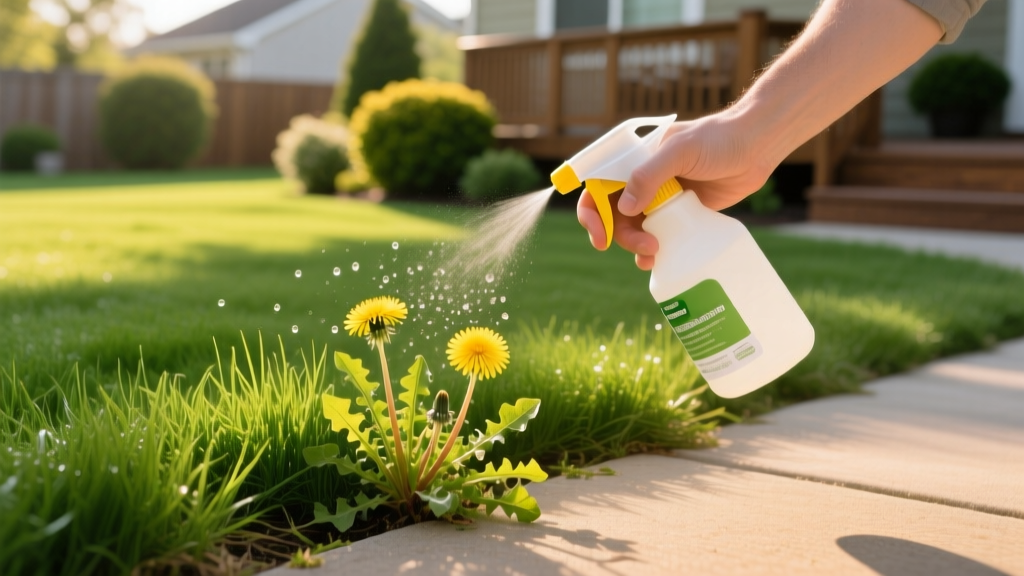
Best Weed Killer That Doesn't Kill Grass: Spot-Treatment Guide
The Science of Selective Herbicides
Finding a weed killer that doesn't kill grass requires understanding the biochemical differences between monocots (grasses) and dicots (broadleaf weeds), or the specific metabolic pathways unique to grassy weeds and sedges. Selective herbicides exploit these differences. For instance, synthetic auxins like 2,4-D mimic plant growth hormones, causing rapid, uncontrolled cell division in broadleaf weeds while leaving grasses unharmed. Conversely, HPPD inhibitors like mesotrione block carotenoid biosynthesis, bleaching susceptible weeds white while tolerant grass species rapidly metabolize the chemical into inactive compounds.
Quick Decision Matrix: Weed Type to Active Ingredient
- Broadleaf Weeds (Dandelion, Clover, Thistle) → 2,4-D + Dicamba + MCPP
- Grassy Weeds (Crabgrass, Foxtail) → Quinclorac or Mesotrione
- Sedges (Nutsedge, Kyllinga) → Halosulfuron-methyl
- Tough Perennials (Wild Violet, Ground Ivy) → Triclopyr + 2,4-D
Top Selective Herbicides for Spot-Treatment
Spot-treating individual weeds or small patches is vastly more economical and environmentally sound than broadcast spraying. Below are the industry-standard active ingredients and specific product formulations for targeted eradication.
1. Broadleaf Weeds: The Three-Way Herbicide Approach
Single-ingredient 2,4-D is largely obsolete for home lawns due to poor efficacy on resistant weeds like clover and plantain. Modern spot-treatment relies on three-way mixtures. Ortho WeedClear Lawn Weed Killer (approx. $18 for 32oz ready-to-spray) combines 2,4-D, Dicamba, and MCPP (Mecoprop-p). For professional-grade concentrate, Trimec 992 Broadleaf Herbicide ($85 per gallon) covers up to 85,000 square feet. The addition of Dicamba provides soil residual activity, while MCPP targets tough perennials like wild violet. According to Penn State Extension, three-way herbicides remain the gold standard for cool-season turfgrass safety.
2. Grassy Weeds: Quinclorac and Mesotrione
Eradicating grassy weeds in a grass lawn is the most complex challenge in turf management. For crabgrass and foxtail, Drive XLR8 (Quinclorac) is highly effective on cool-season grasses and Bermudagrass, but it will severely injure St. Augustine and Centipede grass. For a broader safety profile, Tenacity (Mesotrione 4SC) is the premier choice. Priced around $65 for an 8oz bottle, Tenacity safely eliminates crabgrass, nimblewill, and bentgrass in Kentucky Bluegrass, Tall Fescue, and Centipedegrass. The EPA notes that HPPD inhibitors like mesotrione have a favorable environmental profile due to their low application rates and rapid soil degradation.
3. Sedges: Halosulfuron-methyl
Nutsedge is neither a grass nor a broadleaf weed; it is a sedge with a triangular stem and a tuber-producing root system. Standard broadleaf killers will not touch it. SedgeHammer+ (Halosulfuron-methyl) is the definitive spot-treatment. Sold in 13.5-gram water-soluble packets (approx. $16 per packet), it halts amino acid synthesis in the weed. As documented by the UC Statewide IPM Program, targeting nutsedge before it produces new tubers (typically early summer) is critical for long-term control.
Precision Mixing and Application Protocols
The primary reason selective herbicides fail or damage surrounding turf is improper mixing. Concentrates require exact dilution and the mandatory inclusion of a surfactant to break the surface tension of the weed's waxy cuticle.
| Product | Spot-Treatment Mix Rate (per 1 Gallon) | Surfactant Requirement | Coverage |
|---|---|---|---|
| Trimec 992 (Concentrate) | 1.5 fl oz | Optional (contains built-in) | 1,000 sq ft |
| Tenacity (Mesotrione 4SC) | 1/2 teaspoon | Mandatory: 1 tsp Non-Ionic Surfactant | 1,000 sq ft |
| SedgeHammer+ | 1/2 packet (approx 6.7g) | Included in packet formulation | 1,000 sq ft |
Critical Temperature Warning: Never apply 2,4-D or Dicamba products when ambient temperatures exceed 85°F. At high temperatures, these chemicals undergo volatilization—turning into a vapor that drifts onto and severely damages nearby desirable plants, shrubs, and trees. Apply spot-treatments in the early morning when temperatures are between 65°F and 80°F.
Troubleshooting Spot-Treatment Failures
When a selective herbicide fails to kill the target weed, or inadvertently harms the lawn, the root cause almost always traces back to one of three application errors:
Failure Mode 1: The Weed Turns White but Doesn't Die
Cause: You applied Tenacity (mesotrione) without a non-ionic surfactant, or the weed is mature. Mesotrione causes photobleaching (whitening) by shutting down chlorophyll production. Without a surfactant, the chemical sits on the leaf surface and only partially absorbs, stunting the weed without killing the root crown. Fix: Always mix 1 teaspoon of NIS per gallon of water when using Tenacity, and target weeds when they are young and actively growing.
Failure Mode 2: Surrounding Grass Shows Yellowing or Stunting
Cause: Overlapping spray passes during spot-treatment. When treating a dense patch of dandelions, homeowners often spray the same area multiple times to ensure coverage. This doubles or triples the active ingredient load on the soil, overwhelming the grass's metabolic ability to detoxify the herbicide. Fix: Spray only until the weed leaves are visibly wet (dew point). Do not spray to the point of runoff.
Failure Mode 3: Nutsedge Returns in 3 Weeks
Cause: Pulling the weed before the herbicide translocates, or applying SedgeHammer to drought-stressed turf. Halosulfuron-methyl must be absorbed through the foliage and translocated down to the tubers (nutlets) in the soil. Fix: Do not mow for 48 hours before and 48 hours after application. Allow the chemical 14 to 21 days to fully kill the subterranean tubers before resuming normal mowing.
Post-Application Lawn Recovery
Selective herbicides can cause temporary phytotoxicity (stress) to the surrounding grass, even when applied correctly. To accelerate recovery, wait 48 hours after the herbicide has fully dried and absorbed, then apply a liquid kelp extract or a light dose of fast-release nitrogen (like ammonium sulfate at 0.5 lbs per 1,000 sq ft). This stimulates the grass to push new growth and quickly fill the micro-gaps left by the dying weeds, preventing new weed seeds from germinating in the exposed soil.

