
Pest Control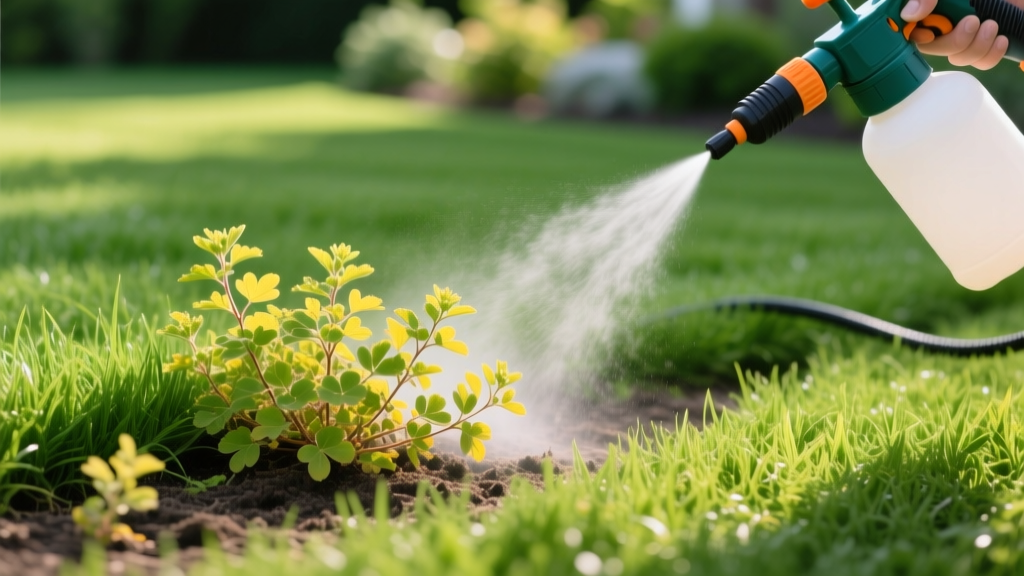
Best Herbicide for Spurge: Spot-Treatment Guide for Lawns
Identifying Your Spurge Invader
Spurge is a notoriously aggressive summer annual weed that thrives in heat, compacted soil, and thinning turf. Before selecting an herbicide for spurge, accurate identification is critical, as misidentification leads to ineffective chemical applications and wasted money. The two most common varieties in residential lawns are spotted spurge (Euphorbia maculata) and prostrate spurge (Euphorbia supina).
Spotted spurge features small, oval leaves with a distinct dark red or purple spot in the center of the leaf blade. Prostrate spurge lacks this spot but shares the same low-growing, mat-forming habit. Both species develop a deep, woody taproot that can extend up to 6 inches into the soil, making casual hand-pulling largely ineffective unless the entire root system is extracted.
The Milky Sap Test
To confirm you are dealing with a Euphorbia species, perform the snap test. Wearing gardening gloves, break a stem near the base. Spurge will immediately exude a sticky, milky-white latex sap. This sap is a mild skin irritant and serves as a natural defense mechanism against grazing insects and poor herbicide absorption.
Pre-Emergent vs. Post-Emergent Herbicide for Spurge
Because spurge germinates when soil temperatures consistently reach 60°F to 65°F in late spring, pre-emergent herbicides are highly effective if applied in early April. However, once the weed establishes its taproot and begins photosynthesizing, you must transition to a post-emergent herbicide for spurge spot-treatments.
| Treatment Type | Active Ingredients | Application Timing | Est. Cost per 1,000 sq ft |
|---|---|---|---|
| Pre-Emergent | Prodiamine, Dithiopyr | Early Spring (Soil 55°F) | $0.08 - $0.12 |
| Post-Emergent (Selective) | 2,4-D, MCPP, Dicamba, Quinclorac | Late Spring to Mid-Summer | $0.04 - $0.09 |
| Non-Selective (Hardscapes) | Glyphosate, Glufosinate | Any active growth stage | $0.02 - $0.05 |
Top Post-Emergent Herbicides for Spot-Treating Spurge
Spurge leaves possess a thick, waxy cuticle that repels water-based sprays. A standard single-active-ingredient herbicide like basic 2,4-D will often fail to penetrate this barrier. You need a multi-active-ingredient formulation combined with a non-ionic surfactant to break the surface tension and drive the chemical into the plant's vascular system.
1. Ortho WeedClear Lawn Weed Killer (Ready-to-Spray)
Active Ingredients: 2,4-D, Quinclorac, Dicamba.
Best For: Cool-season grasses (Kentucky Bluegrass, Fescue) and Bermuda grass.
Pricing: Approximately $16 for a 32 oz hose-end sprayer (covers up to 5,000 sq ft).
Expert Note: The addition of Quinclorac makes this highly effective against spurge and crabgrass simultaneously. Do not use on St. Augustine or Centipede grass, as 2,4-D will cause severe phytotoxicity.
2. Fertilome Weed-Out Lawn Weed Killer (Concentrate)
Active Ingredients: 2,4-D, MCPP-P, Dicamba.
Best For: Sensitive warm-season grasses like St. Augustine and Centipede.
Pricing: Approximately $24 for a 32 oz concentrate.
Mix Rate: 2 oz per gallon of water for spot-treating 1,000 sq ft. Always add 0.25% v/v (1 teaspoon per gallon) of a non-ionic surfactant like Hi-Yield Spreader Sticker.
3. Glyphosate (Roundup Pro Max) for Hardscapes
Active Ingredient: Glyphosate (41%).
Best For: Spurge growing in driveway cracks, sidewalk joints, and mulch beds where no desirable turf exists.
Pricing: $45 for a 1-gallon concentrate (yields over 40 gallons of mixed solution).
Warning: Glyphosate is non-selective. A single drop of drift will kill your lawn. Use a shielded spray wand or a paintbrush application method for spurge growing immediately adjacent to turf edges.
Step-by-Step Spot-Treatment Protocol
Applying an herbicide for spurge requires strict adherence to environmental parameters to prevent turf damage and ensure weed mortality.
- Mow 48 Hours Prior: Mow your lawn two days before application. This allows the spurge to generate new, tender leaf tissue that absorbs herbicide more rapidly than older, hardened leaves.
- Check the Thermometer: Apply only when ambient air temperatures are between 65°F and 85°F. Applications made above 90°F cause ester-based herbicides to volatilize (turn into a gas), drifting onto and burning desirable turf.
- Mix with Surfactant: If using a concentrate, mix the herbicide with a methylated seed oil (MSO) or non-ionic surfactant. The waxy spurge cuticle requires this chemical breaker to absorb the poison.
- Calibrate for Coarse Droplets: Adjust your pump sprayer nozzle to a coarse, flat-fan spray pattern (15 to 20 PSI). Fine mist settings create aerosolized drift that damages surrounding plants.
- Withhold Water and Mowing: Do not irrigate the lawn for 48 hours post-application. Wait at least 3 days before mowing to allow the herbicide to translocate down into the 6-inch taproot.
Organic and Cultural Spot-Treatments
For homeowners managing organic lawns or dealing with spurge in vegetable garden perimeters, chemical herbicides are off the table. Spurge is an indicator species for compacted, nutrient-poor soil. Addressing the soil profile is the ultimate organic control method.
- Horticultural Vinegar (20% Acetic Acid): Effective only on young spurge seedlings (under 2 inches wide). It burns the foliage but will not kill the taproot. Expect multiple applications. Cost: ~$25 per gallon.
- Manual Extraction: Use a stand-up weeding tool with a deep V-notch (like the Fiskars Uproot Weeder) to lever out the entire taproot. If the root snaps below the soil line, the spurge will regenerate within 14 days.
- Core Aeration: Spurge thrives in soil with high bulk density. Core aeration reduces soil compaction, allowing desirable turfgrass roots to outcompete spurge for water and nutrients.
Troubleshooting: Why Your Spurge Keeps Coming Back
If your spot-treatments are failing, evaluate these common failure modes identified by turfgrass scientists at institutions like UC Agriculture and Natural Resources and Purdue University's Turfgrass Science program.
Failure Mode 1: The Weed Turned Red but Didn't Die
Cause: You applied the herbicide during a period of drought stress or extreme heat. When spurge is stressed, it halts internal fluid movement (translocation) to conserve water. The herbicide burns the leaves it touches but never reaches the taproot.
Fix: Deeply irrigate the lawn for two days to encourage active growth, then reapply the herbicide during a cooler weather window.
Failure Mode 2: Surrounding Grass is Yellowing or Curling
Cause: Herbicide volatilization or spray drift. This happens when spraying in high winds or when temperatures exceed 85°F, particularly with 2,4-D formulations.
Fix: Switch to an amine-based 2,4-D formulation rather than an ester-based one, as amines have a much lower vapor pressure and are less likely to vaporize and drift in summer heat. Always follow EPA guidelines for safe lawn pesticide application regarding wind speed and temperature limits.
Successful spurge eradication relies on patience and precision. By combining a high-quality multi-active-ingredient herbicide with a dedicated surfactant and strict temperature management, you can eliminate spurge colonies without compromising the health of your surrounding turfgrass.

