
Pest Control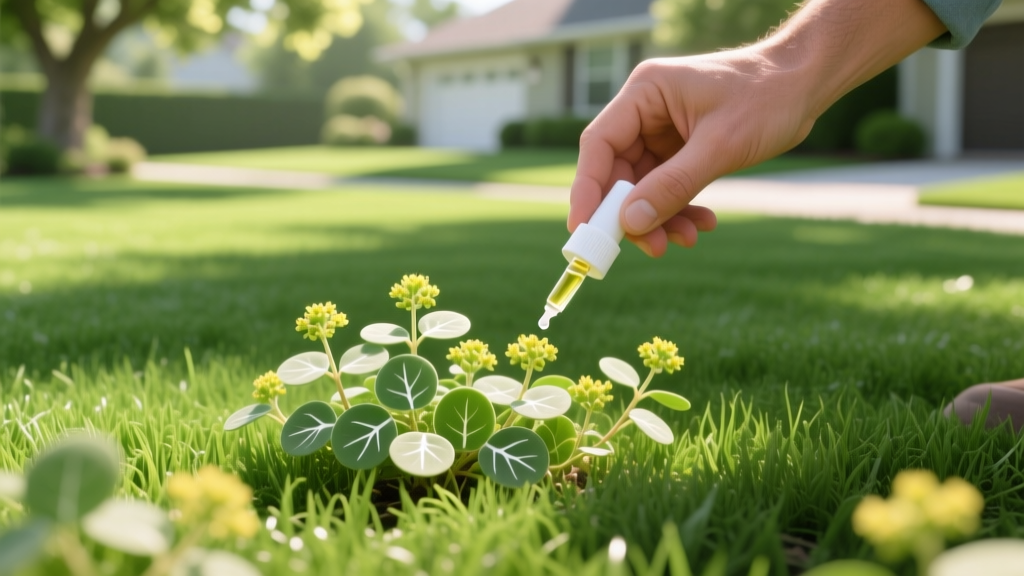
Effective Spotted Spurge Weed Killer & Spot Treatment Guide
Spotted spurge (Euphorbia maculata) is a highly adaptive summer annual weed that thrives in compacted, nutrient-poor soils, driveways, and hot pavement edges. Unlike upright broadleaf weeds, spurge grows in a low, prostrate mat that chokes out turfgrass and resists standard mowing. Its most notorious defense mechanism is a thick, waxy leaf cuticle and a milky latex sap that causes skin irritation and repels water-based herbicides. If you are relying on generic 2,4-D formulations from a big-box store, you are likely experiencing rapid leaf burn without root death, guaranteeing the weed will resprout within 14 days. Eradicating this weed requires a targeted chemical approach, precise surfactant chemistry, and strict adherence to application timing.
The Botanical Challenge: Why Spurge Resists Standard Herbicides
The primary failure mode in spotted spurge control is poor foliar absorption. The plant's waxy cuticle causes standard aqueous herbicide solutions to bead up and roll off onto the soil, where they are rendered useless. Furthermore, spurge possesses a deep, wiry taproot. If a systemic herbicide does not penetrate the leaf tissue and translocate down to the root crown, the plant will simply regenerate from the base.
Handling Warning: Always wear nitrile gloves when hand-pulling or mechanically disturbing spotted spurge. The exuded milky sap contains diterpene esters, which are severe contact irritants and can cause blistering on sensitive skin or severe reactions if transferred to the eyes.
Selecting the Right Spotted Spurge Weed Killer
To defeat the waxy cuticle and ensure root translocation, your spotted spurge weed killer must contain a rapid-burn active ingredient paired with a systemic hormone herbicide. Carfentrazone-ethyl is the industry gold standard for spurge. It acts as a PPO inhibitor, rapidly destroying cell membranes and stripping away the waxy cuticle, which allows the accompanying systemic herbicides (like 2,4-D, MCPP, or Triclopyr) to flood the plant's vascular system.
| Active Ingredient | Role in Spurge Control | Efficacy Rating |
|---|---|---|
| Carfentrazone-ethyl | Strips waxy cuticle; rapid 24-hour burn-down | Excellent |
| Triclopyr | Deep root translocation; woody/tough broadleaf control | Very Good |
| Fluroxypyr | Excellent systemic movement in high-heat conditions | Very Good |
| 2,4-D (Standalone) | Fails to penetrate mature spurge cuticle; poor root kill | Poor |
Exact Formulations and Market Pricing
When selecting a commercial or professional-grade spotted spurge weed killer, look for these specific formulations. Pricing reflects average 2026 market rates for professional and high-end consumer packaging.
1. SpeedZone Broadleaf Herbicide for Turf
Active Ingredients: Carfentrazone-ethyl, 2,4-D, MCPP, Dicamba.
Cost: ~$55 per pint.
Mix Rate: 1.5 fl oz per gallon of water (covers ~1,000 sq ft).
Best For: Cool-season turfgrasses (Fescue, Kentucky Bluegrass) and Bermudagrass. SpeedZone provides visible wilting within 12 hours and total necrosis in 5 days. Note: Do not use on St. Augustine or Centipedegrass without verifying specific label dilution rates, as carfentrazone can cause temporary phytotoxicity on sensitive warm-season grasses.
2. Trimec Southern Broadleaf Herbicide
Active Ingredients: 2,4-D, MCPP, Dicamba (lower concentrations, formulated for warm-season grass).
Cost: ~$45 per gallon.
Mix Rate: 0.75 to 1.5 fl oz per gallon.
Best For: St. Augustine, Zoysia, and Centipedegrass. While it lacks carfentrazone, the specific amine formulation is safer for sensitive southern lawns while still providing adequate systemic control on young spurge.
3. Ortho WeedClear for Lawns (Consumer Grade)
Active Ingredients: 2,4-D, Quinclorac, Dicamba.
Cost: ~$15 per quart (Ready-to-Use) or ~$25 for concentrate.
Best For: Very small, isolated seedling patches. Quinclorac is primarily a grassy weed killer, making this less optimal for mature spurge, but the ready-to-use convenience works for early-season spot treatments.
The Spot-Treatment Protocol: Surfactants and Nozzles
Even the best spotted spurge weed killer will fail if applied incorrectly. Follow this exact protocol to ensure foliar penetration and root death.
- Hydrate the Target Area: Never spray spurge during a drought. When soil is bone dry, spurge closes its leaf stomata to conserve moisture, blocking herbicide uptake. Water the lawn deeply 24 hours before application to open the stomata.
- Add a Non-Ionic Surfactant (NIS): This is non-negotiable. Add a high-quality NIS (such as DyneAmic or a generic crop oil concentrate) at a rate of 0.25% v/v (approximately 1/2 teaspoon per gallon of mixed herbicide). This reduces the surface tension of the water, forcing the chemical through the waxy cuticle.
- Equip a Flat-Fan Nozzle: Remove the adjustable cone nozzle from your pump sprayer. Install a TeeJet 8002VS or 11002VS flat-fan nozzle. Cone nozzles produce large droplets that bounce off the tiny spurge leaves. Flat-fan nozzles produce a fine, even mist that coats the prostrate mat uniformly.
- Calibrate Pressure: Pump your sprayer to exactly 20-30 PSI. Pressures above 40 PSI create microscopic drift that can damage nearby ornamental shrubs and vegetable gardens.
- Timing: Apply between 8:00 AM and 10:00 AM when temperatures are between 65°F and 85°F. Avoid afternoon applications when heat volatility causes herbicides to vaporize and drift.
Pre-Emergent Strategies to Break the Seed Cycle
Spot-treating kills existing weeds, but a single mature spotted spurge plant can produce up to 1,000 seeds. To prevent a massive outbreak the following year, you must apply a pre-emergent herbicide. According to turfgrass researchers at the University of California Integrated Pest Management (UC IPM) program, spurge seeds germinate when soil temperatures consistently reach 60°F to 65°F at a 2-inch depth.
Apply Prodiamine 65 WDG (Barricade) at a rate of 0.4 oz per 1,000 sq ft, or Dithiopyr (Dimension) at 0.43 oz per 1,000 sq ft, roughly 2 to 3 weeks before your region's historical soil-temperature threshold. Water the pre-emergent in with 0.5 inches of irrigation immediately after application to activate the chemical barrier in the top inch of the soil profile.
Organic and Non-Chemical Realities
For homeowners strictly avoiding synthetic chemicals, horticultural vinegar (20% to 30% acetic acid) is the only viable organic spot-treatment. However, understand its limitations: acetic acid is a pure contact desiccant. It will burn the spurge leaves to a crisp within hours but will not kill the taproot. Expect to reapply every 7 to 10 days until the root exhausts its carbohydrate reserves. At roughly $35 per gallon, organic control of mature spurge is significantly more expensive and labor-intensive than a single application of a synthetic carfentrazone blend.
Pro-Tip for Driveway Cracks: If spurge is growing in concrete expansion joints or driveway cracks where turfgrass safety is irrelevant, skip the selective herbicides. Use a 41% Glyphosate solution mixed at 2 fl oz per gallon. It is cheaper, non-selective, and guarantees total root eradication in hardscape environments.
Frequently Asked Questions
Will pulling spotted spurge by hand kill it?
Only if you extract the entire taproot. Spotted spurge roots can snap easily in hard, compacted soil. If even a half-inch of the root crown remains in the soil, the plant will regenerate a new rosette within a week. Hand-pulling is only viable for young seedlings before the taproot deepens.
How long does it take for SpeedZone to kill spurge?
SpeedZone (carfentrazone-ethyl) is a rapid-burn herbicide. You will notice the spurge leaves curling and turning black within 12 to 24 hours. Complete necrosis, including the death of the taproot, typically takes 5 to 7 days depending on ambient temperatures and soil moisture.
Is spotted spurge toxic to dogs?
Yes. The Environmental Protection Agency (EPA) and veterinary toxicologists note that the milky latex sap of Euphorbia species can cause severe gastrointestinal distress, vomiting, and oral blistering if ingested by dogs or cats. Always clear pets from the area during treatment and keep them off the lawn until the herbicide application has completely dried.

